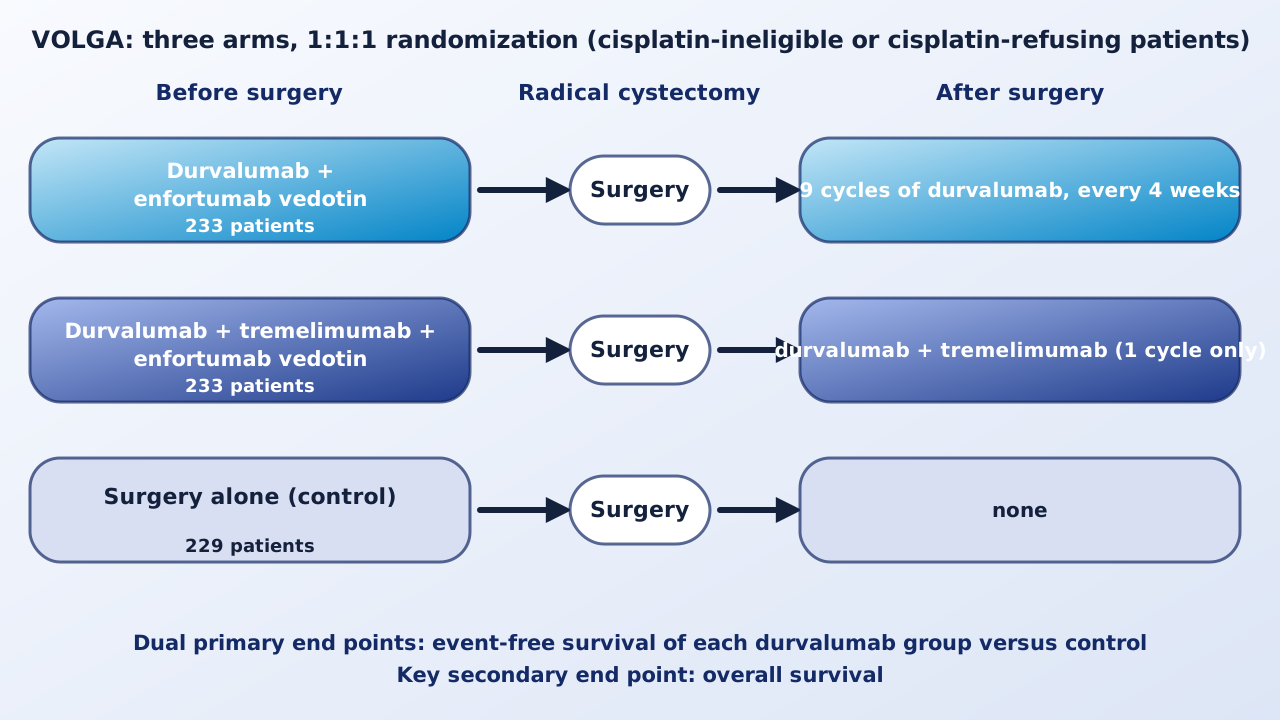
Muscle-invasive bladder cancer is usually treated with chemotherapy that contains cisplatin before surgery, but many patients cannot take cisplatin or decline it. The phase 3 VOLGA trial tested a different approach for them: an immune checkpoint antibody, durvalumab, and an antibody-drug conjugate, enfortumab vedotin, around radical cystectomy. Compared with surgery alone, the combination gave better event-free survival, and the doublet also gave better overall survival.
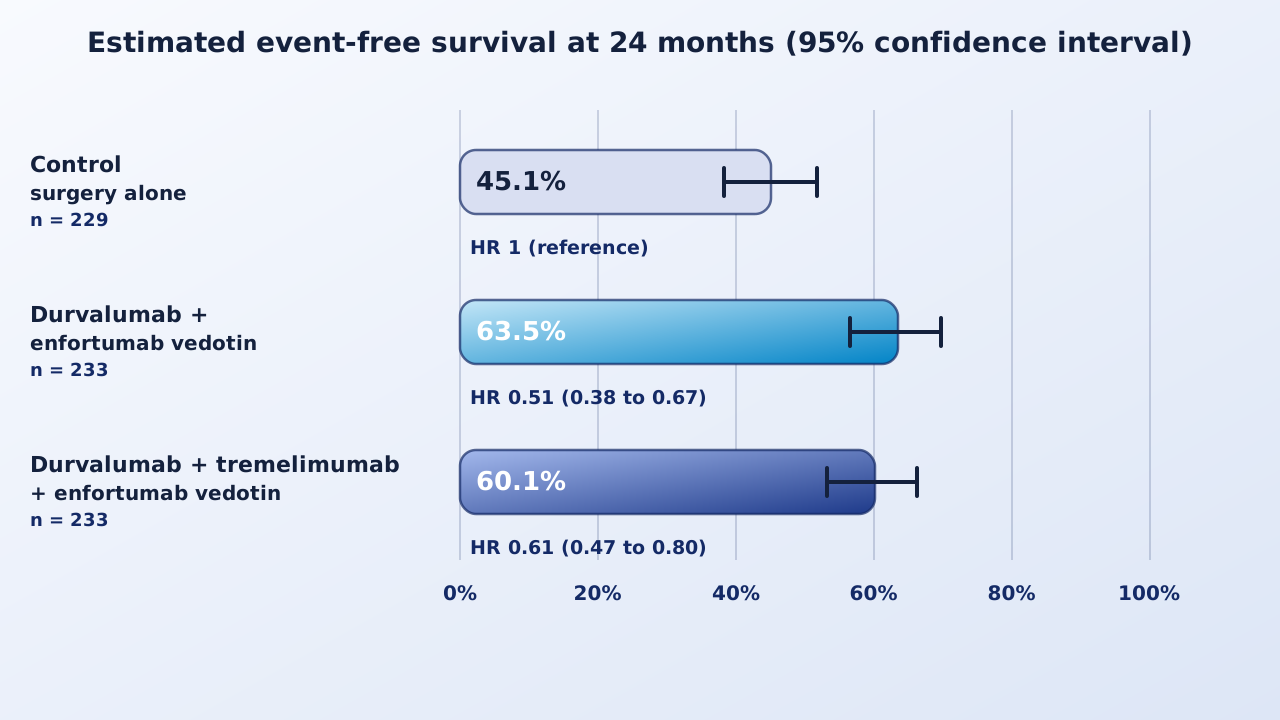
| Arm | Patients | 24-month event-free survival (95% CI) | Hazard ratio vs control (95% CI) | P |
|---|---|---|---|---|
| Durvalumab + enfortumab vedotin | 233 | 63.5% (56.5 to 69.7) | 0.51 (0.38 to 0.67) | <0.001 |
| Durvalumab + tremelimumab + enfortumab vedotin | 233 | 60.1% (53.2 to 66.2) | 0.61 (0.47 to 0.80) | <0.001 |
| Control: cystectomy alone | 229 | 45.1% (38.2 to 51.8) | reference | reference |
Who was studied and what was given
VOLGA was an open-label trial sponsored by AstraZeneca. Patients with muscle-invasive bladder cancer who were ineligible for or declined cisplatin-based chemotherapy were randomly assigned 1:1:1. One group received neoadjuvant durvalumab with enfortumab vedotin every 3 weeks for three cycles, radical cystectomy, and then adjuvant durvalumab every 4 weeks for nine cycles. A second group received the same drugs with tremelimumab added, a CTLA-4 antibody given for two cycles before surgery and one cycle after. The control group had radical cystectomy alone. In total 233, 233 and 229 patients were assigned to the three groups. The trial registry lists patients with clinical stage T2 to T4aN0/1 disease, or T1N1, who had received no prior systemic treatment for it.
Why event-free survival
The two primary end points were event-free survival in each durvalumab group compared with the control group; the two durvalumab groups were not compared with each other. Event-free survival counts the time until disease recurs after surgery, progresses, surgery cannot be done because disease remains, or the patient dies. Overall survival was the key secondary end point.
Event-free survival was better in both durvalumab groups
Estimated event-free survival at 24 months was 63.5% (95% CI 56.5 to 69.7) with durvalumab and enfortumab vedotin, 60.1% (95% CI 53.2 to 66.2) with the tremelimumab triplet, and 45.1% (95% CI 38.2 to 51.8) with surgery alone. The hazard ratio for an event or death was 0.51 (95% CI 0.38 to 0.67; P<0.001) for the doublet and 0.61 (95% CI 0.47 to 0.80; P<0.001) for the triplet, each versus control.
Overall survival favored the doublet
Estimated overall survival at 24 months was 78.4% with durvalumab and enfortumab vedotin and 69.4% with surgery alone (hazard ratio for death 0.58; 95% CI 0.40 to 0.83; P=0.003). The abstract gives no overall survival comparison for the triplet, so none is reported here.
Serious adverse events were more common with treatment
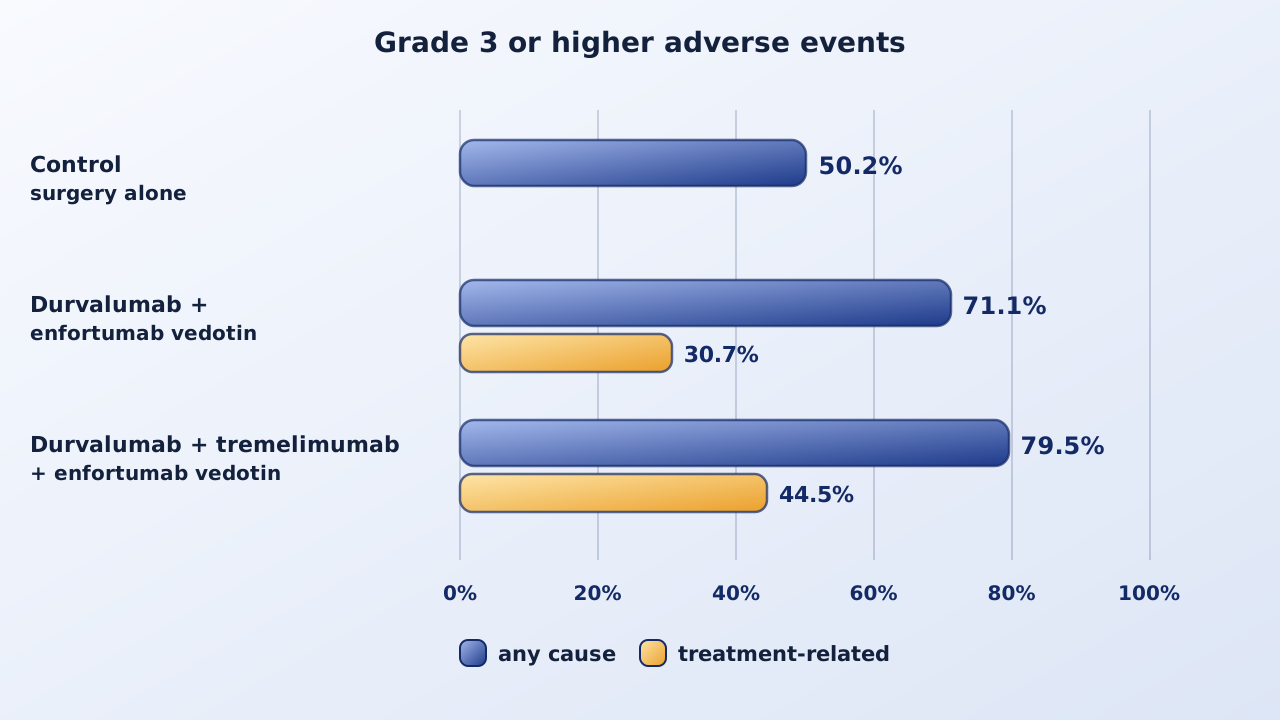
Adverse events of grade 3 or higher occurred in 71.1% of patients with durvalumab and enfortumab vedotin (treatment-related in 30.7%), 79.5% with the triplet (treatment-related in 44.5%) and 50.2% with surgery alone. The authors note that grade 3 or higher events of any cause occurred in more than half of the patients in the durvalumab groups. The abstract does not give discontinuation rates or the types of events.
What it means and what it does not
The authors conclude that perioperative durvalumab with or without tremelimumab, plus three neoadjuvant cycles of enfortumab vedotin, gave significantly better event-free survival than surgery alone, and that the doublet gave better overall survival. The trial does not show which component matters most, because there was no arm without enfortumab vedotin, and it did not compare these regimens with cisplatin-based chemotherapy or with other immunotherapy-based standards. The trial was open-label, and the results apply to patients who could not or would not receive cisplatin. Longer follow-up is needed, and these regimens are for oncologists to weigh case by case.
- Paper
- Powles T, Grande E, Simone G, et al. Durvalumab, tremelimumab, and enfortumab vedotin in muscle-invasive bladder cancer. N Engl J Med. 2026. Published October 24, 2026. VOLGA, ClinicalTrials.gov NCT04960709.
- Type
- Phase 3 randomized open-label trial
- DOI
- 10.1056/NEJMoa2608323
- PubMed
- PMID 42929692
- Funding
- AstraZeneca. EudraCT 2020-005452-38.
Related articles
 Daily brief · Oct 25, 2026Propionate Blocks a Ubiquitin Ligase and Keeps MHC Class I on Tumor Cells, Boosting Anti-PD-1 Efficacy in Models
 Explainer · Oct 26, 2026How a Personalized mRNA Cancer Vaccine Works, and What the Melanoma Trials Show So Far
 Daily brief · Oct 28, 2026Clones Within Single Pancreatic Tumors Differ in MYC Amplification, and MYC Is Linked to a Basal, Immune-Depleted State

Research focus: Molecular Oncology and Cancer Metabolism
Department of Molecular Diagnostics, Faculty of Biomedical Sciences, University of Benghazi, Libya
Weekly digest
The week's briefs and science news in one email. See the privacy policy.
Comments
No account needed. Comments are reviewed before they appear. Please be respectful and on topic.