A cancer therapy built from the mutations in one patient's tumor, and made as a single mRNA medicine for that patient, has reported positive phase 3 results in melanoma, according to its developers, Moderna and Merck. It is often called a personalized mRNA vaccine. It is designed to treat cancer, not to prevent infection, and it is still investigational.
The problem. After surgery, patients with high-risk melanoma (stage IIB to IV) can still relapse. An anti-PD-1 antibody, pembrolizumab, is standard adjuvant treatment, but many patients recur anyway. Cancer cells carry mutations that can produce abnormal proteins called neoantigens, which the immune system can recognize as foreign. Every tumor has its own set, which is why the approach is individualized.
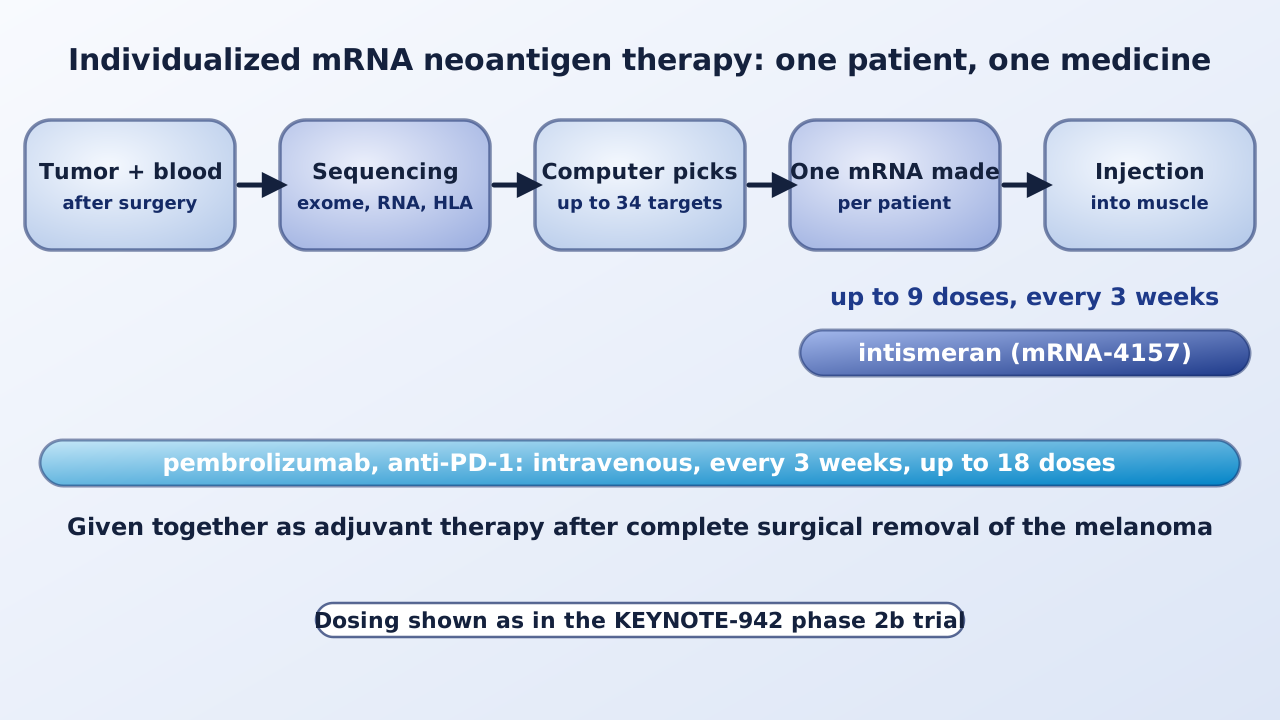
How it is made. A sample of the tumor and a sample of normal blood are sequenced to find mutations present only in the tumor. Computational methods then select up to 34 neoantigens predicted to be recognized by the immune system, and these are encoded in one mRNA sequence made for that patient. A Nature Reviews Clinical Oncology summary of the phase 2b trial describes the product as nanoparticle-encapsulated and notes that the selection draws on whole-exome sequencing, RNA sequencing and HLA profiling. In the phase 3 trial, the companies report that the therapy was successfully manufactured for more than 99% of patients randomized to receive it.
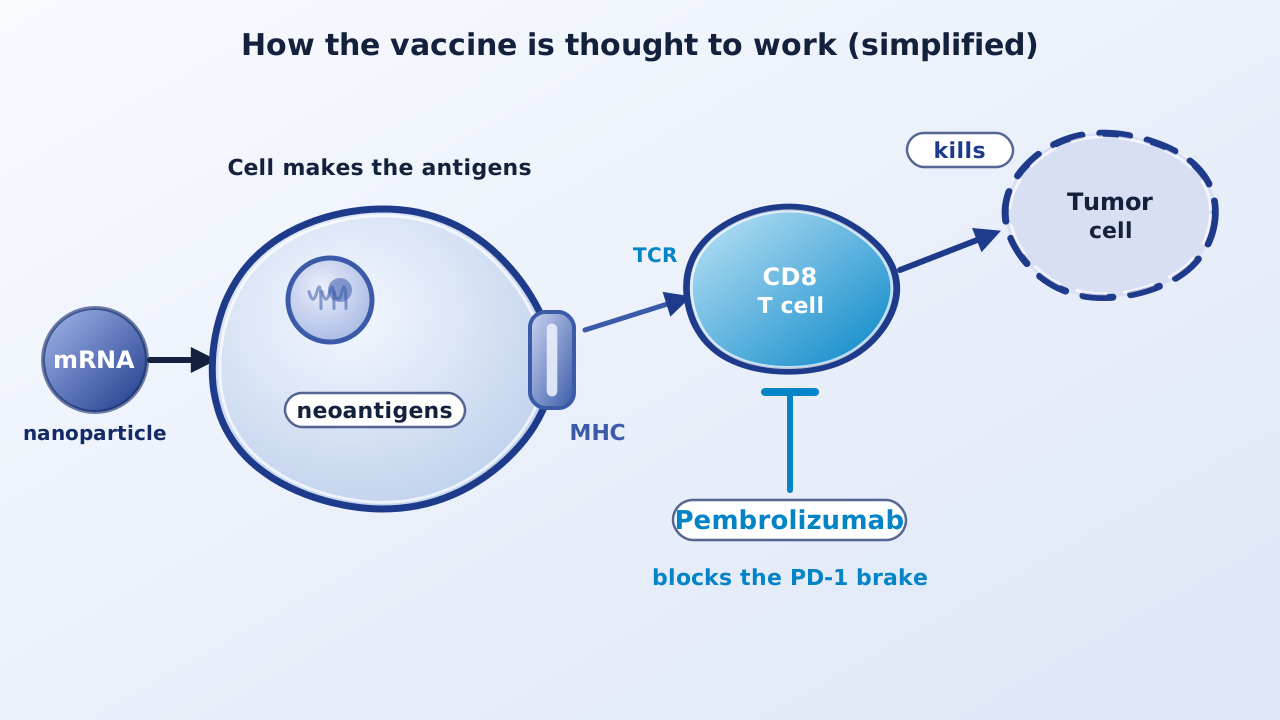
What happens in the body. In the trials the mRNA is injected into muscle, up to nine doses three weeks apart, together with intravenous pembrolizumab. According to the companies, cells translate the mRNA into the neoantigen proteins, and the proteins go through natural antigen processing and presentation, the step that shows protein fragments to T cells on MHC molecules. T cells that recognize those fragments can expand and attack cells that carry the same mutations. Pembrolizumab blocks PD-1, an inhibitory signal that restrains T cells. In the five-year update, the combination was associated with higher T-cell receptor clonality and new T cell clones, and the greatest expansion of new clones was seen in patients who had not recurred. That is an association, and it does not by itself prove the mechanism.
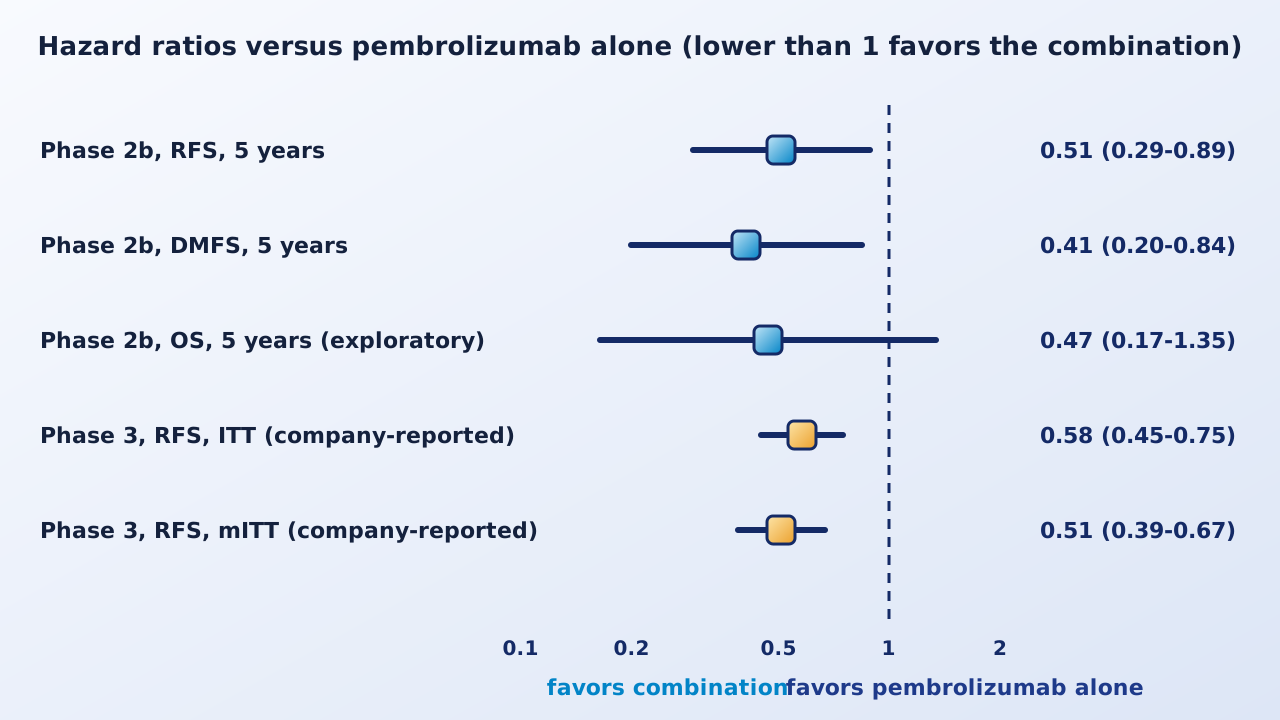
The phase 2b trial. KEYNOTE-942 was an open-label trial of 157 patients with resected stage IIIB to IV melanoma, assigned 2:1 to the combination (107) or pembrolizumab alone (50). In the primary analysis, published in The Lancet in 2024, recurrence-free survival was longer with the combination (hazard ratio 0.561; 95% confidence interval 0.309 to 1.017; two-sided p=0.053). Recurrence or death occurred in 22% of the combination group and 40% of the pembrolizumab group, and 18-month recurrence-free survival was 79% versus 62%. Grade 3 or higher treatment-related adverse events occurred in 25% versus 18%. The five-year update in the Journal of Clinical Oncology (median planned follow-up 60.3 months) reported a hazard ratio of 0.510 (0.294 to 0.887) for recurrence-free survival and 0.411 (0.200 to 0.843) for distant metastasis-free survival, with a favorable trend in overall survival (0.471; 0.165 to 1.345) that is exploratory and whose interval includes 1. The five-year analyses were descriptive and the safety profile showed no new signals.
The phase 3 trial. INTerpath-001 (NCT05933577) is a randomized, double-blind, placebo- and active-comparator-controlled trial. The companies report that 1,137 patients with completely resected stage IIB to IV melanoma were randomized 2:1 to intismeran plus pembrolizumab or placebo plus pembrolizumab. On August 19, 2026 they announced that it met its primary endpoint, recurrence-free survival, and a key secondary endpoint, distant metastasis-free survival, at a prespecified interim analysis. At the ESMO 2026 Congress, per Moderna's summary, the hazard ratio for recurrence or death in the intention-to-treat population was 0.58 (0.45 to 0.75) after a median follow-up of 24.6 months, which the companies describe as a 42% lower risk. In a sensitivity analysis that excluded patients who received no planned dose, the hazard ratio was 0.51 (0.39 to 0.67). The curves were similar during the first six months (0.99) and separated afterward (0.42), which fits the time the immunization course takes. Grade 3 to 5 treatment-related adverse events were 14.2% with the combination and 13.4% with pembrolizumab alone; the most common events with the combination were fever (52.2%), injection-site pain (51.0%) and fatigue (38.5%). A hazard ratio of 0.58 means that at any point in follow-up, patients in the combination group had about 58% of the risk of recurrence or death of patients on pembrolizumab alone.
Why it matters. The phase 2b authors concluded that an mRNA-based individualized neoantigen therapy might be beneficial in the adjuvant setting, and the companies describe the phase 3 result as the first positive phase 3 readout for an individualized neoantigen therapy and for an mRNA-based cancer therapy. The same platform is being tested in nine phase 2 and 3 trials across melanoma, lung, bladder and kidney cancer, according to Merck.
Keep in mind. The therapy is not approved. The phase 3 numbers come from company announcements and have not yet appeared in a peer-reviewed paper, and overall survival has not been reported. The phase 2b trial was small and open-label, and its primary analysis did not reach a p-value of 0.05. The results apply to patients with completely resected high-risk melanoma, not to other cancers or to people with advanced disease. Each dose is made for one patient, so time to treatment and cost remain open questions.
- Phase 2b trial
- Weber JS, et al. Individualised neoantigen therapy mRNA-4157 (V940) plus pembrolizumab versus pembrolizumab monotherapy in resected melanoma (KEYNOTE-942): a randomised, phase 2b study. Lancet. 2024;403:632–644. 10.1016/S0140-6736(23)02268-7. PMID 38246194
- Five-year update
- Khattak A, et al. Intismeran autogene plus pembrolizumab versus pembrolizumab alone in high-risk resected melanoma: 5-year update of the randomized phase IIb KEYNOTE-942 study. J Clin Oncol. 2026;44(26):2482–2489. 10.1200/JCO-26-00835. PMID 42223134. Landmark 5-year rates: ASCO 2026 abstract 9500, 10.1200/jco.2026.44.16_suppl.9500
- Review
- Killock D. Personalized neoantigen mRNA vaccine mitigates melanoma recurrence. Nat Rev Clin Oncol. 2024. 10.1038/s41571-024-00867-1
- Phase 3 (company)
- Merck and Moderna. Press release, August 19, 2026. merck.com. Moderna (D. Berman), IR Insights: recapping the phase 3 INTerpath-001 results, October 24, 2026, reporting the ESMO 2026 presentation. modernatx.com
- Trial records
- ClinicalTrials.gov NCT03897881 (KEYNOTE-942) and NCT05933577 (INTerpath-001), read October 26, 2026
Related articles
 Daily brief · Oct 27, 2026Miro1 Accumulates in Muscle in Type 2 Diabetes and Falls With Exercise Training, a Human and Mouse Study Reports
 Daily brief · Oct 25, 2026Propionate Blocks a Ubiquitin Ligase and Keeps MHC Class I on Tumor Cells, Boosting Anti-PD-1 Efficacy in Models
 Science news · Oct 24, 2026First Prime Editing Treatment Given Directly in the Body Enters a Wilson Disease Trial

Research focus: Molecular Oncology and Cancer Metabolism
Department of Molecular Diagnostics, Faculty of Biomedical Sciences, University of Benghazi, Libya
Weekly digest
The week's briefs and science news in one email. See the privacy policy.
Comments
No account needed. Comments are reviewed before they appear. Please be respectful and on topic.