Prime Medicine, a company in Cambridge, Massachusetts, has dosed the first participant in a clinical trial of a prime editor given directly into the bloodstream, according to the company and a Nature news report. The condition is Wilson disease. No results have been reported.
What was announced. On October 5, 2026, Prime Medicine announced that the first patient had been dosed in a global Phase 1/2 trial of PM577a, which it describes as an investigational in vivo prime editor for Wilson disease caused by the H1069Q mutation in the ATP7B gene. The company calls this its first clinical study of an in vivo prime editing therapy and the first clinical evaluation of its liver programs. The US Food and Drug Administration also granted Rare Pediatric Disease designation to PM577. On October 22, Nature reported that this is the first known instance of prime editing being used directly in a person's body.
Why Wilson disease. Wilson disease is a rare inherited disorder in which loss-of-function mutations in ATP7B impair the liver's ability to excrete copper. Copper builds up in the liver and later affects the brain, kidneys and cornea. According to the company, current treatments are copper chelators and zinc salts taken for life, and liver transplantation is the only curative option. The company describes H1069Q as the most prevalent disease-causing allele in North America and Europe, and says a follow-on candidate for R778L, the most common allele in East Asian populations, is in preclinical development.
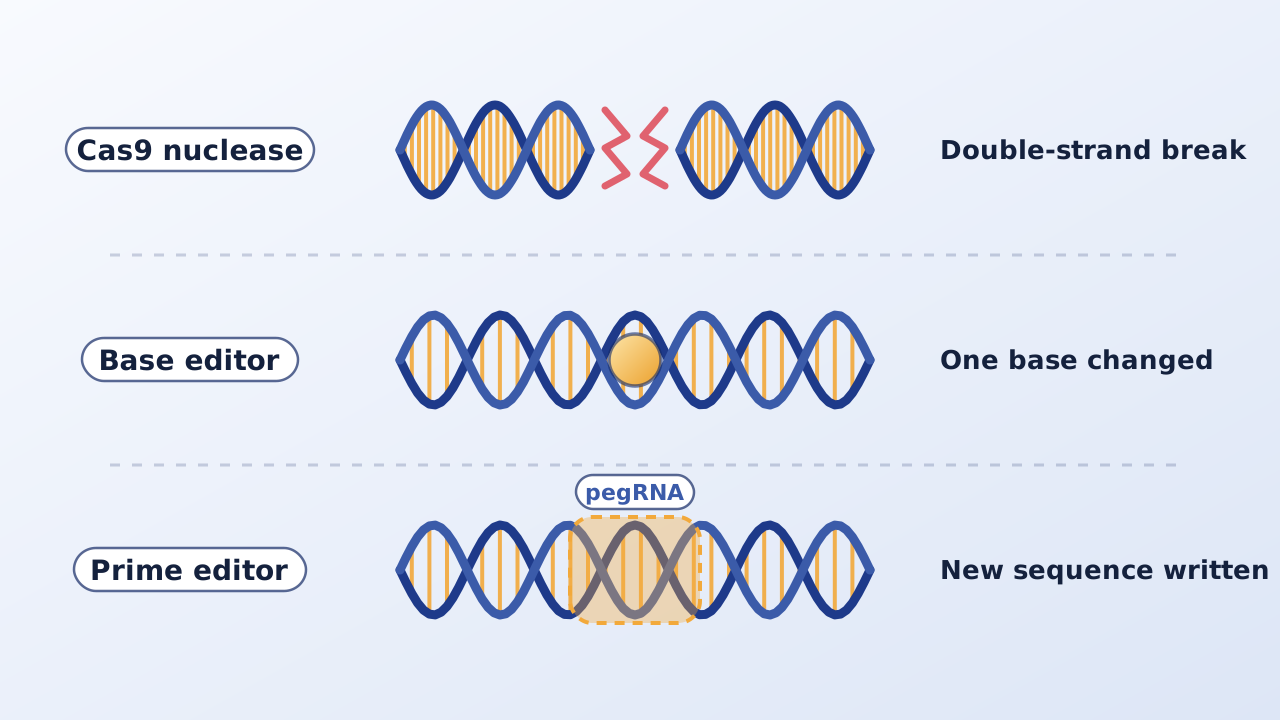
How prime editing differs. Prime editing was described in 2019 by David Liu's group at the Broad Institute. A prime editor joins a catalytically impaired Cas9 to an engineered reverse transcriptase and is programmed by a prime editing guide RNA (pegRNA) that both specifies the target site and encodes the desired edit. It can make insertions, deletions and all 12 types of point mutation without double-strand breaks or donor DNA templates. The original paper estimated that, in principle, it could correct up to 89% of known disease-associated variants; that is a computational estimate, not a clinical result. Nature notes that base editing can rewrite single DNA letters but cannot make the particular corrections needed for the most common ATP7B mutations.
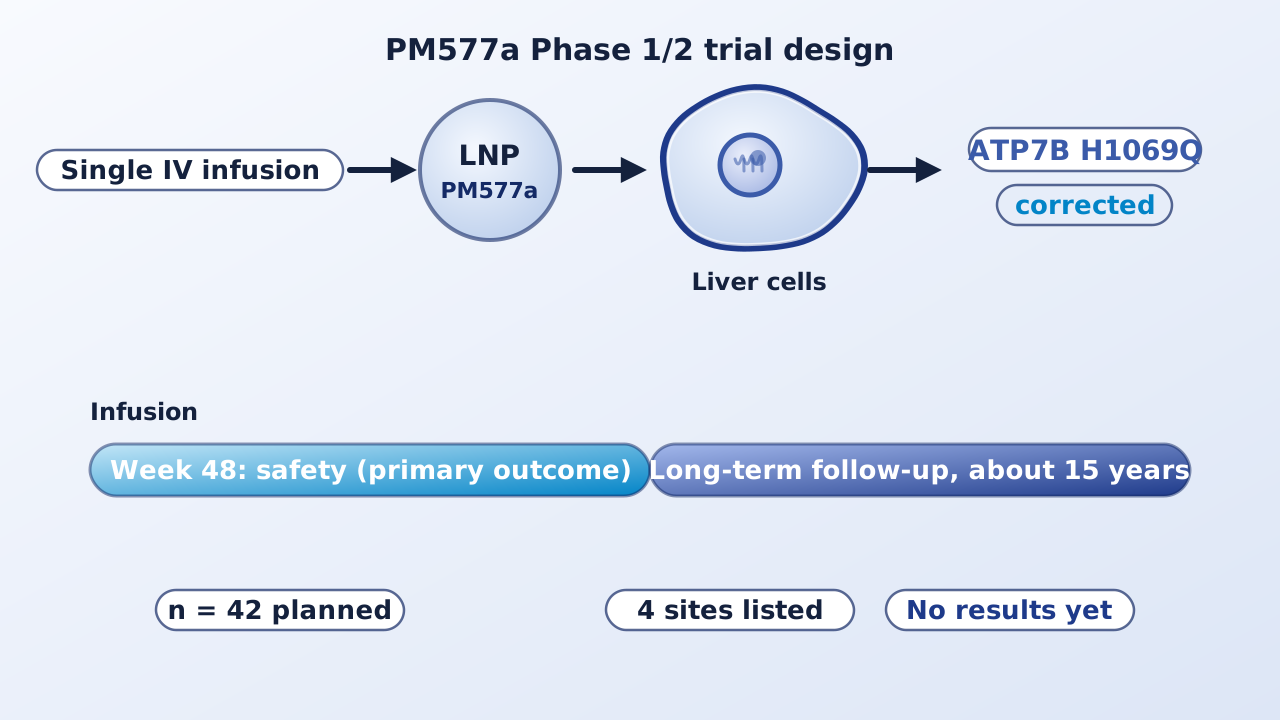
How the trial is built. The registry record (NCT07748403) describes an open-label Phase 1/2 study with a planned enrollment of 42 participants aged 12 years and older. Participants must carry at least one H1069Q allele, be stable on standard-of-care therapy for at least six months and show adequate copper control; the company says the study will initially enroll adults. Each participant receives a single intravenous infusion of PM577a, a lipid nanoparticle formulation, with ascending doses across the study. Participants are followed for about 48 weeks and are then asked to join a separate long-term follow-up study of about 15 years. The primary outcome is safety and tolerability through week 48. Secondary outcomes include copper measures (non-ceruloplasmin-bound copper, ceruloplasmin, 24-hour urinary copper and copper efflux by 64Cu PET), on-target editing in liver biopsies at weeks 24 and 48, and the proportion of participants who stop standard-of-care therapy. The record lists four sites in the United States and New Zealand; when read on October 24, two were recruiting and two were not yet recruiting.
Where this fits. Prime Medicine's first clinical data came from a different approach. In the New England Journal of Medicine in December 2025, the company and its collaborators reported two people with p47-deficient chronic granulomatous disease who received their own blood stem cells edited outside the body (PM359). Neutrophil NADPH oxidase activity appeared within one month and was maintained for six months in one participant and four months in the other at last follow-up, and adverse events were consistent with the busulfan conditioning. The Wilson disease trial moves editing inside the body. Nature quotes a bioengineer who notes that in vivo approaches carry their own risks. The article adds that Casgevy is the only gene-editing therapy approved by the FDA, that none is approved for in vivo use, and that an FDA decision on an in vivo CRISPR-Cas9 therapy for hereditary angioedema is expected early next year. Lipid nanoparticles, the carrier used here, are also the subject of our October 23 brief on nanoparticles designed for large mRNA cargo.
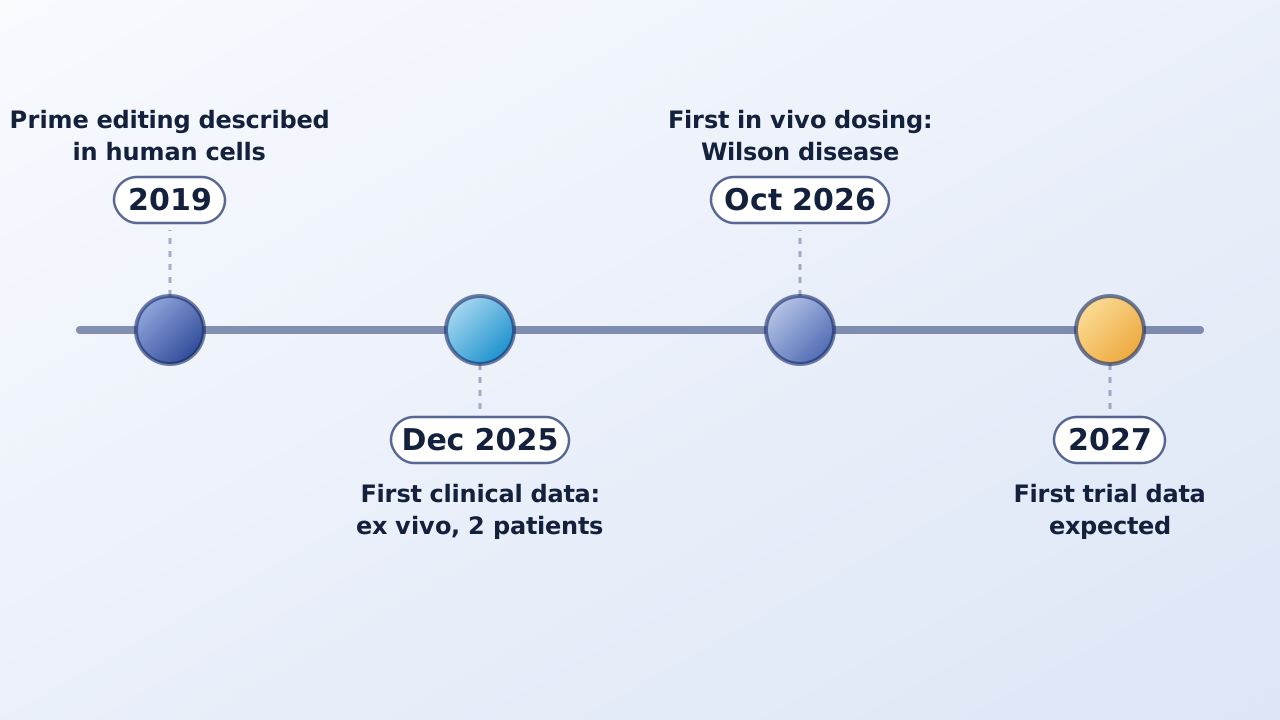
What is not known. No efficacy or safety data have been reported, and the company expects initial clinical data in 2027. In the sources reviewed, the dose, the editing efficiency in the liver and the number of participants dosed beyond the first were not disclosed. The study is early-phase and open-label, with ascending doses, so it is designed to assess safety and biological activity, not to prove benefit.
Keep in mind. This item summarizes a sponsor announcement, a public trial record and a news report. The design and the stated aims come from the company, and its statements about a possible one-time cure are forward-looking. The Nature piece is a news report, not a peer-reviewed study. Treat the claims as plans and early facts until trial data are published.
- Announcement
- Prime Medicine, Inc. Press release, October 5, 2026. GlobeNewswire
- Trial record
- ClinicalTrials.gov, NCT07748403, read October 24, 2026. NCT07748403
- News report
- Ledford H. A first for CRISPR: powerful prime editing alters DNA directly in the human body. Nature, news, October 22, 2026. nature.com/articles/d41586-026-03371-x
- Background
- Anzalone AV, et al. Search-and-replace genome editing without double-strand breaks or donor DNA. Nature. 2019;576:149–157. 10.1038/s41586-019-1711-4. PMID 31634902
- Background
- Gori JL, et al. Prime editing for p47-deficient chronic granulomatous disease. N Engl J Med. 2026;394:1195–1203. Published online December 7, 2025. 10.1056/NEJMoa2509807. PMID 41358590
Related articles
 Daily brief · Oct 23, 2026Designing Lipid Nanoparticles Around mRNA Size Improves In Vivo Genome Editing in Liver, Brain and Lung
 Daily brief · Oct 21, 2026A Compact RNA Switch Lets a Small-Molecule Drug Turn Gene Therapy On and Off in Mice
 Daily brief · Oct 20, 2026Programmable Cas13b Silences Cancer-Driving Fusion Transcripts, Including Drug-Resistant BCR::ABL1, in Cell Models

Research focus: Molecular Oncology and Cancer Metabolism
Department of Molecular Diagnostics, Faculty of Biomedical Sciences, University of Benghazi, Libya
Weekly digest
The week's briefs and science news in one email. See the privacy policy.
Comments
No account needed. Comments are reviewed before they appear. Please be respectful and on topic.