Lipid nanoparticles are clinically validated carriers for RNA, but their potency often declines as the RNA gets longer. Genome editors such as Cas9 and base editors need long mRNAs, so delivery is a practical limit for editing therapies. A group at the University of Toronto asked whether the lipid itself can be chosen with cargo size in mind.
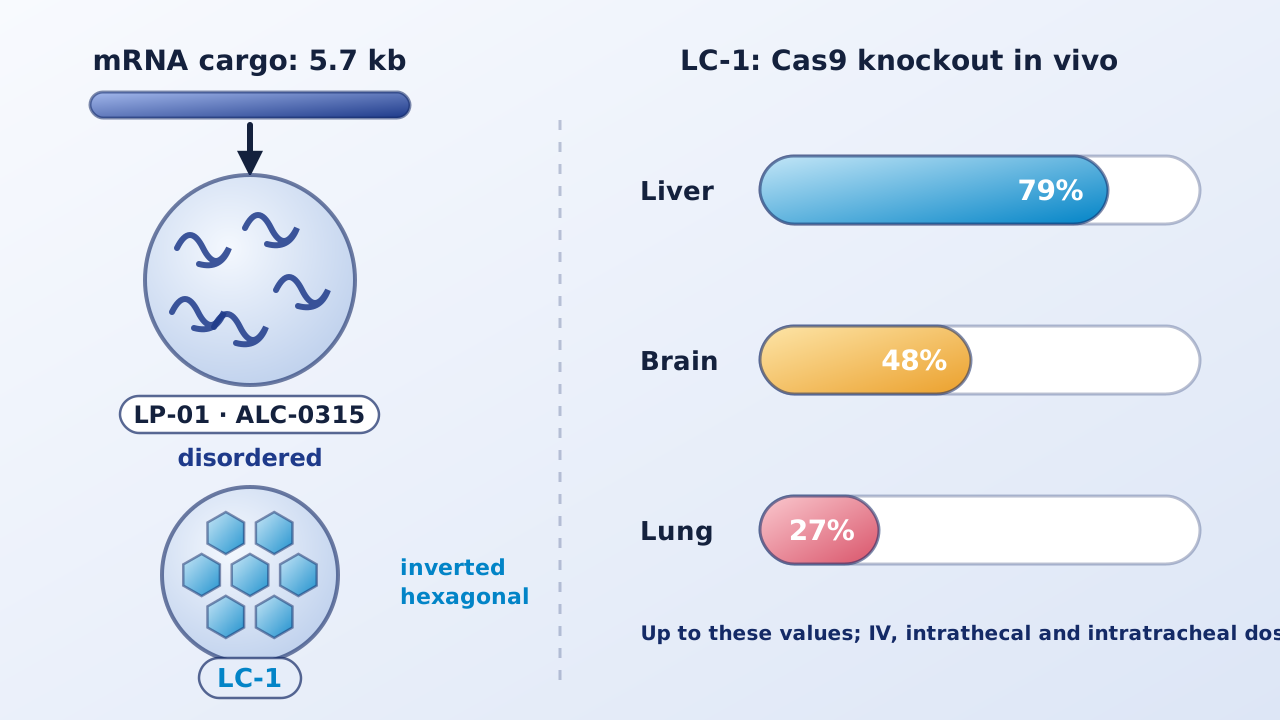
What they did. The authors built a large-cargo-informed discovery strategy that builds mRNA size into the screening of ionizable lipids. They screened a combinatorial library of 384 lipids with a 5.7-kb reporter mRNA encoding an adenine base editor (ABE) and NanoLuc, and identified large-cargo-optimized lipids led by one called LC-1. They tested LC-1 after intravenous, intrathecal and intratracheal administration, and compared it with the benchmark lipids LP-01 and ALC-0315.
What they found. LC-1 reached up to 79% Cas9-mediated knockout in liver, and 48% and 27% in brain and lung, up to fourfold higher than LP-01 and ALC-0315. It also produced higher ABE-mediated reporter correction across all three routes. LC-1 supported base editing of PCSK9, CFTR and Ube3a-ATS. In mechanistic studies, LC-1 formed stronger lipid-RNA interactions, and as mRNA size increased it kept an ordered, fusogenic inverted-hexagonal structure with pH-responsive membrane disruption, whereas the benchmark lipids became disordered.
Why it matters. The authors conclude that cargo size is a key design parameter for ionizable lipid discovery. If the finding holds, lipids selected for the size of the cargo they must carry may extend editing beyond the liver.
Keep in mind. The percentages are the highest values reported across the routes and organs tested, not averages. The abstract does not state which animal species were used, and it reports no human data. The knockout and correction values come from reporter and editing readouts, not from a disease model or from therapeutic benefit. Safety and tolerability are not described in the abstract. This summary is based on the abstract; the full text was not reviewed.
- Paper
- Dong S, Gong F, Thomson T, et al. Lipid nanoparticles optimized for large RNA cargo and tissue targeting enhance in vivo genome editing. Nature Biotechnology. 2026. Published online September 28, 2026.
- Type
- Preclinical laboratory study (in vivo)
- DOI
- 10.1038/s41587-026-03298-8
- PubMed
- PMID 42806111
Related articles
 Daily brief · Oct 20, 2026Programmable Cas13b Silences Cancer-Driving Fusion Transcripts, Including Drug-Resistant BCR::ABL1, in Cell Models
 Daily brief · Oct 21, 2026A Compact RNA Switch Lets a Small-Molecule Drug Turn Gene Therapy On and Off in Mice
 Daily brief · Oct 22, 2026Cell Lineage, Not Only KRAS Signaling, Decides Whether Lung Tumors Escape KRAS Inhibitors in Mouse Models

Research focus: Molecular Oncology and Cancer Metabolism
Department of Molecular Diagnostics, Faculty of Biomedical Sciences, University of Benghazi, Libya
Weekly digest
The week's briefs and science news in one email. See the privacy policy.
Comments
No account needed. Comments are reviewed before they appear. Please be respectful and on topic.