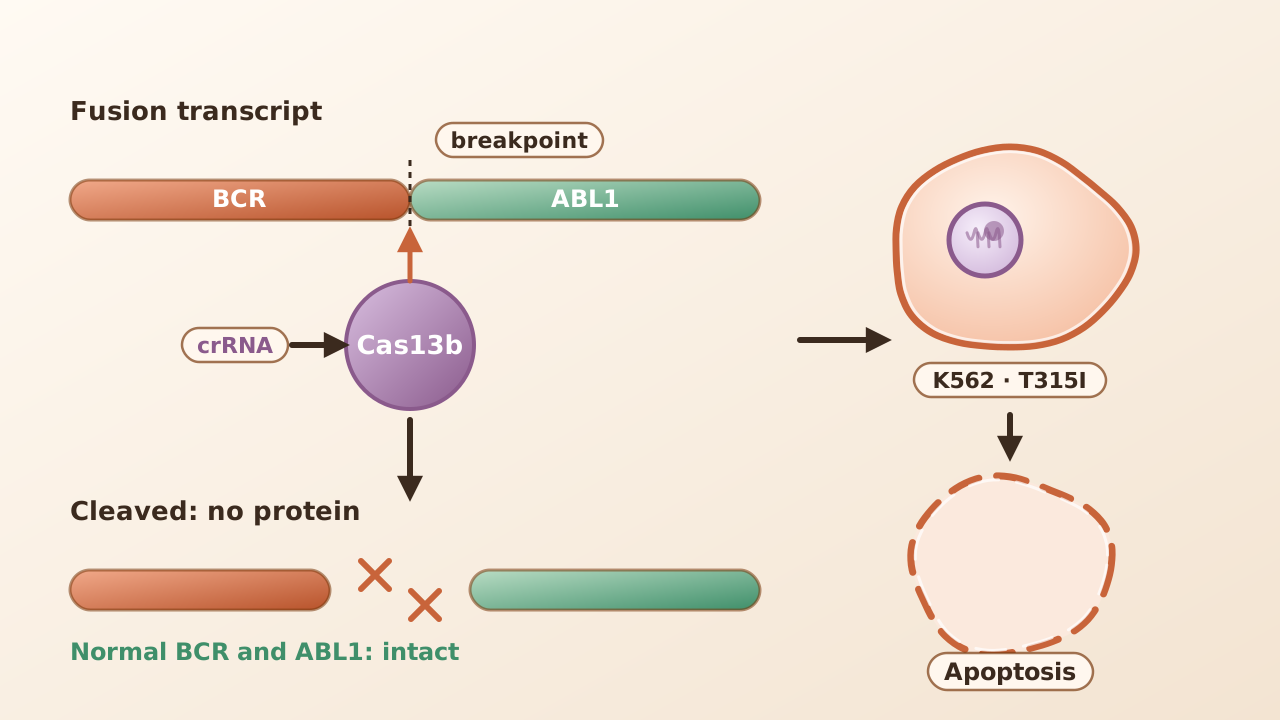
Gene fusions are present in about 20% of human cancers, and about 16.5% of cancers carry fusions that act as bona fide drivers. Most fusion proteins remain undruggable, and where kinase inhibitors exist, resistance mutations often cause relapse.
What they did. The authors reprogrammed the RNA-cleaving enzyme PspCas13b to recognize the breakpoint, the junction sequence that is present only in the fusion transcript. They tiled crRNAs across the breakpoints of four ABL1 fusions in HEK 293T cells, then tested the approach in K562 cells, a chronic myeloid leukemia line that expresses BCR::ABL1 (p210), and in a K562 line made resistant to dasatinib by more than 90 days of escalating exposure. That line carries the T315I gatekeeper mutation.
What they found. Breakpoint-targeting crRNAs silenced all four ABL1 fusions by about 80% to 90% in the reporter assay. Up to three mismatches between crRNA and target were tolerated; four or more markedly reduced silencing. A crRNA against the BCR::ABL1 breakpoint did not affect untranslocated BCR or ABL1 transcripts. RNA sequencing of HEK 293T cells showed no significant down-regulation of endogenous transcripts. In K562 cells, silencing BCR::ABL1 lowered STAT5 and ERK phosphorylation and slowed proliferation over 96 hours, comparable to imatinib. In the dasatinib-resistant line, imatinib had no effect, whereas Cas13b still reduced BCR::ABL1 signaling, inhibited proliferation and promoted apoptosis. Cleavage also produced aberrant transcripts with internal deletions of about 30 to 8,000 nucleotides (median about 1.16 kb); about two-thirds of the full-length aberrant reads were out of frame. The same design silenced nine fusions in total, including RUNX1::RUNX1T1, NPM::ALK, SS18::SSX1/2 and EWSR1::FLI1.
Why it matters. Because the resistance mutation lies outside the targeted breakpoint, an RNA-level approach can act where kinase inhibitors fail, and the crRNA can be redesigned for each patient's fusion. Cas13 acts on RNA, so it does not change the genome.
Keep in mind. All experiments used cultured cells, and the paper reports no animal or patient data. Cas13b and crRNA were delivered by transfection or nucleofection, and delivery to tumors in the body remains unresolved. Collateral RNA cleavage was assessed in HEK 293T and K562 cells and found minimal, but off-target effects in other cell types and in vivo are unknown. This summary is based on the main text; the supplementary material was not reviewed.
- Paper
- Hu W, Chen H, He S, et al. Programmable and selective silencing of oncogenic fusion transcripts by CRISPR-Cas13b via breakpoint sequence recognition. Science Advances. 2026;12(42):eady0296. Published October 16, 2026.
- Type
- Preclinical laboratory study (cell lines)
- Basis
- Full text (PubMed Central, open access); supplementary material not reviewed
- DOI
- 10.1126/sciadv.ady0296
- PubMed
- PMID 42886793
This brief summarizes a published paper for general information. It is not medical advice.
Related articles
 Science news · Oct 20, 2026Nobel Prize in Physiology or Medicine 2026 Honors the Light-Gated Channels Behind Optogenetics
 Daily brief · Oct 19, 2026A New Class of Mitochondria-Targeted Compounds Induces Ferroptosis and Suppresses Tumors in Cancer Models
 Feature · Oct 19, 2026Why a Glutaminolysis Signature Falls With PTEN Loss: Passenger Co-Deletion, Not Metabolic Regulation
Research focus: Molecular Oncology and Cancer Metabolism
Department of Molecular Diagnostics, Faculty of Biomedical Sciences, University of Benghazi, Libya
Weekly digest
The week's briefs and science news in one email. See the privacy policy.
Comments
No account needed. Comments are reviewed before they appear. Please be respectful and on topic.