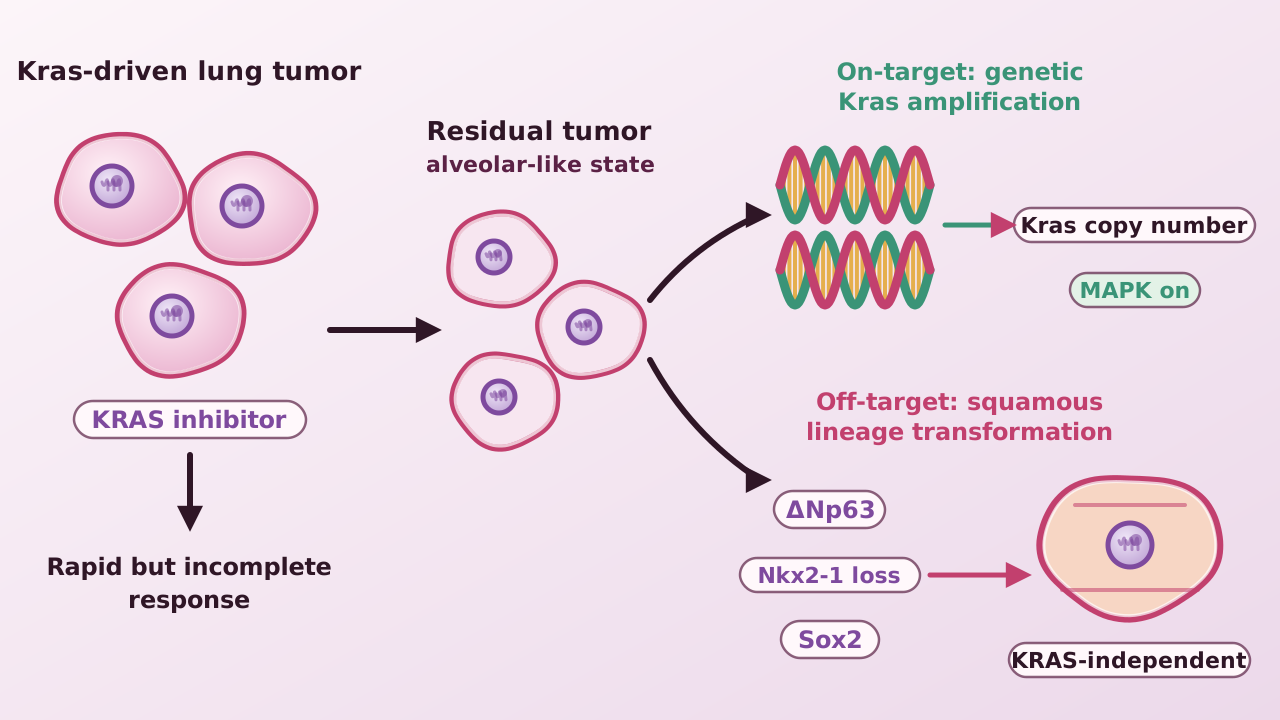
KRAS inhibitors give incomplete clinical responses in lung adenocarcinoma, and resistance to them is common. A team at the Massachusetts Institute of Technology and Columbia University asked how resistance arises when the tumors are followed over time in genetically engineered mice.
What they did. The authors treated genetically engineered mouse models of Kras-driven lung adenocarcinoma with KRAS inhibitors to model primary and acquired resistance. To model resistance that does not depend on the oncogene, they used functional CRISPR approaches to push tumor cells toward a squamous lineage. They tested whether the transcription factor ΔNp63 could transform alveolar organoids in vitro, and whether loss of Nkx2-1 or ectopic expression of Sox2 prepared tumors in vivo for squamous commitment.
What they found. The initial response to treatment was rapid but incomplete, and the residual tumor burden resembled alveolar epithelial cells at the transcriptional level. With continued treatment, the authors invariably observed genetic Kras amplification as a resistance mechanism. ΔNp63 alone was sufficient to transform alveolar organoids to a squamous state in vitro, and these organoids were insensitive to KRAS inhibition. In vivo, Nkx2-1 loss, ectopic Sox2 expression, or both poised tumors for squamous lineage commitment. Squamous-transformed tumors showed no evidence of KRAS/MAPK reactivation.
Why it matters. The authors conclude that lineage transcription factors and histologic transformation can mediate independence from KRAS. In this view, resistance is not only a matter of restoring KRAS signaling; a change in cell identity can remove the dependence on the drug target.
Keep in mind. The work used mouse models and mouse organoids, and the abstract reports no patient data. The squamous state was induced experimentally with CRISPR, so the study shows that this route is sufficient to confer insensitivity, not how often it occurs in patients. This summary is based on the abstract and the PubMed record; the full text is behind a subscription and was not reviewed.
- Paper
- Mathey-Andrews N, Rodriguez CL, Shui B, et al. Lineage identity governs oncogene dependence in mouse NSCLC models of KRAS inhibitor resistance. Nature Genetics. 2026;58(10):2605–2618. Published online September 30, 2026.
- Type
- Preclinical laboratory study (genetically engineered mice, organoids)
- DOI
- 10.1038/s41588-026-02768-8
- PubMed
- PMID 42816600
Related articles
 Daily brief · Oct 20, 2026Programmable Cas13b Silences Cancer-Driving Fusion Transcripts, Including Drug-Resistant BCR::ABL1, in Cell Models
 Daily brief · Oct 21, 2026A Compact RNA Switch Lets a Small-Molecule Drug Turn Gene Therapy On and Off in Mice
 Science news · Oct 20, 2026Nobel Prize in Physiology or Medicine 2026 Honors the Light-Gated Channels Behind Optogenetics

Research focus: Molecular Oncology and Cancer Metabolism
Department of Molecular Diagnostics, Faculty of Biomedical Sciences, University of Benghazi, Libya
Weekly digest
The week's briefs and science news in one email. See the privacy policy.
Comments
No account needed. Comments are reviewed before they appear. Please be respectful and on topic.