The Nobel Assembly at Karolinska Institutet announced on October 5, 2026 that the Nobel Prize in Physiology or Medicine goes jointly to Karl Deisseroth (Stanford University and the Howard Hughes Medical Institute), Peter Hegemann (Humboldt University of Berlin) and Georg Nagel (University of Würzburg) “for their discoveries concerning light-gated ion channels and optogenetics.” The prize amount is 12 million Swedish kronor, shared equally.
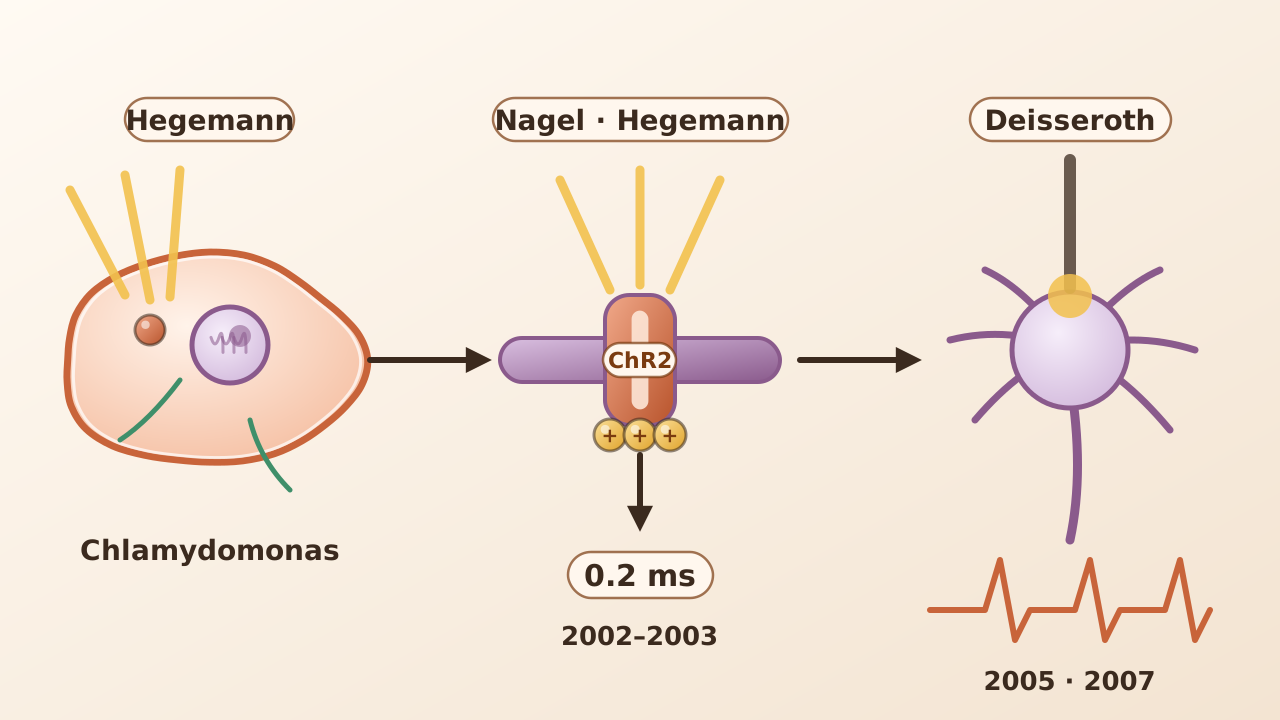
The discovery. Hegemann asked how the single-celled alga Chlamydomonas swims toward light. Electrical signals appeared in the alga about half a millisecond after its eyespot was illuminated, far faster than the chain of reactions in the human eye. In the early 1990s he proposed that one protein both captures light and forms an ion channel. In the early 2000s he and Nagel found two candidate genes. Nagel expressed them in frog egg cells and showed that the proteins, named channelrhodopsin-1 and channelrhodopsin-2, are light-gated ion channels. Channelrhodopsin-2 opened within 0.2 milliseconds and let positive ions into the cell. It also made human embryonic kidney cells and hamster kidney cells respond to light with an electrical signal.
From alga to brain. Deisseroth obtained the gene, introduced it into cultured rat nerve cells and triggered nerve signals with blue light, a result published in 2005. The method was named optogenetics in 2006. In 2007 his group activated nerve cells in the motor cortex of living mice through an optical fiber and controlled whisker movements.
What it has enabled. Because researchers can switch defined cell types on and off, they can test cause and effect rather than correlation. The Committee lists neural circuits for pain, social behavior, thirst, food intake, reward and attention, and a 2012 experiment by Deisseroth and Susumu Tonegawa that reactivated the nerve cells holding a fear memory in mice. Clinical use is at an early stage: ongoing trials try to restore vision in retinitis pigmentosa, and one person who received a channelrhodopsin-like protein in the retina regained some vision, according to the Committee.
Keep in mind. This summary relies on the Committee's press release and popular information and on the abstracts of three key papers; the longer scientific background document was not reviewed. The Committee's key publications include co-authors beyond the three laureates, among them Ernst Bamberg and Edward Boyden, and a Nobel Prize is shared by at most three people. Most optogenetics work so far is in laboratory animals, and the clinical applications are not yet established treatments.
- Announcement
- The Nobel Assembly at Karolinska Institutet. Press release, October 5, 2026. nobelprize.org
- Background
- Popular information, The Nobel Committee for Physiology or Medicine. nobelprize.org
- Key paper
- Nagel G, et al. Channelrhodopsin-1: a light-gated proton channel in green algae. Science. 2002;296:2395–8. 10.1126/science.1072068. PMID 12089443
- Key paper
- Nagel G, et al. Channelrhodopsin-2, a directly light-gated cation-selective membrane channel. Proc Natl Acad Sci U S A. 2003;100:13940–5. 10.1073/pnas.1936192100. PMID 14615590
- Key paper
- Boyden ES, et al. Millisecond-timescale, genetically targeted optical control of neural activity. Nat Neurosci. 2005;8:1263–8. 10.1038/nn1525. PMID 16116447
- Basis
- Press release and popular information read in full; abstracts of the three papers on PubMed; scientific background document not reviewed
This article summarizes a Nobel Prize announcement and published papers for general information.
Related articles
 Daily brief · Oct 20, 2026Programmable Cas13b Silences Cancer-Driving Fusion Transcripts, Including Drug-Resistant BCR::ABL1, in Cell Models
 Feature · Oct 19, 2026Why a Glutaminolysis Signature Falls With PTEN Loss: Passenger Co-Deletion, Not Metabolic Regulation
 Feature · Oct 19, 2026Ammonium Ions Improve Survival of Glutamine-Starved Hybridoma Cells Without Blocking Core Apoptosis Events
Research focus: Molecular Oncology and Cancer Metabolism
Department of Molecular Diagnostics, Faculty of Biomedical Sciences, University of Benghazi, Libya
Weekly digest
The week's briefs and science news in one email. See the privacy policy.
Comments
No account needed. Comments are reviewed before they appear. Please be respectful and on topic.