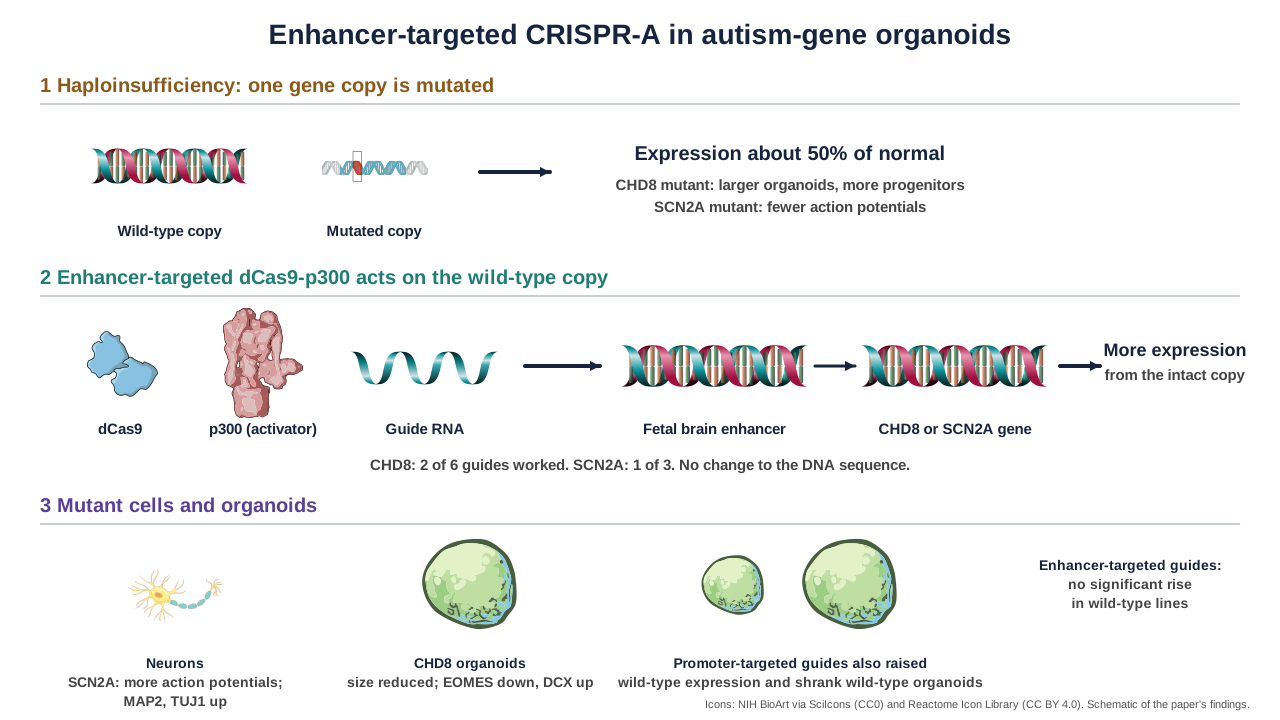
About 15% of the genetic risk for autism comes from new mutations that disable one copy of a gene. In those people the other copy still works, but it makes only about half the normal amount. A team at the University of California, Los Angeles now reports that CRISPR activation aimed at a gene's enhancer can raise output from the intact copy in human cell models of two such genes, CHD8 and SCN2A, and move several measured features toward normal.
| Measure | Detail | Reported result |
|---|---|---|
| Guides tested in HEK293T cells | CHD8 and SCN2A fetal brain enhancers | 2 of 6 CHD8 guides and 1 of 3 SCN2A guides raised expression |
| Effect of the mutation | Stem cell lines with one disabled copy | About 50% less mRNA and protein |
| CHD8-mutant organoids | Bulk RNA-seq at 50 days vs wild-type | 5,933 differentially expressed genes (2,608 up, 3,325 down) |
| Size versus CHD8 expression | Organoids across guides | Size fell as expression rose (R squared 0.56) |
| Duration | One infection, organoids | Expression raised up to 3 months |
The idea and the genes
CRISPR activation (CRISPR-A) uses a catalytically inactive Cas9 fused to an activator, here the acetyltransferase p300 (dCas9-p300), and a guide RNA that brings it to a chosen site without cutting the DNA. Most earlier work aimed it at promoters. The authors targeted enhancers instead, reasoning that an enhancer keeps the timing and cell-type pattern of normal expression, which matters for genes that are sensitive to dose. CHD8 encodes a chromatin remodeler and SCN2A encodes the sodium channel Nav1.2. Both are high-confidence autism genes, and the authors describe Nav1.2 as essential for generating and propagating action potentials in neurons.
How the models were built
The team used human stem cell lines with one copy of CHD8 or SCN2A disabled, made by CRISPR editing or taken from patients (SCN2A), with matched control lines. They grew excitatory neurons and cerebral cortical organoids from them. They confirmed about 50% less gene product, then looked for features to rescue. CHD8-mutant organoids were larger at 50 and 70 days, had more cells in the S and G2/M phases, and carried more EOMES-positive progenitors. In SCN2A-mutant organoids, the markers EOMES and SATB2 were lower at later times, and mutant neurons fired fewer action potentials.
Finding guides that work
The authors combined published fetal brain maps of open chromatin and chromatin contacts to pick candidate enhancers: four for CHD8 and three for SCN2A, narrowed to two and one after filtering. In HEK293T cells, only 2 of 6 CHD8 guides and 1 of 3 SCN2A guides raised expression significantly. The working guides also raised expression in primary human neural progenitor cells, and one treatment kept expression raised for up to 3 months in organoids.
What changed in mutant cells
In CHD8-mutant neurons, both guides raised CHD8 expression. In CHD8-mutant organoids the rise varied by line and guide, and only one guide was consistently significant. Treated organoids were smaller than untreated mutant organoids at one month, and organoid size fell as CHD8 expression rose (R squared 0.56 across data pooled over guides). Bulk RNA sequencing showed treated mutant organoids shifting toward the wild-type pattern, with neuron-maturation gene sets enriched. In neurons, EOMES fell while DCX, TUBB3 and MAP2 rose. In SCN2A-mutant lines, treatment raised SCN2A in organoids and neurons and increased MAP2 and TUJ1. In the engineered SCN2A-mutant line, it restored firing to wild-type levels, and in patient-derived lines it increased the number of action potentials and normalized rheobase and action potential threshold.
Enhancers versus promoters
Guides aimed at the CHD8 and SCN2A promoters raised expression in wild-type as well as mutant cells, and the CHD8 promoter guide reduced organoid size in both wild-type and mutant lines. The enhancer guides produced no significant increase in wild-type lines. The authors take this as support for the view that enhancer targeting is more physiological for dose-sensitive genes, and they also note that they could not predict which enhancers or guides would work best.
Keep in mind
These are cultured human stem cell lines, organoids and neurons, not animals or people, and the rescue was partial. Lentiviral delivery reached only a subset of organoid cells, and the effect faded over time. Results differed between cell lines and guides, and the effect depended on the dCas9-p300 level. Treatment at day 50 for SCN2A and at day 300 for CHD8 did not raise expression, so timing matters. The authors checked neighboring genes for off-target effects and found no increase, but they list off-target activity, delivery and the need for different enhancers in other organs as open questions. No therapy was tested.
- Paper
- Chen GT, Nair G, Osorio AJ, Holley SM, Ghassemzadeh K, Zhou Y, et al. Enhancer-targeted CRISPR-A rescues haploinsufficiency and mutant phenotypes in organoid models of autism. Nature Neuroscience. 2026. Published online November 13, 2026.
- Type
- Laboratory study in human stem cell models
- DOI
- 10.1038/s41593-026-02504-9
- PubMed
- PMID 43026327
- Funding
- National Institutes of Health grants to D.H.G. (NIMH R01MH10027, U01MH116489, RM1MH132651) and to G.T.C. (NIMH F32MH124337), a Simons Foundation Autism Research Initiative pilot grant and SFARI support to N.E.S. (Genomics of ASD 896724), a UCLA Broad Stem Cell Research Center Innovation Award, an Eagles Autism Foundation pilot grant, and the Cell, Circuits and Systems Analysis Core (NIH P50HD103557); the funders had no role in the study. The authors declare no competing interests.
Related articles
 Daily brief · Nov 7, 2026Lowering MSH3 With an AAV-Delivered microRNA Cut Somatic CAG Expansion in a Huntington's Disease Mouse Model and Reduced MSH3 mRNA 48 to 94% in Macaque Striatal Neurons
 Daily brief · Nov 3, 2026A Network Model of the Tipping Point in Colon Tumor Development Points to USP7, and a USP7 Inhibitor Shifts Cancer Organoids Toward a Normal-Like State
 Daily brief · Oct 31, 2026First-in-Human AAV-CRISPR Therapy for Duchenne Muscular Dystrophy Shows Editing in Muscle but a Fatal Immune Reaction at the Higher Dose

Research focus: Molecular Oncology and Cancer Metabolism
Department of Molecular Diagnostics, Faculty of Biomedical Sciences, University of Benghazi, Libya
Weekly digest
The week's briefs and science news in one email. See the privacy policy.
Comments
No account needed. Comments are reviewed before they appear. Please be respectful and on topic.