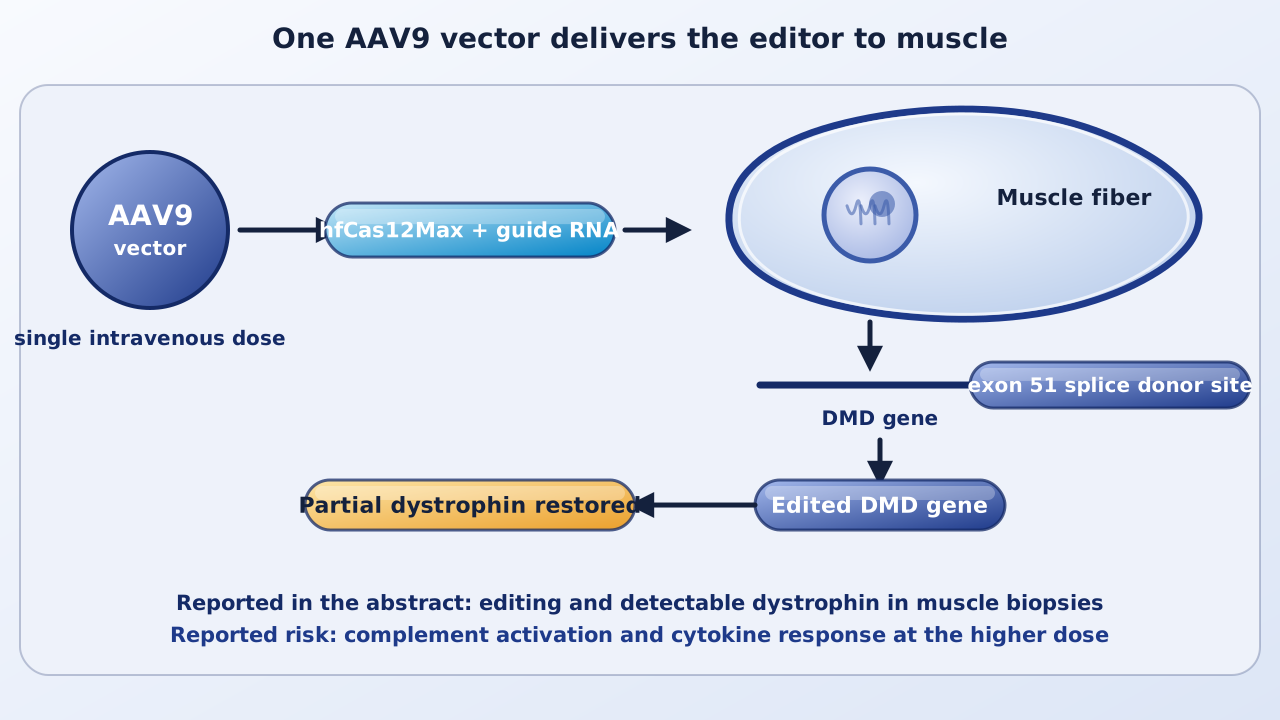
Duchenne muscular dystrophy (DMD) is caused by loss of dystrophin, a protein that protects muscle fibers. A group in Shanghai now reports the first human data for a genome-editing therapy for DMD given as a single intravenous dose. Muscle biopsies showed editing and dystrophin, but at the higher dose level one participant had a fatal reaction, and the authors say the findings show a narrow therapeutic window.
Background
DMD is an X-linked disease that begins in early childhood and leads to progressive loss of muscle and function. According to the trial registry, treatment today relies on glucocorticoids, exon-skipping oligonucleotides that restore only small amounts of dystrophin, and an approved AAV gene-replacement therapy that delivers a shortened mini-dystrophin gene. Editing the patient's own DMD gene is a different strategy: the aim is a lasting change in the gene itself.
The therapy
The therapy, called HG302 in the registry, uses a single adeno-associated virus (AAV9) vector that carries the CRISPR system hfCas12Max, designed to edit the splice donor site of DMD exon 51. The first-in-human study (NCT06594094, called MUSCLE) is an open-label, dose-escalation trial at one center in Shanghai. The registry lists boys aged 4 to 8 years with deletions in specific exons, safety over 26 weeks as the primary outcome, and an enrollment of four.
What was found before and in the first trial
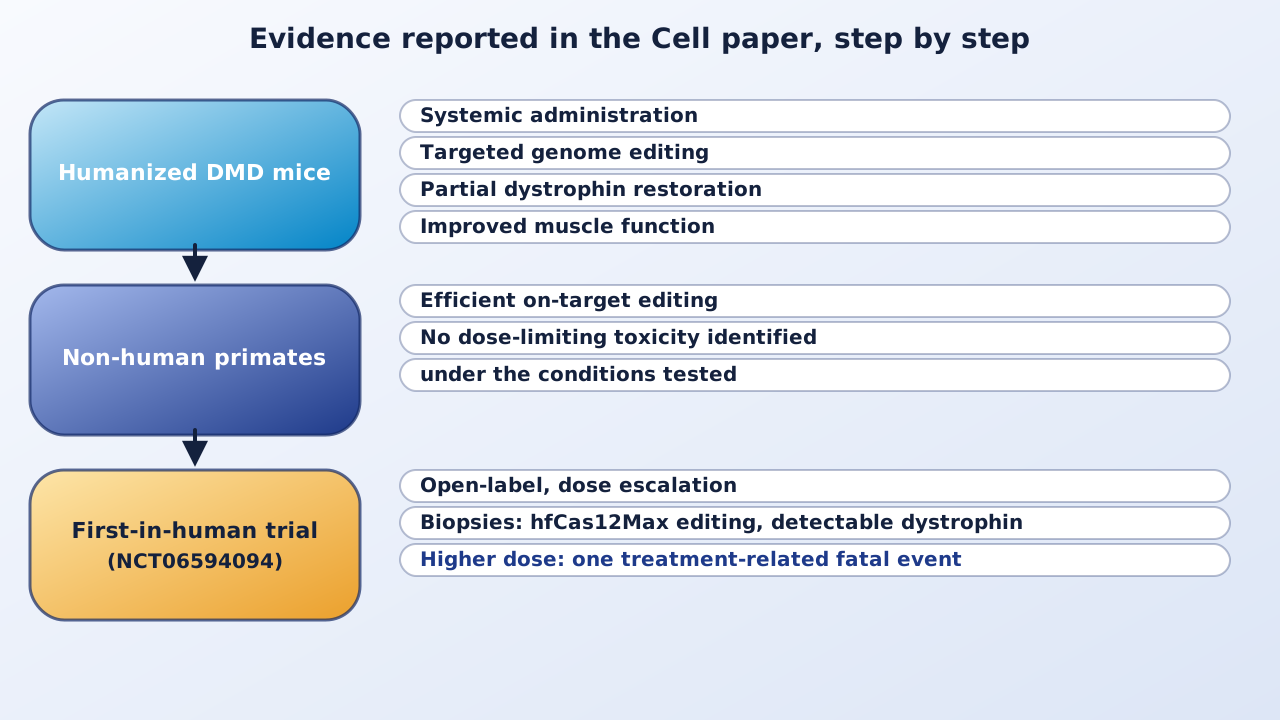
In humanized DMD mice, systemic administration produced targeted genome editing, partial dystrophin restoration and improved muscle function. In non-human primates, on-target editing was efficient and no dose-limiting toxicity was identified under the conditions tested. In the human trial, muscle biopsies after treatment gave early molecular evidence of hfCas12Max-mediated editing and detectable dystrophin expression in participants.
The safety finding
At the higher dose level, one participant had a treatment-related fatal serious adverse event, characterized by marked complement activation and a systemic cytokine response shortly after dosing. The authors conclude that the work gives initial human proof of concept for muscle genome editing, and that it shows the importance of immune risks and the narrow therapeutic window of systemic AAV-CRISPR therapies. They state that safer dosing and immunomodulation strategies are needed.
What it means
The result shows that editing of muscle after one intravenous dose is possible in people, and that the immune response to high doses of AAV vectors can be dangerous. The abstract names complement activation and a systemic cytokine response as the features of the fatal event.
Keep in mind
The abstract does not give the number of participants treated, the dose values, how much dystrophin was produced, or any change in muscle function, so no judgment about benefit can be made from it. The therapy is investigational and not approved. The authors include employees of HuidaGene Therapeutics, which the registry lists as the sponsor. The abstract does not describe what happened to the trial afterward.
- Paper
- Li G, Han F, Wang C, et al. In vivo genome-editing therapy for Duchenne muscular dystrophy: preclinical studies and first-in-human trial. Cell. 2026. Published October 26, 2026. ClinicalTrials.gov NCT06594094.
- Type
- Preclinical studies and an open-label first-in-human dose-escalation trial
- DOI
- 10.1016/j.cell.2026.09.059
- PubMed
- PMID 42933389
- Funding
- Sponsor listed in ClinicalTrials.gov: HuidaGene Therapeutics Co., Ltd.; the abstract does not state the funding.
Related articles
 Science news · Oct 24, 2026First Prime Editing Treatment Given Directly in the Body Enters a Wilson Disease Trial
 Daily brief · Oct 29, 2026Perioperative Durvalumab With Enfortumab Vedotin Improves Event-Free Survival in Cisplatin-Ineligible Muscle-Invasive Bladder Cancer: The VOLGA Trial
 Daily brief · Oct 27, 2026Miro1 Accumulates in Muscle in Type 2 Diabetes and Falls With Exercise Training, a Human and Mouse Study Reports

Research focus: Molecular Oncology and Cancer Metabolism
Department of Molecular Diagnostics, Faculty of Biomedical Sciences, University of Benghazi, Libya
Weekly digest
The week's briefs and science news in one email. See the privacy policy.
Comments
No account needed. Comments are reviewed before they appear. Please be respectful and on topic.