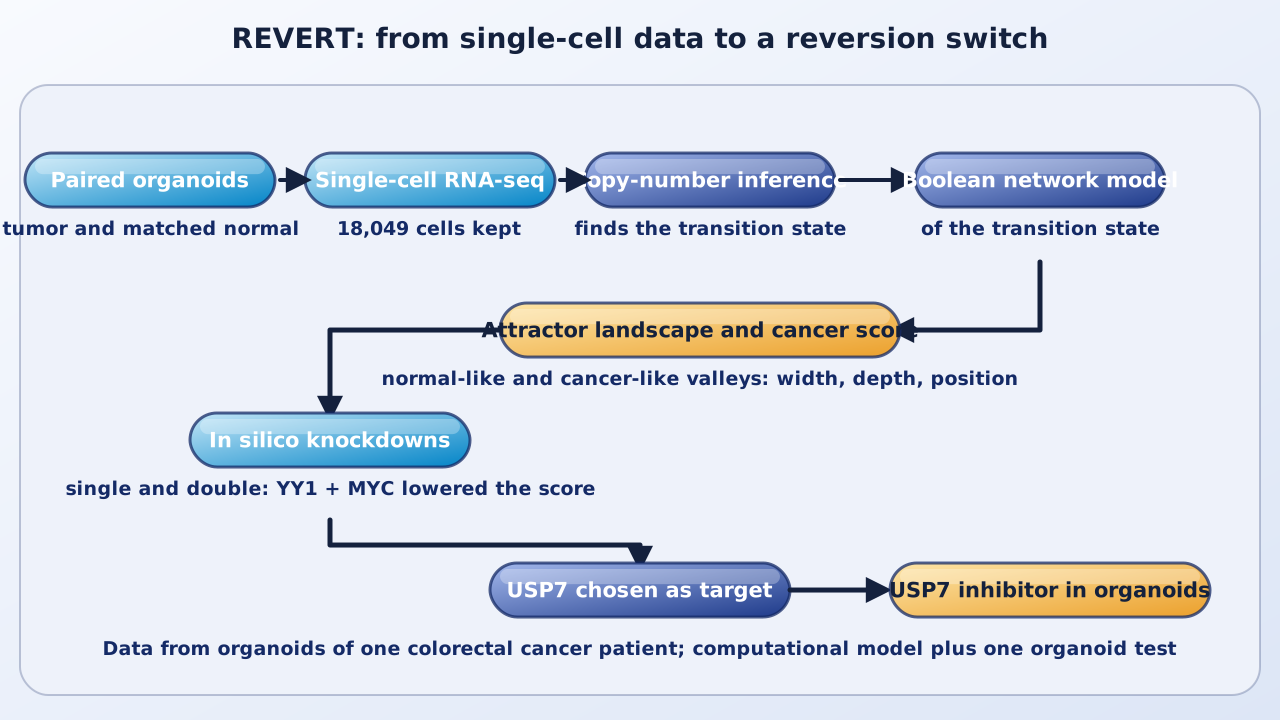
Can a cancer cell be pushed back toward a normal-like state instead of being killed? A KAIST group, with colleagues at Seoul National University, describes a computational framework called REVERT that looks for genes that could do this, and tests its top prediction in organoids. The paper appeared online in January 2025. This brief covers what it shows and what it does not.
The idea: a tipping point in tumor development
The authors start from the observation that tumor development involves a critical transition, a sudden change of state at a tipping point, much as water turns to steam. Just before the change, cells can exist in an unstable mixed state in which normal-like and tumor-like behavior coexist. In the language of dynamical systems, each stable state is an attractor, and the set of attractors and their valleys is an attractor landscape. If a gene or pair of genes could deepen the normal-like valley and shrink the tumor-like one, cells might drift back toward the normal-like state.
What REVERT does
REVERT takes single-cell RNA data from a tumor and matched normal tissue. It infers copy-number changes in each cell to order cells along a tumor lineage and to find the transition state, where normal-like and cancer-like cells coexist. It then builds a Boolean network, a logic model in which each gene is on or off, of the key regulators in that state, and maps its attractor landscape. A cancer score summarizes how dominant and stable the cancer-like attractor is. Finally the model is perturbed in silico, gene by gene and in pairs, and the targets that lower the score most are listed.
The data
The input was single-cell RNA sequencing of patient-derived organoids: a tumor organoid and a matched normal organoid from one colorectal cancer patient. After filtering out low-quality cells, 18,049 cells remained. Cells in the transition state had higher values of two measures of instability and plasticity, a critical transition index and single-cell entropy, than normal-like or cancer-like cells, and intermediate scores for cancer-related and normal colon signatures.
The model and the in silico results
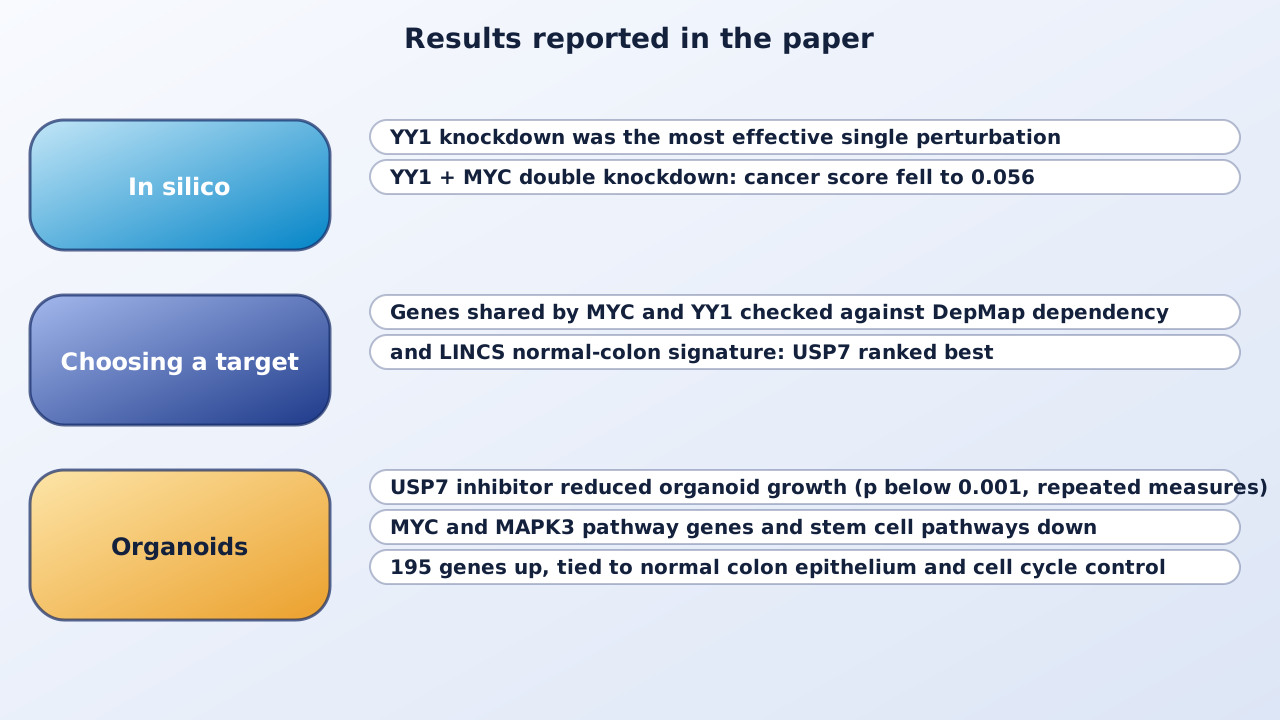
The network model produced nine attractors, eight stable points and one cycle. The cancer attractor had a much larger basin than the normal one, and MYC was higher in it. Among single perturbations, knocking down YY1 was the most effective. Knocking down YY1 and MYC together lowered the cancer score to 0.056 and led to dominant normal-like attractors. The double knockdown also gave low scores across most of the settings the authors varied, which supports its robustness within the model.
From two hard targets to USP7
MYC is difficult to inhibit with drugs, and YY1 regulates many genes. The authors therefore looked for genes regulated by both, and ranked them with two public datasets: DepMap, which measures how much colon cancer cell lines depend on each gene, and LINCS, which records how perturbing a gene changes expression, here toward a normal colon signature. USP7, a deubiquitinating enzyme that stabilizes several oncogenic proteins, scored best on the combination.
The organoid test
In the same colon cancer organoids, a USP7 inhibitor reduced growth at the concentrations tested (repeated-measures ANOVA, p below 0.001). Gene set analysis showed lower activity of tumor-formation signatures, including genes in the MYC and MAPK3 pathways, and of stem cell pathways. A set of 195 genes went up, and these were linked to normal colon epithelium and to negative regulation of the cell cycle and cell proliferation. The authors conclude that USP7 inhibition moved the organoids toward a more normal colon state.
Keep in mind
The model rests on the organoids of one patient, and its normal-like and cancer-like states are tumor-associated states, not healthy and malignant tissue. The authors also note that copy-number changes are permanent, so what is reversed, if anything, is the gene expression state. Reduced growth is also what an anti-cancer drug would be expected to do, so the data do not show that cells became normal. Binarizing expression loses detail, and the results depend on hyperparameters the authors constrained. There are no animal or patient treatment data. USP7 inhibitors are not presented as a treatment, and headlines that describe cancer cells as turned back into normal cells go further than this paper does.
- Paper
- Shin D, Gong JR, Jeong SD, Cho Y, Kim HP, Kim TY, Cho KH. Attractor landscape analysis reveals a reversion switch in the transition of colorectal tumorigenesis. Advanced Science. 2025;12(8):e2412503. Published online January 22, 2025. Open access (PMC11848608).
- Type
- Computational network model with patient-derived organoid experiments
- DOI
- 10.1002/advs.202412503
- PubMed
- PMID 39840939
Related articles
 Daily brief · Nov 4, 2026In Mice, Hepatocytes Use IRE1α–XBP1s to Hold Down Glutamine and Inflammatory Monocytes, and Losing It Enlarges Liver Metastases
 Daily brief · Oct 28, 2026Clones Within Single Pancreatic Tumors Differ in MYC Amplification, and MYC Is Linked to a Basal, Immune-Depleted State
 Explainer · Oct 19, 2026Glutamine Addiction: Why Some Cancer Cells Depend on a Nonessential Amino Acid

Research focus: Molecular Oncology and Cancer Metabolism
Department of Molecular Diagnostics, Faculty of Biomedical Sciences, University of Benghazi, Libya
Weekly digest
The week's briefs and science news in one email. See the privacy policy.
Comments
No account needed. Comments are reviewed before they appear. Please be respectful and on topic.