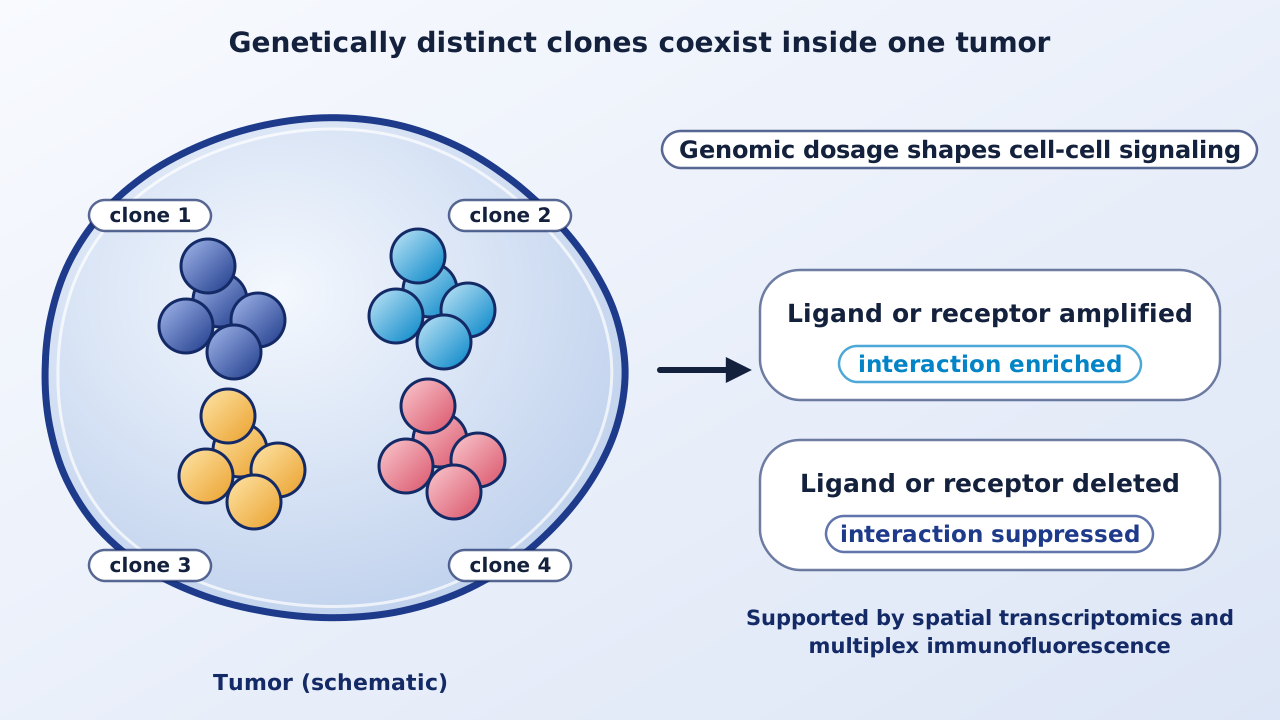
A pancreatic tumor is not one population of cells. A group led from NYU Grossman School of Medicine and UC San Diego now reports that single tumors contain several genetically distinct clones, that gains and losses of DNA in each clone change which signals it sends and receives, and that amplification of the MYC region is linked to a shift toward a more aggressive, immune-depleted cell state.
Background. Pancreatic ductal adenocarcinoma (PDAC) is an aggressive cancer with dense scar-like tissue around the tumor cells, known as desmoplasia, and with marked cellular diversity. Bulk sequencing averages all of these cells together and cannot resolve them. PDAC cells are often described as classical or basal, with the basal state tied to worse behavior. The MYC transcription factor drives growth and, as in the glutamine addiction work discussed on this site, also reshapes metabolism.
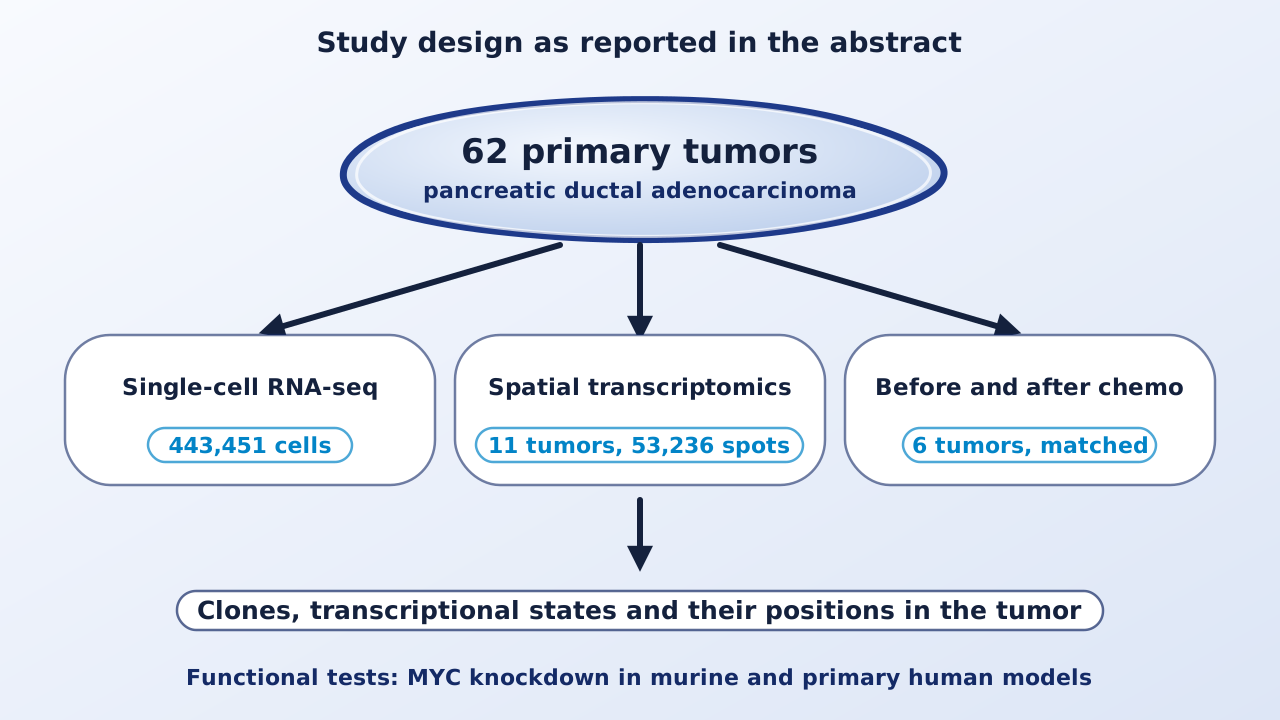
What they did. The authors profiled 62 primary tumors by single-cell RNA sequencing (443,451 cells in total). For 11 of the tumors they added spatial transcriptomics (53,236 spots), which records where in the tissue each expression pattern sits. They also had matched samples from six tumors collected before and after chemotherapy. The aim was to map clonal, transcriptional and spatial diversity together.
What they found. Individual tumors held multiple genetically distinct neoplastic clones. Clones differed in ligand-receptor programs, and the differences followed genomic dosage: amplification of a ligand or receptor enriched the matching interaction, while deletion suppressed it. Spatial transcriptomics and multiplex immunofluorescence supported these genetically encoded differences.
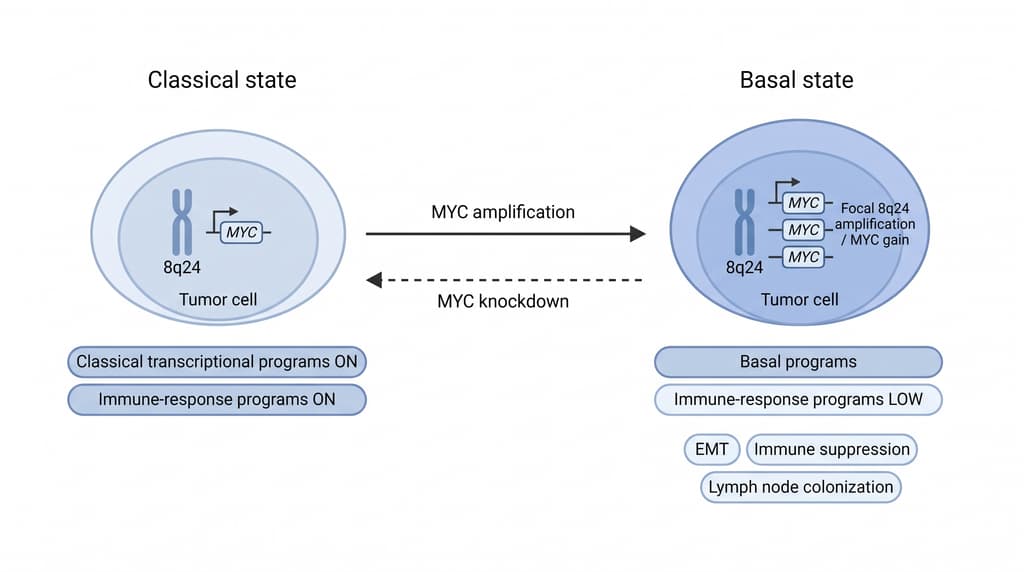
MYC and the basal state. Integrating clonal phylogeny with cell state, the authors found that focal amplification at 8q24, the MYC locus, was recurrently associated with classical-to-basal transitions within tumor lineages, at a frequency above chance, and that these transitions came with coordinated depletion of immune-response programs. In murine and primary human models, MYC knockdown reactivated classical transcriptional programs and restored immune-response pathways, which the authors read as support for a role of MYC in maintaining a basal, immune-depleted state. Spatial analyses also showed dispersed clones enriched for epithelial-to-mesenchymal transition activity and immune suppression, correlating with metastatic potential and colonization of lymph node niches; these clones shifted toward a basal phenotype.
Why it matters. The study treats PDAC as a set of evolving clones whose DNA changes alter both their state and their neighbors. If the link between MYC dosage and an immune-depleted state holds, it connects tumor genetics to the poor immune response often seen in this cancer; the brief on MHC class I and anti-PD-1 covers one route by which tumors escape immune attack. The authors suggest that therapies aimed at clonal evolution and at the mechanisms behind metastasis might follow from this view.
Keep in mind. The associations come from tissue and cells from patients, and only the MYC knockdown experiments test cause, in models rather than in patients. The chemotherapy comparison covers six tumors, so no conclusion about how treatment reshapes clones can be drawn from it. The abstract does not report survival, treatment response or any trial of a MYC-directed drug, and MYC has no approved inhibitor. Nothing here changes patient care at present.
- Paper
- Kalfakakou D, Cameron DC, Kawaler EA, et al. Clonal heterogeneity in human pancreatic ductal adenocarcinoma and its impact on tumor progression. Nature Genetics. 2026. Published online October 13, 2026.
- Type
- Human tumor single-cell and spatial genomics with functional models
- DOI
- 10.1038/s41588-026-02779-5
- PubMed
- PMID 42869988
Related articles
 Daily brief · Oct 25, 2026Propionate Blocks a Ubiquitin Ligase and Keeps MHC Class I on Tumor Cells, Boosting Anti-PD-1 Efficacy in Models
 Explainer · Oct 26, 2026How a Personalized mRNA Cancer Vaccine Works, and What the Melanoma Trials Show So Far
 Feature · Oct 19, 2026Glutamine Plus Chemotherapy for Advanced Pancreatic Cancer: A Small Phase 1 Trial Finds the Combination Feasible

Research focus: Molecular Oncology and Cancer Metabolism
Department of Molecular Diagnostics, Faculty of Biomedical Sciences, University of Benghazi, Libya
Weekly digest
The week's briefs and science news in one email. See the privacy policy.
Comments
No account needed. Comments are reviewed before they appear. Please be respectful and on topic.