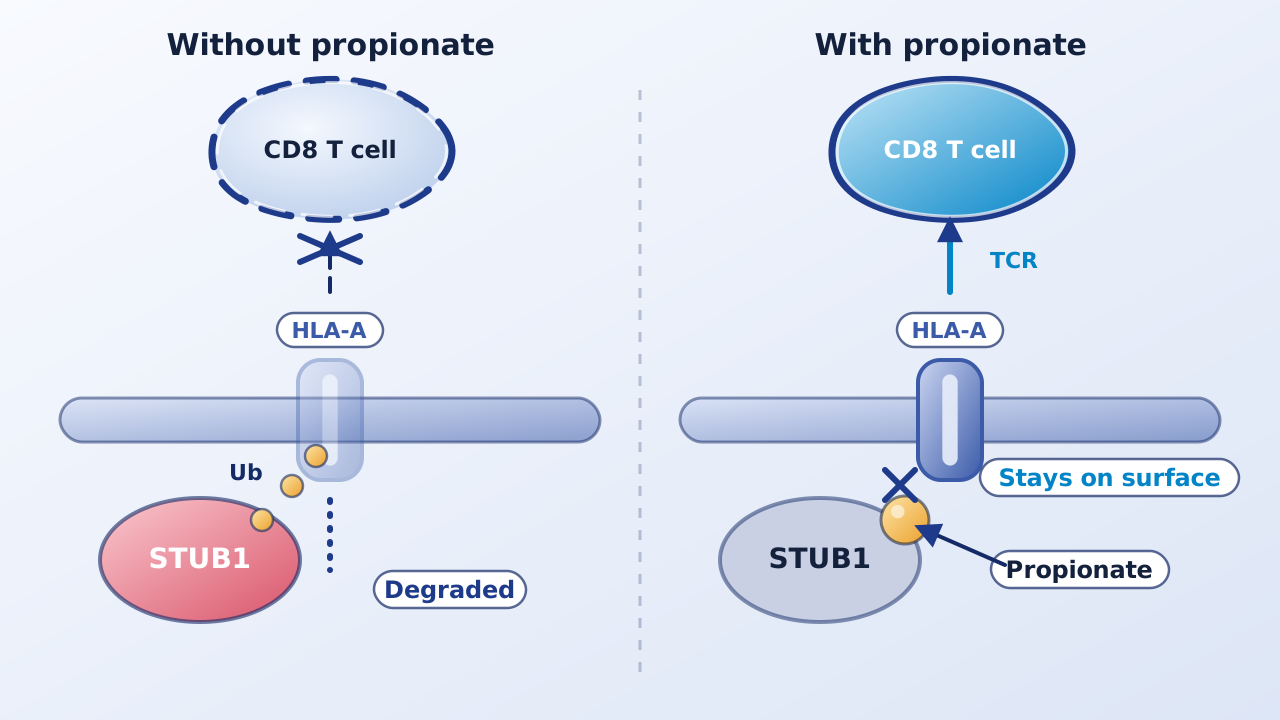
Tumors that stop showing fragments of their proteins to the immune system can escape attack and resist immune checkpoint therapy. A group at Zhejiang University now reports that propionate, a short-chain fatty acid that gut bacteria can produce, keeps the display machinery in place, and that it does so by a route that has nothing to do with propionate's role as a fuel.
Background. Major histocompatibility complex (MHC) class I proteins sit on the cell surface and present peptide fragments to CD8 T cells, the cells that kill infected or cancerous cells. In humans the class I proteins are called HLA. Tumors can lose this presentation, which is one reason checkpoint drugs such as anti-PD-1 antibodies fail in some patients. The paper asks whether a small metabolite can restore it.
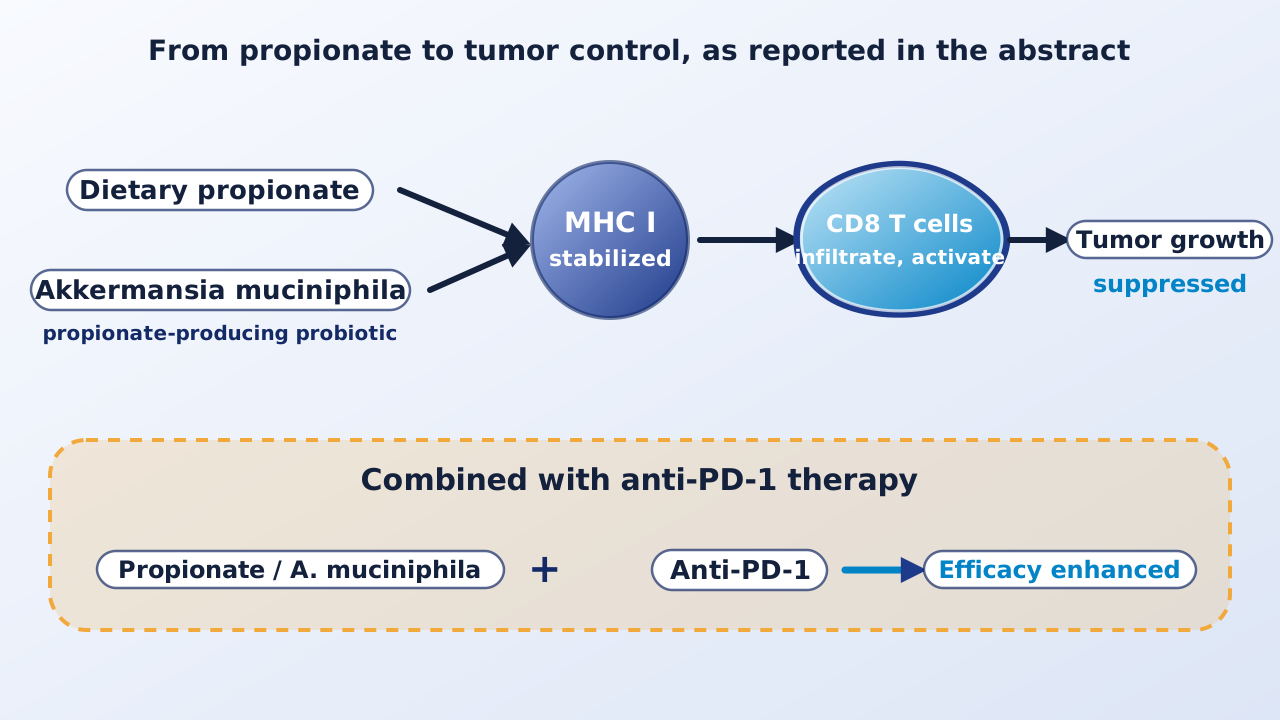
What they found. The authors identified propionate as a potent enhancer of MHC class I antigen presentation. In their models, propionate stabilized MHC class I on tumor cells, promoted CD8 T cell infiltration and activation, and suppressed tumor growth. The mechanism involves STUB1, an E3 ubiquitin ligase, an enzyme that tags proteins for destruction. STUB1 interacts directly with HLA-A and adds ubiquitin chains at lysines 168 and 170, which leads to degradation of the protein. Propionate binds STUB1 directly through hydrogen bonds involving K30 and N34, residues that overlap with the MHC class I-binding interface. That binding blocks STUB1-mediated polyubiquitination of MHC class I, so the protein is stabilized, T cell receptor engagement improves and T cells are activated more strongly.
Therapy angle. Propionate, or the propionate-producing probiotic Akkermansia muciniphila, markedly enhanced the efficacy of anti-PD-1 therapy. The authors describe a non-metabolic, moonlighting function of short-chain fatty acids in regulating tumor immunity, and they conclude that dietary propionate or propionate-producing probiotics could be used to strengthen immune checkpoint therapy.
Why it matters. If the mechanism holds, protecting MHC class I from degradation is a way to keep antigen presentation in place on tumor cells. The work also links a product of the gut microbiome directly to a defined molecular target, a ubiquitin ligase, rather than to a general change in metabolism.
Keep in mind. This is preclinical work. The abstract does not name the tumor models or species, and it gives no doses, effect sizes or patient data, so no conclusion about people can be drawn from it. It does not show that eating more propionate-rich foods, or taking supplements or probiotics, helps patients with cancer. The abstract does not address safety or the amounts of propionate that reach tumors. Patients should not change their diet or treatment on the basis of this report; any clinical use would need trials.
- Paper
- Li S, Guo D, Yang Q, et al. Propionate promotes MHC class I antigen presentation and anti-tumor immunity. Cell Metabolism. 2026. Published online October 21, 2026.
- Type
- Preclinical laboratory study
- DOI
- 10.1016/j.cmet.2026.09.018
- PubMed
- PMID 42906554
Related articles
 Daily brief · Oct 19, 2026A New Class of Mitochondria-Targeted Compounds Induces Ferroptosis and Suppresses Tumors in Cancer Models
 Feature · Oct 19, 2026Why a Glutaminolysis Signature Falls With PTEN Loss: Passenger Co-Deletion, Not Metabolic Regulation
 Feature · Oct 19, 2026Glutamine Plus Chemotherapy for Advanced Pancreatic Cancer: A Small Phase 1 Trial Finds the Combination Feasible

Research focus: Molecular Oncology and Cancer Metabolism
Department of Molecular Diagnostics, Faculty of Biomedical Sciences, University of Benghazi, Libya
Weekly digest
The week's briefs and science news in one email. See the privacy policy.
Comments
No account needed. Comments are reviewed before they appear. Please be respectful and on topic.