- What was tested: whether the expression of glutaminolysis genes rises as PTEN copy number falls, as the PI3K/AKT/mTORC1 signaling model predicts, across 14 TCGA tumor types [1].
- Main result: the five-gene signature fell with PTEN loss in all 14 types (significant in 12), most strongly in prostate cancer (Spearman ρ = −0.54) [1].
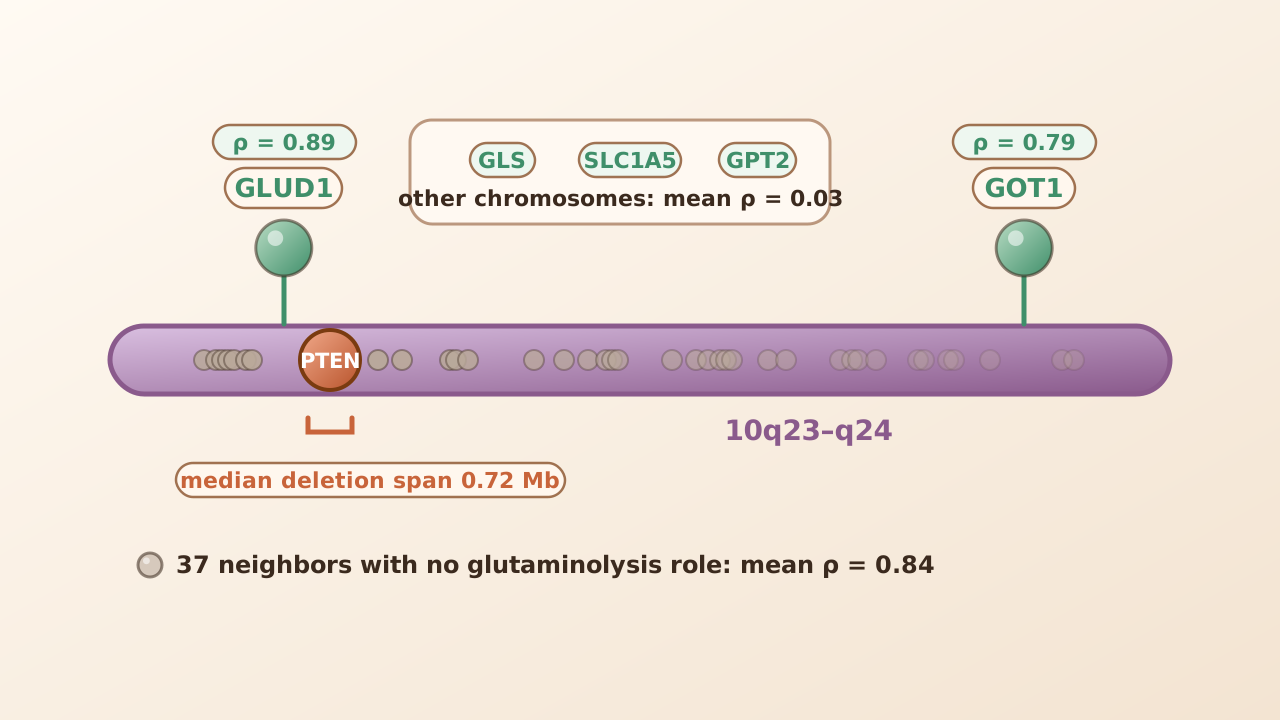
- Why: two signature genes, GLUD1 and GOT1, sit on chromosome 10q near PTEN and are deleted with it. Thirty-seven neighbors with no glutaminolysis role tracked PTEN copy number as closely (mean ρ 0.843 versus 0.842) [1].
- Implication: PTEN copy number is unreliable as a stand-alone biomarker for glutaminase-inhibitor selection. Prostate cancer is a partial exception that the analysis could not explain [1].
Why this matters
Loss of the tumor suppressor PTEN is among the most common events in human cancer. In cell-line studies, PTEN loss activates PI3K/AKT/mTORC1 signaling, which can raise glutamine transporter expression and, through MYC, glutaminase. The field has generalized this to an expectation that PTEN-deficient tumors are broadly glutamine-dependent, and that expectation has helped motivate the clinical development of glutaminase inhibitors [1]. For background on glutamine dependence, see the earlier explainer.
No study had asked, across many tumor types and with attention to gene dosage, whether the glutaminolysis program really tracks PTEN copy-number loss, or whether any such association reflects regulation or a structural artifact [1].
The study
The analysis used only public data. Gene expression, copy-number (GISTIC), mutation and clinical data came from the TCGA PanCancer Atlas through cBioPortal, and cell-line CRISPR gene-effect scores came from DepMap Public 26Q1. Of 31 solid-tumor studies assessed, 14 met a rule fixed in advance: at least 10 tumors in each of the intact, one-copy (hemizygous) and two-copy (homozygous) PTEN deletion groups [1].
The glutaminolysis signature was defined before looking at the data. It combined five genes: GLS, SLC1A5, GOT1, GLUD1 and GPT2. Spearman correlation with PTEN loss severity was corrected for multiple testing, and the authors then tested two competing explanations, MYC-mediated regulation and physical co-deletion [1].
What the researchers found
| Question | Result |
|---|---|
| Does the signature rise with PTEN loss? | No. It fell in all 14 tumor types and was significant in 12 after correction. The strongest effect was in prostate cancer (ρ = −0.54, adjusted P = 5.3 × 10−37). Effect sizes varied widely: the association explained 29.1% of variance in prostate cancer but 0.5% in breast and 0.4% in stomach cancer [1]. |
| Is MYC the mediator? | No consistent evidence. PTEN loss tracked MYC expression significantly in 3 of 14 types, and the direction was inconsistent [1]. |
| Do unrelated neighbors behave the same way? | Yes. Thirty-seven genes across 10q23–q24 with no glutaminolysis annotation tracked PTEN copy number as closely as GLUD1 and GOT1 (mean ρ 0.843 versus 0.842). The three signature genes on other chromosomes averaged 0.034. Fidelity fell with distance from PTEN (ρ = −0.993) [1]. |
| Does adjusting for aneuploidy remove it? | No. Adjusting for genome-wide aneuploidy left the associations essentially unchanged. Conditioning on each gene’s own copy number removed it for the chromosome-10 genes (mean coefficient from −0.321 to −0.022) and left the other genes unaffected [1]. |
| Does PTEN mutation alone lower GLUD1? | Not outside endometrial carcinoma. In copy-neutral tumors the pooled difference (P = 1.0 × 10⁻⁸) was driven by endometrial carcinoma. Excluding it, no difference was detectable (P = 0.22; equivalence P = 0.015). Deletion lowered GLUD1 dose-dependently (hemizygous mean −0.44, homozygous −0.89) [1]. |
| Do PTEN-deleted cell lines depend more on GLS? | No difference across PTEN dosage groups in DepMap (Kruskal–Wallis P = 0.74) [1]. |
One lineage did not fit the passenger account. In prostate cancer the three signature genes outside chromosome 10 also fell with PTEN loss (ρ = −0.38, adjusted P = 1.7 × 10⁻¹⁷), and this persisted after adjusting for tumor purity, stage, ERG expression and proliferation. The authors call its basis unresolved and the analysis exploratory, because it was done after the main result. Breast and stomach cancers showed small associations in the direction the signaling model predicts, explaining about 3% and 4% of variance [1].
PTEN loss was associated with worse overall survival in endometrial carcinoma and glioblastoma, but the signature was not consistently prognostic [1].
The deletions involved are focal: in homozygously deleted tumors the median co-deleted span was 0.72 Mb, and 90% of tumors had deletions confined within 2 Mb of PTEN. GLUD1 lies 0.77 Mb from PTEN and GOT1 11.57 Mb away, and their copy-number correlation with PTEN reached 0.89 and 0.79 on average. A genome-wide aneuploidy score missed the confound because it cannot isolate loss of a single chromosome arm; the gene-level copy-number test is the appropriate one [1].
What this does not show
- Not that PTEN is irrelevant to glutamine metabolism. PTEN affects metabolism through post-transcriptional routes and flux that a transcriptional signature cannot capture [1].
- A transcriptional proxy. The signature does not measure glutamine flux. Dosage was defined by copy number, which misses mutations and promoter methylation, so some deficient tumors count as intact [1].
- Some groups are thin. The glioblastoma cohort had only 13 intact tumors, and GLS is a weak dependency in most cell lines whatever the PTEN status, so the DepMap result bounds rather than proves the absence of a dependency [1].
- Prostate cancer remains unexplained, and the authors note that bulk RNA-seq mixes tumor and stromal cells [1].
What this means
For biomarkers. The authors argue against using PTEN loss as a stand-alone biomarker to select patients for glutaminase inhibition. They note that glutaminase-inhibitor trials so far were not selected on PTEN status and did not include the tumor types analyzed here, so the trials neither confirm nor contradict the finding [1].
For signature design. The authors propose a four-step screen, offered as a workflow and not a validated instrument: (1) split the signature by chromosomal position relative to the driver gene; (2) correlate each gene’s own copy number with the driver’s; (3) compare driver-mutant copy-neutral tumors with copy-neutral wild-type tumors; (4) check the inferred pathway activity against independent functional data such as CRISPR dependency screens [1].
- Paper
- Abusneina AM, Elwirfli SM. PLOS ONE 21(10):e0354937, 2026. doi:10.1371/journal.pone.0354937
- PubMed
- PMID 42853860
- Full text
- Free on PubMed Central; the full text was used for this summary
- Data and code
- Public TCGA and DepMap data; analysis code on GitHub (its README lists a Zenodo archive and a figshare minimal data set)
- Disclosure
- The author of this post is the first author of the paper.
- Funding
- Listed in the paper.
This post summarizes a published study for general information.
References
- A. M. Abusneina and S. M. Elwirfli, “Passenger co-deletion confounds glutaminolysis signatures anchored on PTEN loss: A cautionary case for location-aware signature design,” PLoS ONE, vol. 21, no. 10, art. e0354937, Oct. 2026. doi: 10.1371/journal.pone.0354937. PMID: 42853860. Full text: PMC13652231.
Related articles
 Explainer · Oct 19, 2026Glutamine Addiction: Why Some Cancer Cells Depend on a Nonessential Amino Acid
 Feature · Oct 19, 2026Ammonium Ions Improve Survival of Glutamine-Starved Hybridoma Cells Without Blocking Core Apoptosis Events
 Feature · Oct 19, 2026Glutamine Plus Chemotherapy for Advanced Pancreatic Cancer: A Small Phase 1 Trial Finds the Combination Feasible
Research focus: Molecular Oncology and Cancer Metabolism
Department of Molecular Diagnostics, Faculty of Biomedical Sciences, University of Benghazi, Libya
Comments
No account needed. Comments are reviewed before they appear. Please be respectful and on topic.