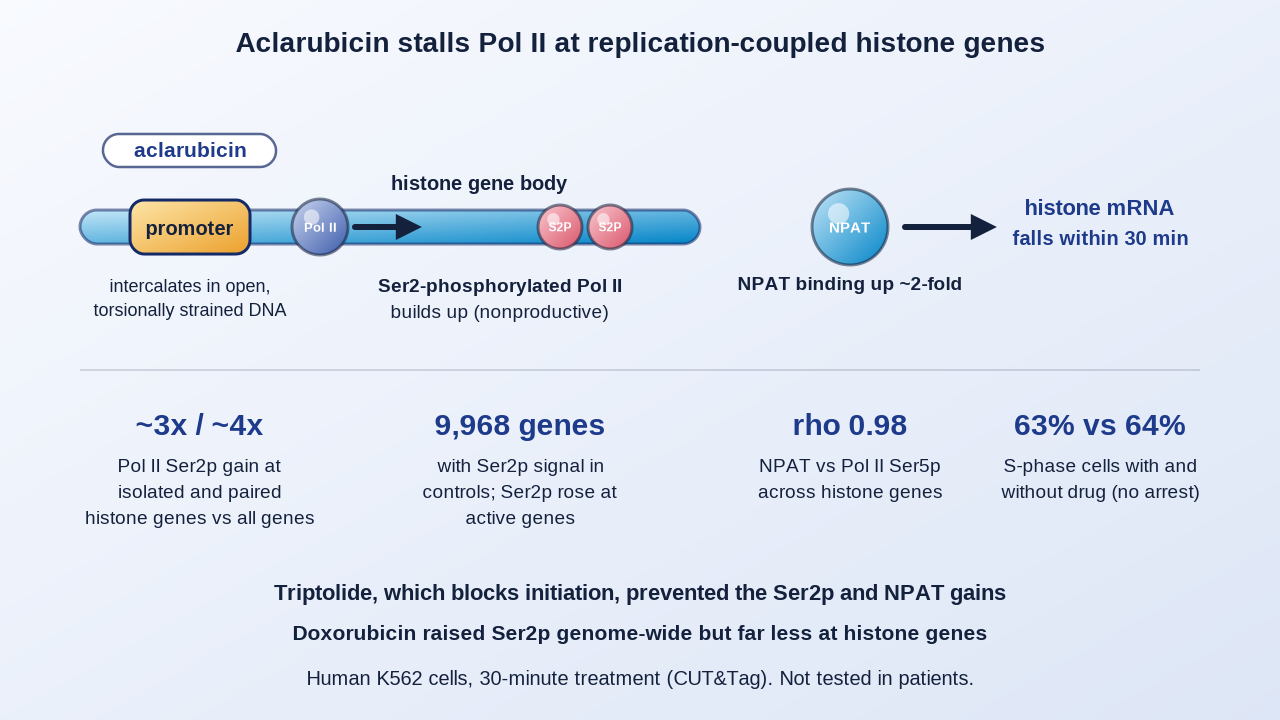
Anthracyclines such as doxorubicin kill cancer cells partly by damaging DNA. One member of the class, aclarubicin, kills with little DNA damage and seems to act on chromatin instead. A Seattle group now maps where it acts on RNA polymerase II in human cells and finds that the genes that make histones are the most sensitive.
| Measure | System | Reported result |
|---|---|---|
| Promoters profiled | K562 cells, hg19 | 19,305 |
| Genes with Pol II Ser2p signal in controls | CUT&Tag | 9,968 |
| Ser2p gain at isolated / paired histone genes vs all genes | Aclarubicin, 30 min | About 3-fold / 4-fold |
| Histone mRNA after aclarubicin | RT-qPCR, 3 replicates | Significantly lower for all histone classes |
| NPAT vs Ser5p across histone genes | Control cells | Spearman ρ = 0.98 |
| S-phase cells, drug vs control | 519 cells imaged (controls) | 63% vs 64% |
Background
Aclarubicin intercalates into DNA and, according to prior work, alters its physical properties and weakens DNA-histone contacts, with potency similar to doxorubicin but no detectable DNA damage. The group had earlier shown in Drosophila cells that it raises the elongating form of Pol II. The replication-coupled histone genes sit in histone locus bodies on chromosomes 1 and 6, carry the densest Pol II loading in the genome during S phase, and need the factor NPAT.
Elongating Pol II rises at active genes
In K562 leukemia cells treated for 30 minutes, the authors used CUT&Tag for total Pol II, initiating or paused Pol II (Ser5p) and elongating Pol II (Ser2p) at 19,305 promoters. Total and Ser5p Pol II barely changed genome-wide, but Ser2p increased at active genes (9,968 genes had Ser2p signal in controls). Doxorubicin also raised Ser2p, but unlike aclarubicin it did not shift Pol II downstream of the transcription start site.
Histone genes stand out
Histone genes were among the most Pol II-occupied loci and showed one of the largest Ser2p gains. Aclarubicin lowered total and Ser5p Pol II upstream of the start site and raised it downstream. Histone genes usually carry little Ser2p, yet it rose about threefold at isolated and fourfold at paired (divergent) histone genes relative to all genes, with the biggest gains at H2A and H2B genes and the smallest at H1. Despite this, histone mRNA fell significantly for every histone class after 30 minutes, so the extra Ser2p is nonproductive. Doxorubicin had a much smaller effect at these genes.
Blocking initiation prevents the pile-up
Treatment with triptolide, which blocks TFIIH and initiation, lowered Pol II at histone genes and left Ser2p low. Adding aclarubicin deepened the loss of total and Ser5p Pol II but produced no Ser2p gain, so the accumulation requires ongoing initiation.
NPAT follows Pol II
NPAT levels correlated tightly with Ser5p across histone genes (Spearman ρ = 0.98). Aclarubicin roughly doubled NPAT at these genes, and the change tracked the Ser2p change (ρ = 0.75). Imaging of 519 cells showed more NPAT foci per nucleus in both S-phase and gap-phase cells after treatment, and S-phase fractions were similar (63% versus 64%), so the effect was not caused by cell-cycle arrest. Triptolide abolished the NPAT increase.
A proposed mechanism
The authors propose that high transcription at histone genes creates negative supercoils at promoters where aclarubicin intercalates, and that, because aclarubicin also inhibits topoisomerases, positive supercoils build ahead of Pol II. This torsional barrier slows or stalls Pol II, giving more time for Ser2 phosphorylation, possibly by the histone-specific kinase CDK11, while the disordered protein NPAT may lengthen Pol II residence through multivalent contacts.
Keep in mind
The work uses one leukemia cell line and a 30-minute treatment, CUT&Tag cannot separate stalled from slowly moving polymerase directly, and the supercoiling and CDK11 explanations are proposals that were not tested. The paper does not show that histone gene disruption is what kills cancer cells, nor that it predicts response in patients. The authors suggest the replication-coupled histone genes as a target for therapeutic intervention, which remains an idea to test.
- Paper
- Nguyen KK, Wooten M, Ahmad K, Henikoff S. Aclarubicin disrupts RNA polymerase II progression at replication-coupled histone genes. Science Advances. 2026;12(48):eaej7096. Published November 25, 2026.
- Type
- Cell-line genomics (CUT&Tag) and imaging
- DOI
- 10.1126/sciadv.aej7096
- PubMed
- PMID 43084682
- Funding
- Howard Hughes Medical Institute; NIGMS K99 Pathway to Independence Award K99GM152821; University of Washington Genome Training Grant T32HG000035. The authors declare no competing interests.
Related articles
 Daily brief · Nov 6, 2026Sitagliptin, a Diabetes Drug, Lowers RRM1 and RRM2 and Restores Gemcitabine Response in Models; a 22-Patient Phase 2 Trial in Pancreatic Cancer Reports a 36.4% Response Rate
 Daily brief · Nov 5, 2026Chemotherapy Raises NAD+ Recycling Through Macrophage IL-1β, and Blocking NAMPT Restores Chemotherapy Response and NK Cell Function in Mouse Tumor Models
 Science news · Nov 10, 2026Childhood Cancers May Spread by Switching Between Reversible Cell States, a New Review Proposes, Not Only by Accumulating Mutations

Research focus: Molecular Oncology and Cancer Metabolism
Department of Molecular Diagnostics, Faculty of Biomedical Sciences, University of Benghazi, Libya
Weekly digest
The week's briefs and science news in one email. See the privacy policy.
Comments
No account needed. Comments are reviewed before they appear. Please be respectful and on topic.