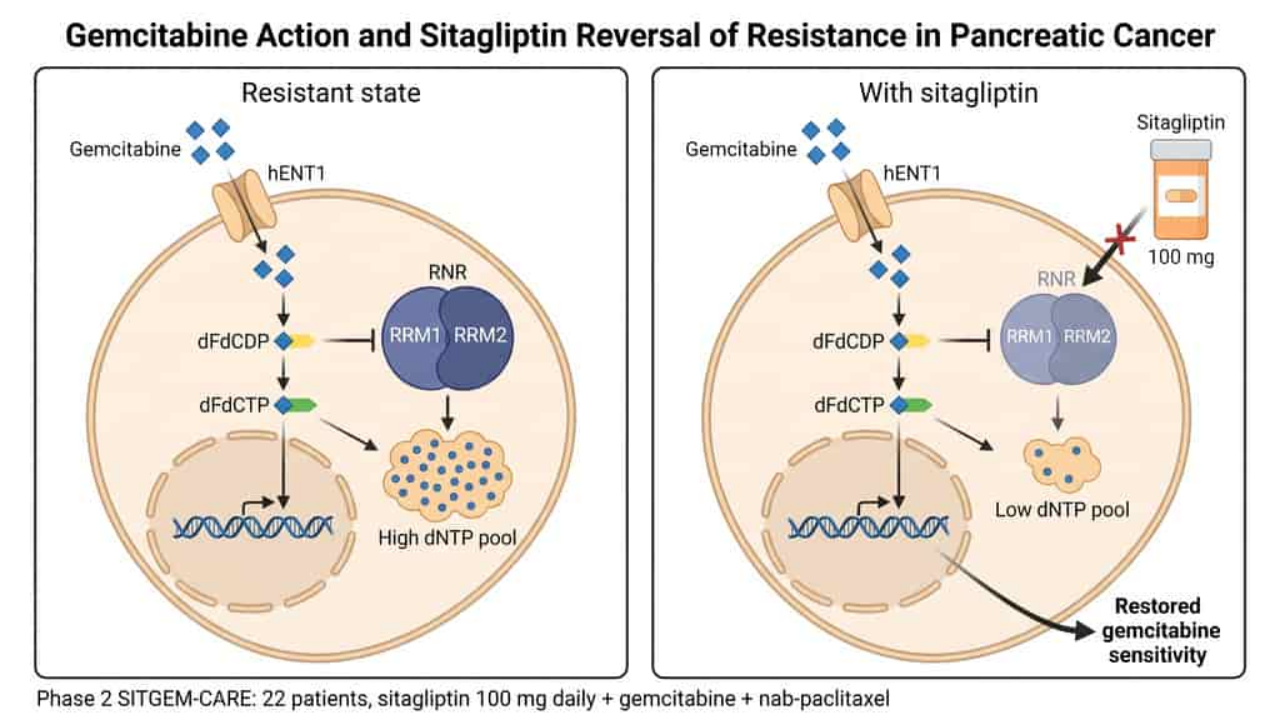
Most patients with advanced pancreatic ductal adenocarcinoma (PDAC) receive a gemcitabine-based regimen at some point, and resistance to gemcitabine drives progression. A team at Tianjin Medical University Cancer Institute and Hospital reports that sitagliptin, an inexpensive generic drug for type 2 diabetes, lowers a key resistance enzyme in models and, added to chemotherapy in a small phase 2 trial, was followed by tumor responses in 8 of 22 patients.
| Measure | Result (22 treated patients) | 95% CI |
|---|---|---|
| Objective response rate | 36.4% (8 partial responses) | 17.2 to 59.3% |
| Disease control rate | 86.4% (19 patients) | 65.1 to 97.1% |
| Median progression-free survival | 6.6 months | 4.8 to 12.4 |
| Median overall survival | 12.5 months | 7.8 to not reached |
| Alive at 12 months | 62.9% | 37.4 to 80.4% |
| Grade 3 adverse events / grade 4 or 5 treatment-related | 11 patients (50.0%) / none | not reported |
The resistance problem
Gemcitabine is activated in the cell and builds into replicating DNA. Its diphosphate form also inhibits ribonucleotide reductase (RNR), the enzyme that makes the building blocks of DNA, which deepens the drug's effect. Tumors that keep RNR activity high can sustain their nucleotide pools and keep replicating. RNR has two subunits, RRM1 and RRM2, and the authors describe sustained RRM1 and RRM2 upregulation as the dominant, clinically actionable node among gemcitabine resistance mechanisms. No approved drug had been repurposed to target it in PDAC.
A computational screen and what it found in models
The authors used artificial intelligence-guided, structure-based virtual screening of approved drugs against the RRM1/RRM2 complex and picked sitagliptin, which has been in clinical use for nearly two decades. It lowered RRM1 and RRM2 protein in a dose-dependent manner in human (SW1990, PANC-1) and mouse (KPC, PANC02) PDAC cell lines and in patient-derived organoids. Knocking down RRM1 and RRM2 reduced cell viability about as much as sitagliptin plus gemcitabine and nab-paclitaxel, and sitagliptin added nothing further, which fits RRM1/2 being needed for the effect; overexpressing them partly reversed it. Sitagliptin restored sensitivity in cells made resistant by stepwise exposure to the chemotherapy. It worked with gemcitabine alone but did not differ from nab-paclitaxel alone, and in an orthotopic patient-derived xenograft model it added to gemcitabine, with lower Ki67 and higher TUNEL staining in tumors. It also enhanced the gemcitabine-nab-paclitaxel and FOLFIRINOX regimens in a mouse model; the authors call the FOLFIRINOX result exploratory and likely independent of RRM1/2.
The SITGEM-CARE trial
From July 30, 2023, to March 20, 2025, 30 patients with locally advanced or metastatic PDAC consented at one center; 8 did not start treatment (5 withdrew consent, 3 failed screening), leaving 22 treated and evaluable patients. Median age was 65 years, 15 (68.2%) had stage IV disease, 12 (54.5%) had liver metastases, and all had an ECOG performance status of 0 or 1. Patients took sitagliptin 100 mg by mouth daily with gemcitabine 1,000 mg/m² and nab-paclitaxel 125 mg/m² on days 1 and 8 of 21-day cycles, for a median of 9 cycles (range 2 to 22). The registry lists the trial as a single-arm phase 2 study with progression-free survival as the primary outcome.
Responses and survival
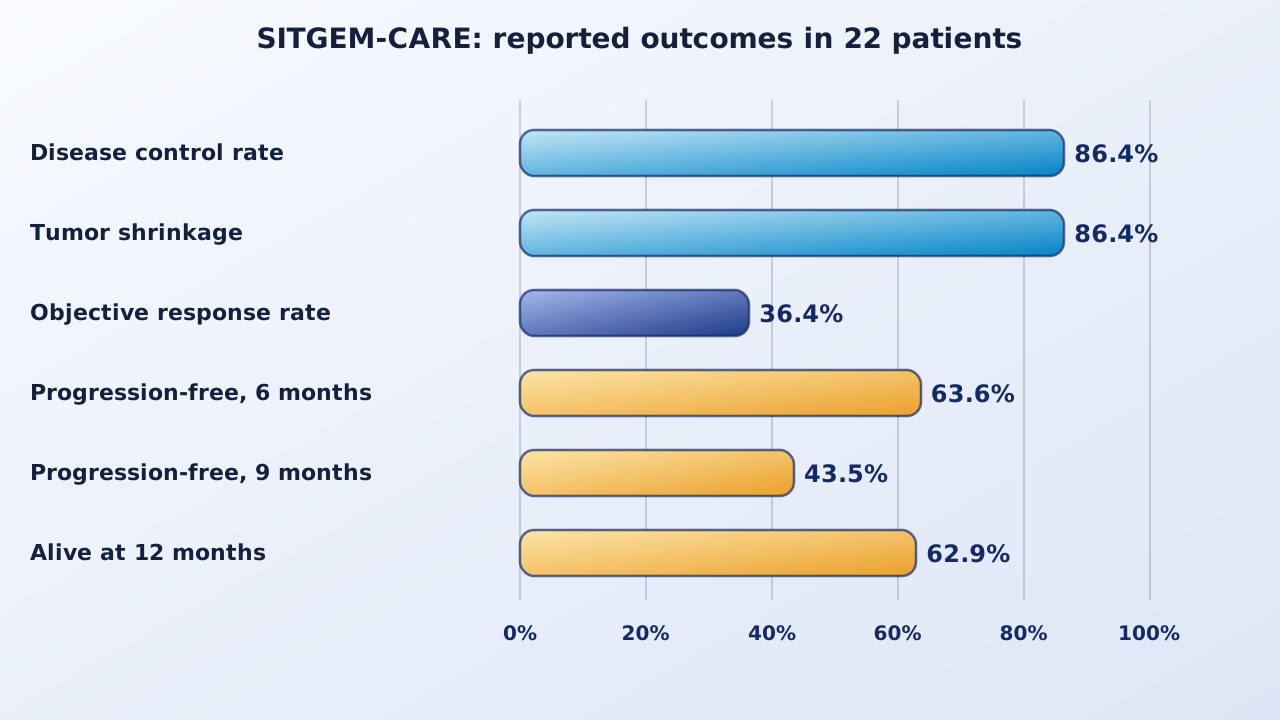
Eight patients had a partial response and 11 had stable disease, giving an objective response rate of 36.4% (95% CI 17.2 to 59.3) and a disease control rate of 86.4% (95% CI 65.1 to 97.1). Tumor shrinkage occurred in 19 patients (86.4%), with a median best change in target lesions of minus 21.8% (range plus 27.3% to minus 58.1%). Among responders, median time to response was 2.7 months and median duration of response 12.0 months (95% CI 2.2 to 14.2). At a median follow-up of 9.9 months, median progression-free survival was 6.6 months (95% CI 4.8 to 12.4), with 63.6% progression-free at 6 months and 43.5% at 9 months. Median overall survival was 12.5 months (95% CI 7.8 to not reached), and 62.9% (95% CI 37.4 to 80.4) were alive at 12 months.
Safety
Twenty patients (90.9%) had a treatment-emergent adverse event of any grade, most often anemia (16 patients, 72.7%), lymphopenia (15, 68.2%), leukopenia (12, 54.5%) and thrombocytopenia (12, 54.5%). Grade 3 events occurred in 11 patients (50.0%), mostly laboratory abnormalities: raised gamma-glutamyl transferase in 5 (22.7%), neutropenia in 3 (13.6%) and anemia in 3 (13.6%). There was no febrile neutropenia, no grade 4 or 5 treatment-related event, and no dose reduction, interruption or discontinuation because of drug-related toxicity.
Why it matters
The work offers a testable mechanism and a low-cost, already approved drug for a disease where median survival with gemcitabine-based therapy has stayed near one year. The authors conclude that the trial gives clinical proof of concept that sitagliptin can act as a chemosensitizer, and they propose randomized studies with mechanism-linked measures such as RRM1/2 levels in tumors.
Keep in mind
This is a single-arm trial of 22 patients at one center in China, so it cannot show that sitagliptin adds benefit; the confidence intervals are wide, follow-up (9.9 months) is shorter than the median survival, and the authors caution against comparing it with other trials, which differed in patients and chemotherapy schedule. The trial included 7 patients with locally advanced disease and was not powered for subgroups. The authors state that the data do not show whether sitagliptin lowers RRM1/2 by direct binding, transcription or protein stability, nor that RRM1/2 is its only action, and that an immune contribution cannot be excluded. Only five patients had CA19-9 return to normal. Randomized trials are needed.
- Paper
- Yu J, Shi S, Li M, Fang Q, Yan J, et al. Sitagliptin, a repurposed diabetes drug, overcomes gemcitabine resistance in pancreatic cancer via ribonucleotide reductase inhibition: SITGEM-CARE phase 2 trial. Signal Transduction and Targeted Therapy. 2026;11(1):483. Published November 3, 2026. ClinicalTrials.gov NCT05947825.
- Type
- Preclinical models and a single-arm, single-center phase 2 trial
- DOI
- 10.1038/s41392-026-02966-0
- PubMed
- PMID 42971953
- Funding
- National Science and Technology Major Projects (2025ZD0552400, 2025ZD0552414), National Key Research and Development Program of China (2021YFA1201100), National Natural Science Foundation of China (82573073), and Tianjin Key Medical Discipline-Specialty Construction Project (TJYXZDXK-3-003A). Sponsor in ClinicalTrials.gov: Tianjin Medical University Cancer Institute and Hospital.
Related articles
 Feature · Oct 19, 2026Glutamine Plus Chemotherapy for Advanced Pancreatic Cancer: A Small Phase 1 Trial Finds the Combination Feasible
 Daily brief · Nov 5, 2026Chemotherapy Raises NAD+ Recycling Through Macrophage IL-1β, and Blocking NAMPT Restores Chemotherapy Response and NK Cell Function in Mouse Tumor Models
 Daily brief · Nov 2, 2026METTL13 Methylation of eEF1A Tunes Codon Decoding, Boosts KRAS Synthesis and Is Linked to Resistance to a KRAS Inhibitor in Lung Cancer Models

Research focus: Molecular Oncology and Cancer Metabolism
Department of Molecular Diagnostics, Faculty of Biomedical Sciences, University of Benghazi, Libya
Weekly digest
The week's briefs and science news in one email. See the privacy policy.
Comments
No account needed. Comments are reviewed before they appear. Please be respectful and on topic.