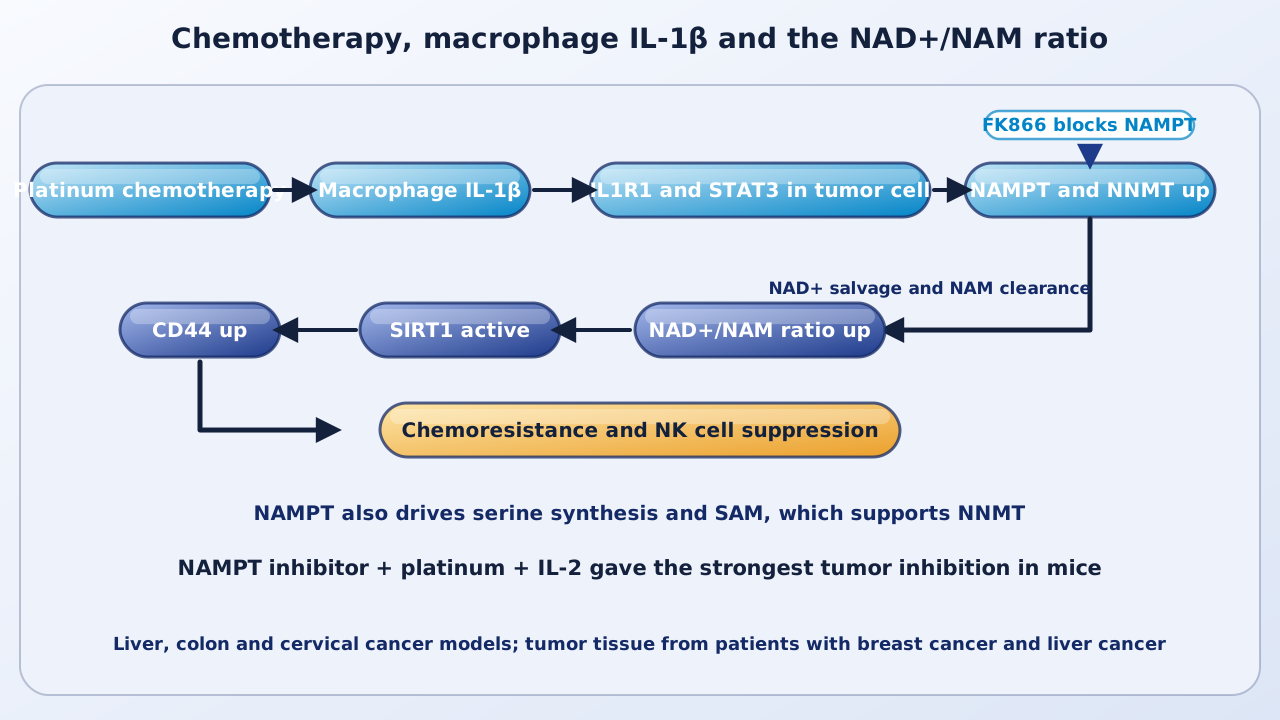
Chemotherapy often shrinks a tumor and then fails. A group at the Eastern Hepatobiliary Surgery Hospital in Shanghai and the University of Science and Technology of China reports that, in mouse models and patient samples, platinum drugs set off an inflammatory signal from macrophages that rewires how tumor cells handle NAD+, a cofactor central to metabolism, and that this rewiring helps tumors resist treatment and escape natural killer (NK) cells.
| Sample or model | Size | Reported result |
|---|---|---|
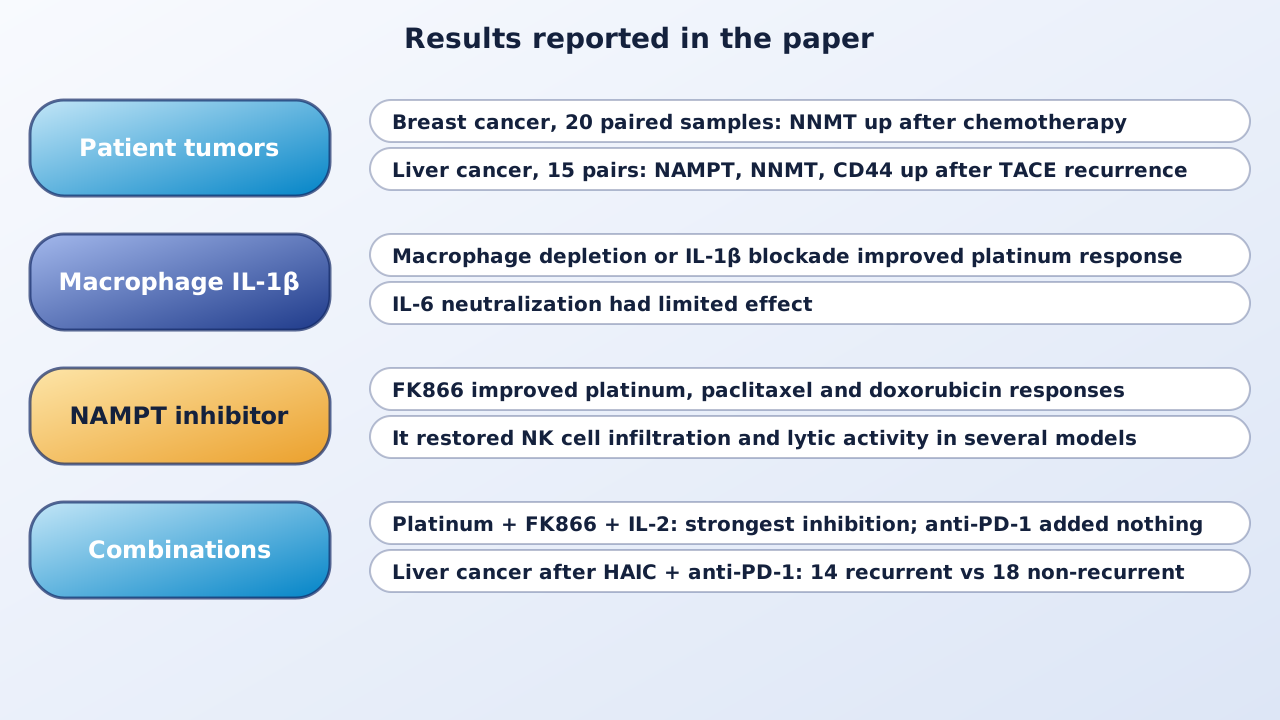
| Breast cancer, before and after doxorubicin and cyclophosphamide | 20 paired patients (public data) | NNMT higher after chemotherapy; NAMPT trend, P = 0.075 |
| Liver cancer, primary versus recurrent after TACE | 15 patients | NAMPT, NNMT and CD44 protein higher in recurrent tumors |
| Liver cancer after HAIC plus anti-PD-1 | 32 patients: 14 recurrent, 18 non-recurrent | NAMPT, NNMT and CD44 higher in recurrent tumors |
| Platinum plus FK866 plus IL-2 | HuH-7 and HeLa xenografts in mice | Strongest tumor inhibition; anti-PD-1 added no benefit |
Why NAD+ metabolism matters here
Cells make NAD+ mainly by recycling nicotinamide (NAM) through the salvage pathway, in which nicotinamide phosphoribosyltransferase (NAMPT) is the rate-limiting enzyme. Nicotinamide N-methyltransferase (NNMT) instead methylates NAM and removes it. NAM also inhibits NAD+-consuming enzymes such as the sirtuins, so the authors argue that the ratio of NAD+ to NAM, not NAD+ alone, sets sirtuin activity. The same group previously reported that replenishing NAD+ sensitized tumors to immune checkpoint blockade, but what chemotherapy does to NAD+ metabolism was unclear.
Chemotherapy raises NAMPT, NNMT and CD44 in patient tumors
In 20 patients with breast cancer, paired samples before and after doxorubicin and cyclophosphamide showed higher NNMT after treatment, with NAMPT trending upward (P = 0.075). In 15 patients with hepatocellular carcinoma who had adjuvant chemoembolization (TACE), recurrent tumors had higher NAMPT, NNMT and CD44 protein than the matched primary tumors. CD44 is a marker of cancer stem-like cells and a driver of chemoresistance, and NAMPT and NNMT expression correlated with CD44 in several cancer types in public datasets.
NAMPT drives the resistance
In mice with human liver cancer cells (HuH-7), knocking out NAMPT sharply increased the effect of platinum and blocked platinum-induced CD44, whereas knocking out NNMT gave only partial benefit that depended on NAMPT. Giving the NAD+ precursor NMN blunted the response to platinum and raised CD44 further. The NAMPT inhibitor FK866 also improved responses to paclitaxel and doxorubicin. Blocking CD44 with an antibody or deleting it removed the effect of NMN, which supports CD44 as the downstream step, and the PARP inhibitor olaparib did not reverse it.
Macrophage IL-1β is the trigger
Macrophage infiltration correlated most strongly with NAMPT, NNMT and CD44 in public datasets, and depleting macrophages in mice blocked the platinum-induced increase and improved the response. Among nine cytokines tested, IL-1β raised NAMPT, NNMT and CD44 in tumor cells through IL1R1 and STAT3. Platinum induced IL-1β-producing macrophages in liver, cervical and colon tumor models. Macrophage-specific knockdown of IL-1β, delivered by an AAV9 vector, or an IL-1β neutralizing antibody improved the platinum response and dampened the NAMPT and NNMT increase, whereas neutralizing IL-6 had limited effect. Spatial transcriptomics of post-TACE recurrent tumors placed IL-1β-positive macrophages next to NAMPT- and NNMT-positive tumor cells.
How the ratio and serine fit in
In IL-1β-treated liver cancer cells, NAD+ rose without NAM accumulating, and the MNAM/NAM and SAH/SAM ratios rose, which the authors read as NAD+ salvage together with NAM clearance. The sirtuin inhibitor selisistat, like NAM, blocked IL-1β-induced CD44, while olaparib and a CD38 inhibitor did not. Deleting NAMPT lowered the NAD+/NAM ratio and abolished the CD44 rise; deleting NNMT lowered the ratio but only partly reduced CD44, and NNMT deletion changed nothing once NAMPT was gone. NAD+ salvage also raised serine biosynthesis, which the authors link to the SAM that NNMT needs; adding SAM partly rescued CD44 in NAMPT-deficient cells and tumors.
NK cells and the combination
High tumor CD44 went with fewer NK cells in patient liver cancers, and NK cells stayed away from NAMPT- and NNMT-positive tumor cells in the spatial data. In mice, FK866 restored NK cell infiltration and lytic activity and lowered PD-1-positive NK cells in colon, liver and cervical cancer models and in a liver cancer patient-derived xenograft; depleting NK cells weakened the benefit, and depleting CD8 T cells did not. In 32 patients with liver cancer treated with hepatic arterial infusion chemotherapy plus anti-PD-1, NAMPT, NNMT and CD44 were higher in the 14 recurrent tumors than in the 18 non-recurrent ones. In mice, FK866 did not add to platinum plus anti-PD-1, but platinum plus FK866 plus IL-2 gave the strongest tumor inhibition in liver and cervical cancer xenografts, and the effect weakened when CD44 was overexpressed.
Safety in the mouse experiments
The authors report minimal toxicity of FK866 alone or with platinum, paclitaxel or doxorubicin, with no differences in body weight, serum AST, ALT or γ-glutamyl transferase, and no obvious organ pathology. They also note that systemic NAMPT inhibition caused dose-limiting thrombocytopenia, gastrointestinal and retinal toxicity in clinical trials, and suggest tumor-targeted delivery.
Why it matters
The study ties an inflammatory signal to a specific metabolic step and to NK cell evasion, and proposes testing a NAMPT inhibitor with chemotherapy and IL-2, especially where anti-PD-1 fails. The authors also argue that NAD+ supplementation would not suit chemoimmunotherapy because chemotherapy already activates NAD+ salvage.
Keep in mind
Most causal data come from mouse models and cell lines, mainly liver, colon and cervical cancer, and the patient work is a correlation in small groups from tissue samples. The mechanism by which SIRT1 raises CD44 is unclear, systemic NAMPT inhibition has limited tolerability in people, and IL-2 has toxicity of its own. Tumors that rely on de novo NAD+ synthesis may behave differently.
- Paper
- Xing F, Lv H, Wang L, Feng Y, et al. Disrupting the NAD+/NAM metabolic ratio driven by IL-1β inflammatory response potentiates chemotherapy and chemoimmunotherapy in mice. Nature Communications. 2026. Published October 13, 2026.
- Type
- Mouse models with patient tissue analysis
- DOI
- 10.1038/s41467-026-78491-z
- Funding
- National Natural Science Foundation of China (82472809, 82273176, 82403267, 82588201), National Key Research and Development Program of China (2023YFC2505900), and Program of Shanghai Academic Research Leader (23XD1404800).
Related articles
 Feature · Oct 19, 2026Glutamine Plus Chemotherapy for Advanced Pancreatic Cancer: A Small Phase 1 Trial Finds the Combination Feasible
 Daily brief · Nov 4, 2026In Mice, Hepatocytes Use IRE1α–XBP1s to Hold Down Glutamine and Inflammatory Monocytes, and Losing It Enlarges Liver Metastases
 Daily brief · Nov 2, 2026METTL13 Methylation of eEF1A Tunes Codon Decoding, Boosts KRAS Synthesis and Is Linked to Resistance to a KRAS Inhibitor in Lung Cancer Models

Research focus: Molecular Oncology and Cancer Metabolism
Department of Molecular Diagnostics, Faculty of Biomedical Sciences, University of Benghazi, Libya
Weekly digest
The week's briefs and science news in one email. See the privacy policy.
Comments
No account needed. Comments are reviewed before they appear. Please be respectful and on topic.