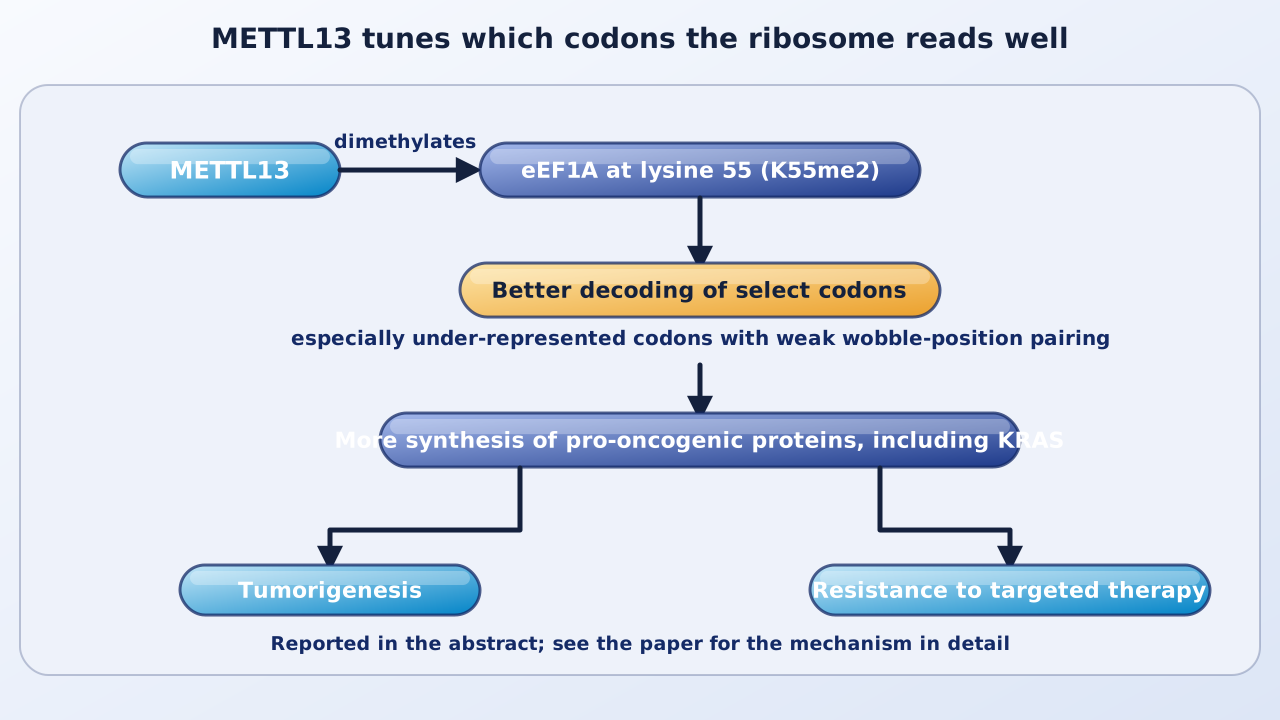
Cancer cells that survive a targeted drug often make more of the proteins that drive their growth. A multi-center team now reports a way this can happen that does not involve a new mutation: a methyl mark on the translation factor eEF1A makes the ribosome read certain codons more efficiently, and KRAS is among the proteins that benefit.
Background
Translation elongation is the stage at which ribosomes add amino acids one codon at a time, using elongation factors such as eEF1A to deliver the right transfer RNA. Different codons are read at different speeds. Whether the elongation machinery itself can change this selectively, and so reshape the set of proteins a cell makes, was not known.
The mechanism
The authors show that the enzyme METTL13 adds two methyl groups to eEF1A at lysine 55 (eEF1A K55me2). Proteomic profiling and single-molecule imaging indicated that this raises decoding efficiency, particularly for under-represented codons whose pairing at the wobble position is weak. The result is preferential synthesis of pro-oncogenic proteins, which the authors link to tumorigenesis and to resistance to targeted therapy.
KRAS and the recoding test
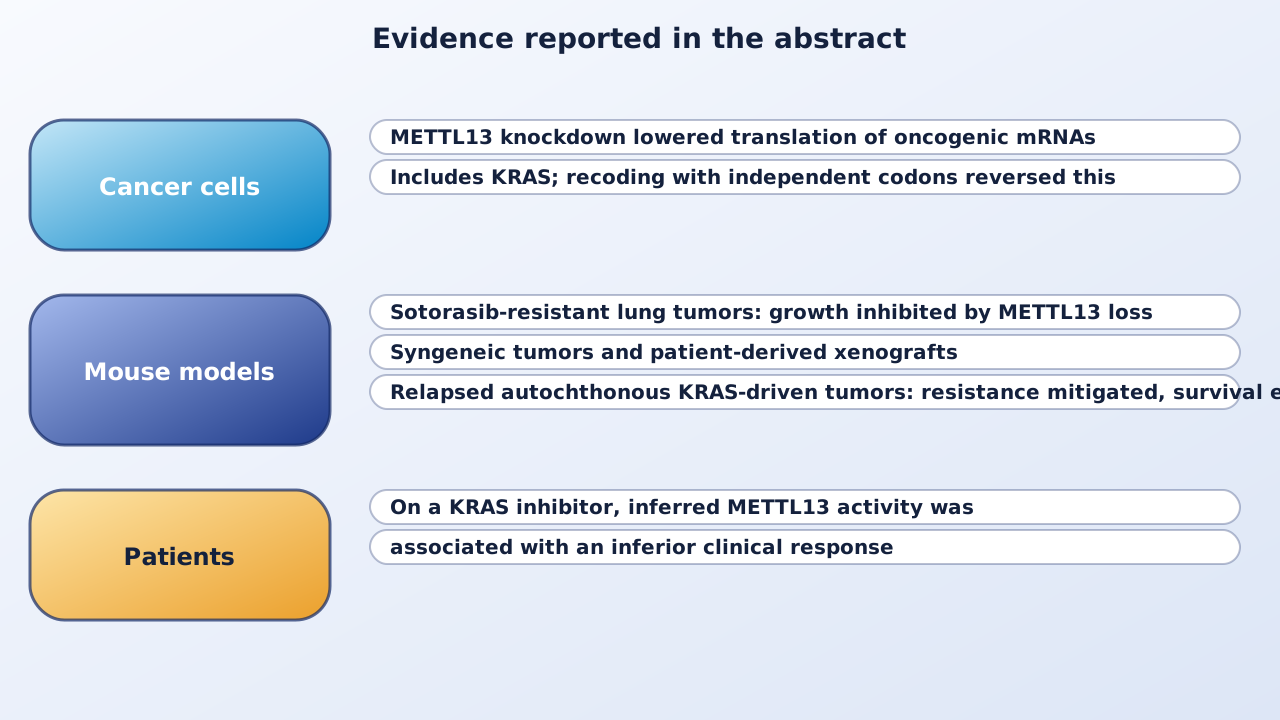
In cancer cells, knocking down METTL13 reduced translation of oncogenic mRNAs rich in the codons that depend on eEF1A K55me2, including KRAS. Recoding the mRNA with synonymous codons that do not depend on eEF1A K55me2 reversed the effect. This recoding experiment indicates that the codon content of the message, and not only the amount of mRNA, sets how well it is translated.
Mouse models and patient data
Loss of METTL13 inhibited the growth of syngeneic lung adenocarcinoma tumors and patient-derived xenografts that were resistant to the KRAS inhibitor sotorasib. In relapsed autochthonous KRAS-driven lung adenocarcinoma in mice, METTL13 ablation mitigated sotorasib resistance and significantly extended survival. Among patients receiving a KRAS inhibitor, inferred METTL13 activity was associated with an inferior clinical response.
Why it matters
Resistance to KRAS inhibitors is a major clinical problem. This work points to the translation machinery as a contributor and suggests METTL13 as a target to counter it. It also adds to the idea that the genetic code is not read uniformly, so that a cell can change its protein output by changing how it decodes.
Keep in mind
The abstract gives no sample sizes, effect sizes, survival times or statistics, so the strength of each finding cannot be judged from it. The patient result is an association based on inferred METTL13 activity, not a measurement of the enzyme in tumors, and it does not show cause. The causal evidence comes from cell and mouse models. No METTL13 inhibitor is described, and nothing here supports a treatment decision for patients.
- Paper
- Liu S, Cruz-Navarrete FA, Hausmann S, et al. Methylated eEF1A selectively decodes mRNA to shape cancer proteomes. Nature Cell Biology. 2026. Published October 29, 2026.
- Type
- Cell, mouse model and patient-data study
- DOI
- 10.1038/s41556-026-02085-6
- PubMed
- PMID 42957783
Related articles
 Daily brief · Oct 22, 2026Cell Lineage, Not Only KRAS Signaling, Decides Whether Lung Tumors Escape KRAS Inhibitors in Mouse Models
 Daily brief · Oct 30, 2026Intron Retention in STAT2 Alters Interferon Signaling and Tracks With Response to Anti-PD-L1 Therapy in Lung Adenocarcinoma
 Daily brief · Oct 20, 2026Programmable Cas13b Silences Cancer-Driving Fusion Transcripts, Including Drug-Resistant BCR::ABL1, in Cell Models

Research focus: Molecular Oncology and Cancer Metabolism
Department of Molecular Diagnostics, Faculty of Biomedical Sciences, University of Benghazi, Libya
Weekly digest
The week's briefs and science news in one email. See the privacy policy.
Comments
No account needed. Comments are reviewed before they appear. Please be respectful and on topic.