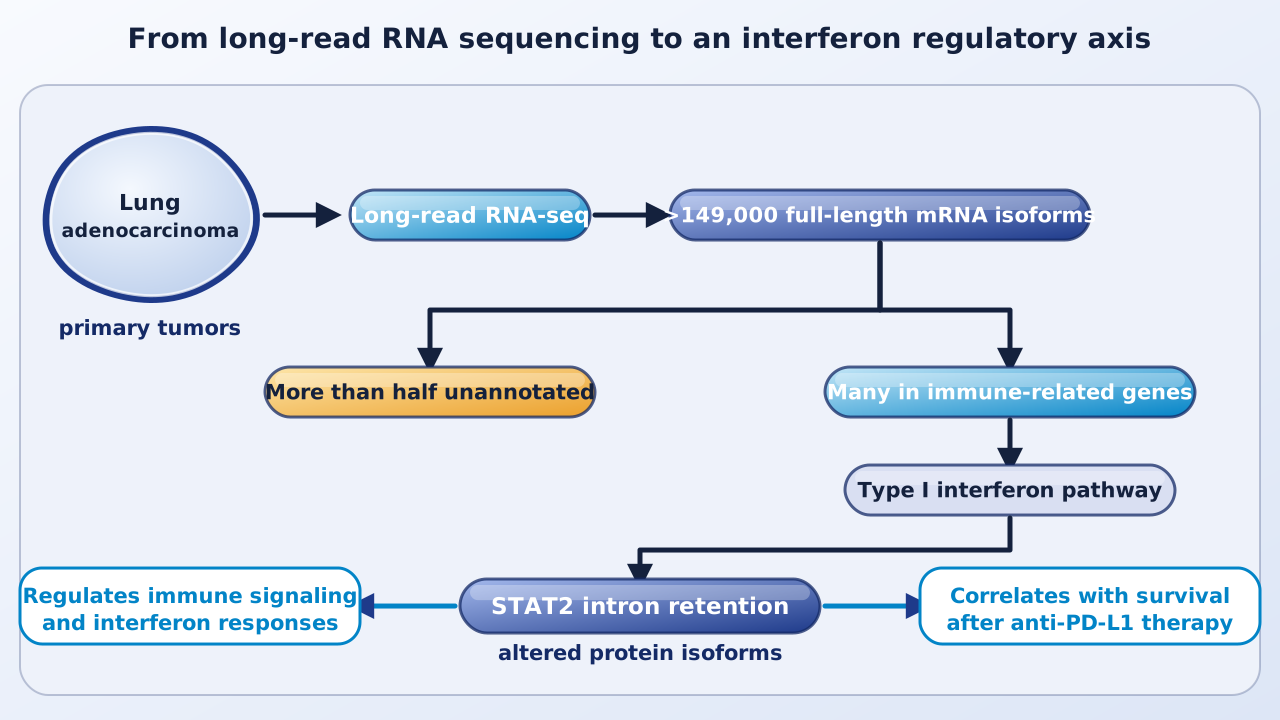
Immune checkpoint inhibitors help many patients with lung cancer, but who benefits is hard to predict. A group at The Jackson Laboratory now reports that a layer of regulation usually missed by standard sequencing, the way pre-mRNA is spliced, tracks with how lung tumors respond to anti-PD-L1 therapy.
Why splicing matters here
Most human genes can be spliced in several ways, so one gene can give several mRNA isoforms and several proteins. Short-read sequencing breaks transcripts into fragments and has trouble reading whole isoforms. Long-read sequencing reads a transcript from end to end. The type I interferon pathway is the antiviral and immune signaling program that also shapes tumor immunity.
What they did
The authors used long-read RNA sequencing to map alternative splicing in human primary lung adenocarcinomas. They then characterized functionally how retained introns in STAT2, a transcription factor in interferon signaling, change the protein and the interferon response, and related the findings to outcomes in patients treated with anti-PD-L1 antibodies.
What they found
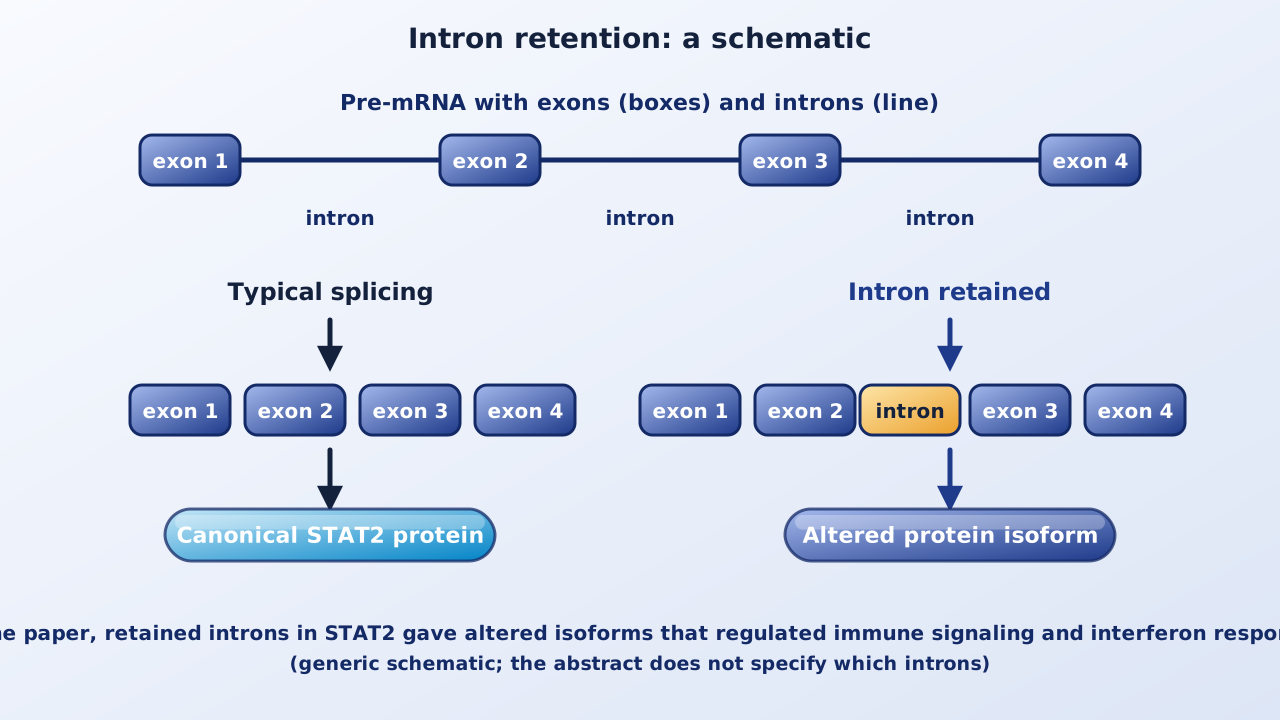
They identified more than 149,000 full-length mRNA isoforms. More than half were not in existing annotations, and many arose in immune-related genes, particularly in the type I interferon response pathway. Retained introns in STAT2 produced altered protein isoforms that regulated immune signaling and interferon responses, and the retention correlated with patient survival after anti-PD-L1 immunotherapy. The authors conclude that intron retention in STAT2 is an interferon regulatory axis that correlates with response to PD-L1 checkpoint inhibitors.
Why it matters
The study adds a splicing-level readout to the search for markers of immunotherapy response and supports the idea that alternative splicing helps set how strongly a tumor and its immune surroundings respond to interferon. It also shows how many isoforms remain uncataloged in tumors, which is a resource for later work.
Keep in mind
The link to survival is a correlation, and the abstract gives no patient numbers, effect sizes or statistics, so how strong or how general it is cannot be judged from it. It does not show that retention of these introns causes response or resistance, and it does not offer a test or a treatment. The results concern lung adenocarcinoma and anti-PD-L1 therapy. Confirmation in independent patient groups would be needed before any clinical use.
- Paper
- Englander RP, Brugiolo M, Devoucoux M, et al. Intron retention regulates STAT2 function and associates with immunotherapy response in lung cancer. Science. 2026;394(6822):eaea7156. Published October 22, 2026.
- Type
- Human tumor long-read transcriptomics with functional experiments
- DOI
- 10.1126/science.aea7156
- PubMed
- PMID 42912151
Related articles
 Daily brief · Oct 29, 2026Perioperative Durvalumab With Enfortumab Vedotin Improves Event-Free Survival in Cisplatin-Ineligible Muscle-Invasive Bladder Cancer: The VOLGA Trial
 Daily brief · Oct 28, 2026Clones Within Single Pancreatic Tumors Differ in MYC Amplification, and MYC Is Linked to a Basal, Immune-Depleted State
 Daily brief · Oct 25, 2026Propionate Blocks a Ubiquitin Ligase and Keeps MHC Class I on Tumor Cells, Boosting Anti-PD-1 Efficacy in Models

Research focus: Molecular Oncology and Cancer Metabolism
Department of Molecular Diagnostics, Faculty of Biomedical Sciences, University of Benghazi, Libya
Weekly digest
The week's briefs and science news in one email. See the privacy policy.
Comments
No account needed. Comments are reviewed before they appear. Please be respectful and on topic.