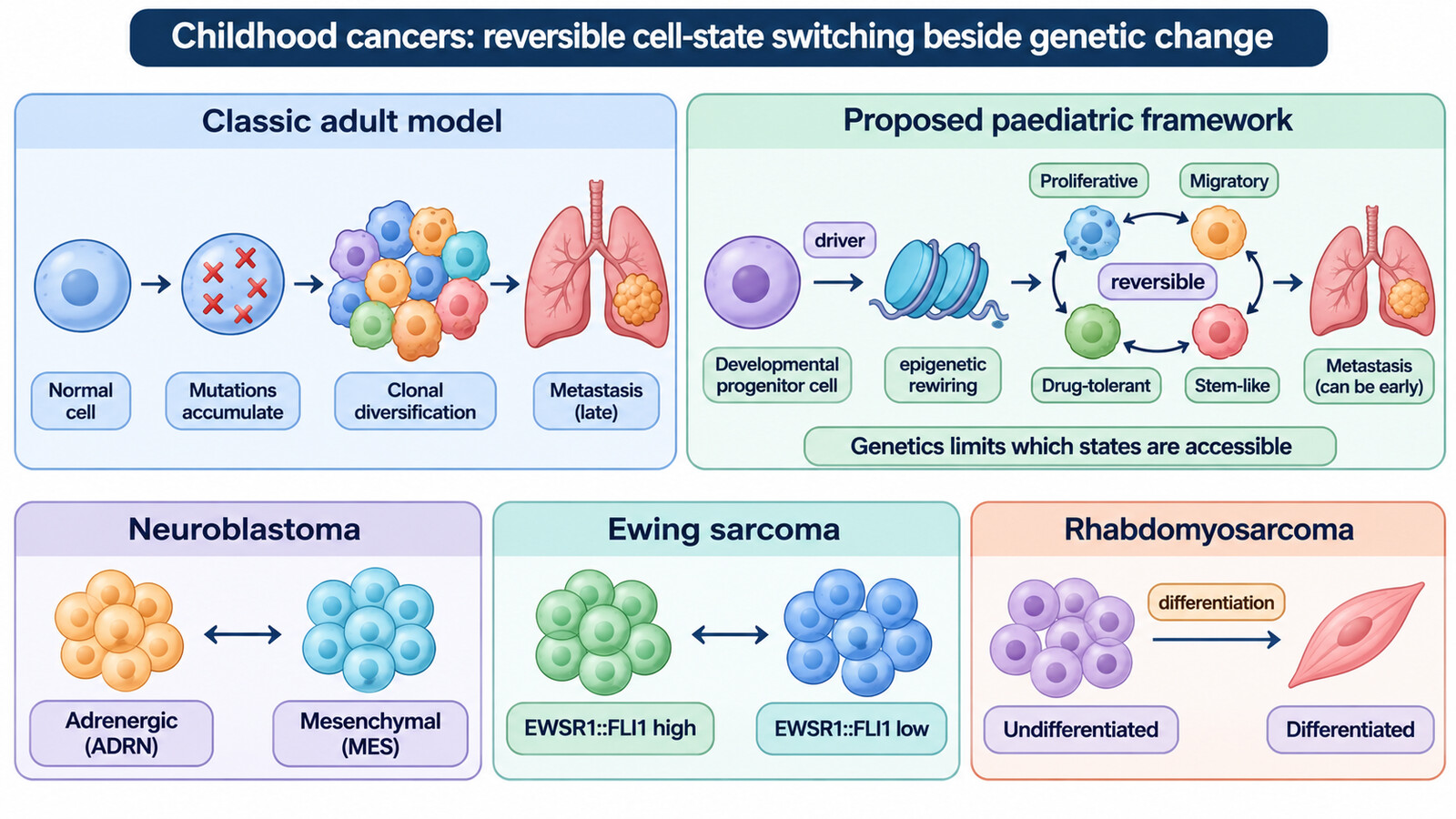
Metastasis is the leading cause of cancer deaths in children, yet childhood tumors usually carry far fewer mutations than adult cancers. A review published this week by Darrell Green (University of East Anglia) and Darren Sexton (Liverpool John Moores University) argues that this is less of a paradox than it looks: cells that arise from developmental programs may already be able to move, resist treatment and seed new sites by switching between reversible states.
| Cancer | State change discussed | Mechanisms named in the review |
|---|---|---|
| Neuroblastoma | Adrenergic to mesenchymal, and back | NOTCH, enhancer rewiring, SWI/SNF remodeling |
| Ewing sarcoma | EWSR1::FLI1 high (proliferative) to low (migratory) | Fusion dosage, YAP/TEAD, HOXD13 |
| Osteosarcoma | Immunometabolic niche adaptation | Extracellular vesicles, macrophages, hypoxia, ferroptosis resistance |
| Medulloblastoma | Progenitor-like, therapy-resistant state | IDH1-linked metabolism, chromatin remodeling |
| Rhabdomyosarcoma | Undifferentiated to differentiated | KDM3A axis, PAX3/PAX7, myogenic differentiation |
What the review is
This is a narrative review in Trends Open, not a new experiment. The authors gather genomic, epigenomic, developmental and single-cell studies across neuroblastoma, Ewing sarcoma, osteosarcoma, medulloblastoma, high-grade glioma, rhabdomyosarcoma, Wilms tumor and leukemia, and propose a framework. It does not report new patient or laboratory data, and it presents its central ideas as hypotheses that need testing.
The proposal
Many childhood tumors have low mutation burdens but still show structural genome changes, so the authors do not call them genetically static. Their proposal is that genetic changes and developmental origin define the landscape of states a tumor can reach, while epigenetic, metabolic and microenvironmental signals move cells between those states. They stress that this complements clonal evolution and does not replace it. They also point to metastasis studies in which genetically distinct subclones from one tumor seeded the same sites, which fits a broadly accessible state better than a single metastasis-specific mutation.
Examples the authors draw on
In neuroblastoma, cells interconvert between an adrenergic and a mesenchymal identity through NOTCH signaling, enhancer rewiring and SWI/SNF chromatin remodeling, and both populations can still form tumors in vivo. In Ewing sarcoma, cells move between a proliferative state with high EWSR1::FLI1 and a migratory state with low EWSR1::FLI1, and work with controlled degradation of the fusion protein suggests that intermediate levels may favor metastasis most. In osteosarcoma, extracellular vesicles and macrophage conditioning help prepare a lung niche. In group 3 medulloblastoma, an IDH1-linked progenitor-like state is linked to resistance that inhibition reversed in the cited work. In rhabdomyosarcoma, a KDM3A axis and high PAX3 and PAX7 activity keep cells undifferentiated, while differentiation is linked to less spread.
How the authors say it could be tested
The central difficulty, they write, is proving causation: seeing several cell states in a tumor does not show that cells move between them, and enrichment of a state in metastases does not show whether it arose during spread or was already present. They call for lineage tracing, barcoding, live imaging, paired genomic and epigenomic profiling and state-specific perturbation. They note that neuroblastoma and Ewing sarcoma come closest to that standard, whereas for many other cancers the evidence is still mostly associative.
What it could mean for treatment
The authors do not propose a drug. They discuss constraining transitions, differentiation therapy such as retinoids in neuroblastoma, epigenetic inhibitors such as histone demethylase inhibition in Ewing sarcoma and rhabdomyosarcoma, and targeting the metabolic and immune dependencies that metastatic states create. They also list risks: blocking one state could select another, epigenetic drugs act broadly, and normal child development shares these programs.
Keep in mind
The university press release says the work shows that childhood cancers do not need extra mutations to spread and that it challenges a long-held assumption. The review itself is more cautious: it says that genetic selection remains important, that cancers differ in how much they depend on plasticity, and that the model's central test is still to be done in patients. Predicting a tumor's next state from its current state is described as the decisive goal, not an achieved one.
- Paper
- Green D, Sexton DW. Developmental plasticity as a framework for paediatric cancer metastasis. Trends Open. 2026. Published online November 9, 2026. Review.
- Type
- Narrative review
- DOI
- 10.1016/j.treopn.2026.10.002
- Funding
- No funding was required for writing this article, according to the authors. The authors declare no competing interests.
Related articles
 Daily brief · Nov 4, 2026In Mice, Hepatocytes Use IRE1α–XBP1s to Hold Down Glutamine and Inflammatory Monocytes, and Losing It Enlarges Liver Metastases
 Daily brief · Oct 22, 2026Cell Lineage, Not Only KRAS Signaling, Decides Whether Lung Tumors Escape KRAS Inhibitors in Mouse Models
 Science news · Oct 24, 2026First Prime Editing Treatment Given Directly in the Body Enters a Wilson Disease Trial

Research focus: Molecular Oncology and Cancer Metabolism
Department of Molecular Diagnostics, Faculty of Biomedical Sciences, University of Benghazi, Libya
Weekly digest
The week's briefs and science news in one email. See the privacy policy.
Comments
No account needed. Comments are reviewed before they appear. Please be respectful and on topic.