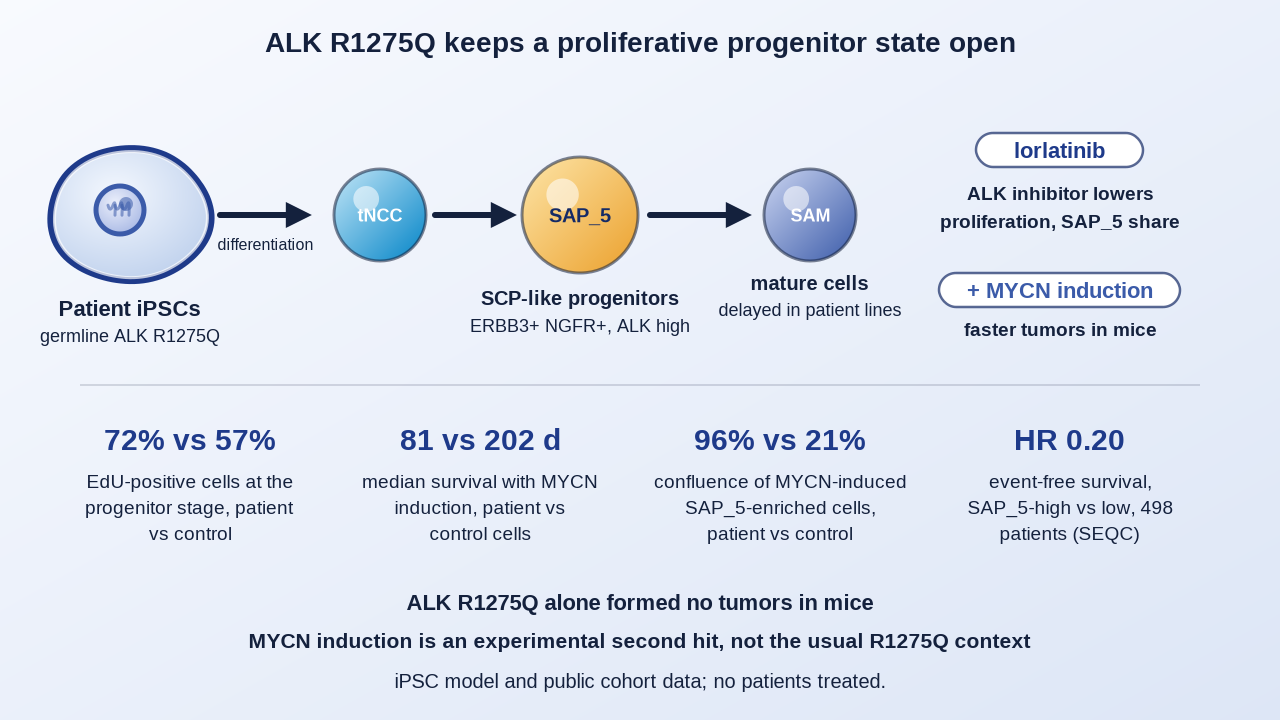
Neuroblastoma is the most common solid tumor outside the brain in children, and inherited ALK variants such as R1275Q raise its risk without always causing it. A Stockholm group now asks what this variant does to developing nerve-lineage cells, using stem cells from patients that carry it.
| Measure | System | Reported result |
|---|---|---|
| EdU-positive cells at day 4 | Patient vs control iPSC lines | 71.65% vs 57.46% (P = 0.0075) |
| Lorlatinib (20 / 30 nM), patient cells at day 4 | EdU-positive cells | 62.82% to 41.56% / 47.38% |
| Median survival after MYCN induction | Mice, patient vs control cells | 81 vs 202 days (P = 0.0018) |
| ERBB3/NGFR double-positive progenitors | Patient vs control | 22.50% vs 19.67% (P = 0.0105) |
| Confluence, MYCN-induced sorted cells (240 h) | Patient vs control double-positive | 95.54% vs 21.00% |
| Event-free survival, SAP_5-high vs low | SEQC cohort, n = 498 | HR 0.20 (95% CI 0.10 to 0.30) |
Background
Neuroblastoma arises from sympathoadrenal (SA) cells derived from the neural crest and accounts for about 15% of pediatric cancer deaths. ALK R1275Q is the most common germline ALK variant, accounting for about 45% of familial and 33% of sporadic neuroblastoma, as the authors cite, and it has incomplete penetrance, with a penetrance near 50% cited for germline ALK mutations. It is usually found in MYCN non-amplified tumors, unlike the stronger F1174L variant. Mouse and xenograft models capture early human development poorly.
A stepwise iPSC model
The authors differentiated iPSCs into trunk neural crest cells, sympathoadrenal progenitors (SAP, day 4) and mature SA cells (SAM, days 8 to 12), confirming identity with SOX10, HOXC9, PHOX2B and PRPH and bulk and single-cell RNA-seq. They compared three healthy-donor lines with iPSCs from three patients carrying germline ALK R1275Q (two from families with neuroblastoma, one de novo). A control single-cell reference (9,062 cells) and an integrated dataset of 30,654 cells were built.
Delayed differentiation and higher proliferation
Patient-derived cells matched controls at the neural crest stage, then diverged after SA commitment. More patient cells stayed in S and G2/M at days 8 and 12, expressed more cell-cycle, E2F, MYC and mTORC1 programs and mapped to earlier control stages. EdU incorporation at day 4 was 71.65% versus 57.46% (P = 0.0075), with no difference at the neural crest stage (about 40%).
ALK signaling persists
ALK and phospho-ALK fell quickly in control cells during differentiation but stayed high in patient cells, with higher phospho-AKT and similar ERK. Lorlatinib at 20 and 30 nM lowered EdU-positive patient cells at day 4 from 62.82% to 41.56% and 47.38%, to the level of controls, which were unaffected.
Permissive, not sufficient
Transplants of neural crest cells from patients or controls into immunodeficient mice, under the skin and orthotopically, formed no tumors. With a doxycycline-inducible MYCN construct, patient-derived cells formed tumors faster: median survival 81 days (NB4) versus 202 days for control cells (P = 0.0018), with tumors in 5 of 5 versus 4 of 5 mice and neuroblastoma-like histology. The authors stress that MYCN is an experimental second hit, not the usual genetic context of R1275Q.
A Schwann cell precursor-like subpopulation
Subclustering of day-4 cells identified SAP_5, enriched in patient cells, proliferative, with the highest ALK activity, and co-expressing SA markers (GATA3, TFAP2B) with Schwann cell precursor genes (ERBB3, NGFR, PLP1, SOX10). Its signature matched precursor populations in two human embryonic adrenal datasets. ERBB3 and NGFR double-positive cells were 22.50% versus 19.67% of patient and control progenitors (P = 0.0105); lorlatinib lowered them to 18.07%, and CRISPR correction of the mutation in the NB1 line lowered them from 23.63% to 15.23% (control 13.70%). After MYCN induction, sorted double-positive patient cells reached 95.54% confluence versus 21.00% for control double-positive cells and about 4% for double-negative cells.
Link to patient data
In the public SEQC cohort of 498 neuroblastomas, a SAP_5-derived score correlated with ALK pathway activity (r = 0.513), was low in MYCN-amplified tumors, and was higher in patients diagnosed younger (mean 473 versus 1,234 days). High scores tracked with better event-free survival (hazard ratio 0.20, 95% CI 0.10 to 0.30), also among MYCN non-amplified tumors.
Keep in mind
These are iPSC-derived cells from three patients and one reference control line for single-cell mapping, plus mouse transplants and a retrospective cohort, so effects on human fetal development and tumor initiation are inferred. The authors do not propose SAP_5 as the cell of origin and call it a transcriptional program, not a discrete cell type. ALK status was not annotated in the cohort, so ALK activity is a proxy. The paper does not test surveillance or treatment of carriers; it suggests that ALK inhibition alone may leave some progenitors and that combinations, for example with ATR inhibitors, may be needed.
- Paper
- Liu M, Polychronopoulos PA, Xia Y, et al. ALKR1275Q expands Schwann cell precursor-like cells during sympathoadrenal commitment, creating a permissive state for neuroblastoma initiation. Nature Communications. 2026;17. Published November 23, 2026.
- Type
- Human iPSC model, mouse transplants and cohort analysis
- DOI
- 10.1038/s41467-026-79380-1
- PubMed
- PMID 43073272
- Funding
- Swedish Childhood Cancer Foundation; Swedish Cancer Society; Swedish Research Council; Radiumhemmets Forskningsfonder; Karolinska Institutet. One author is Chief Scientific Officer of CCRM Nordic; the other authors declare no competing interests.
Related articles
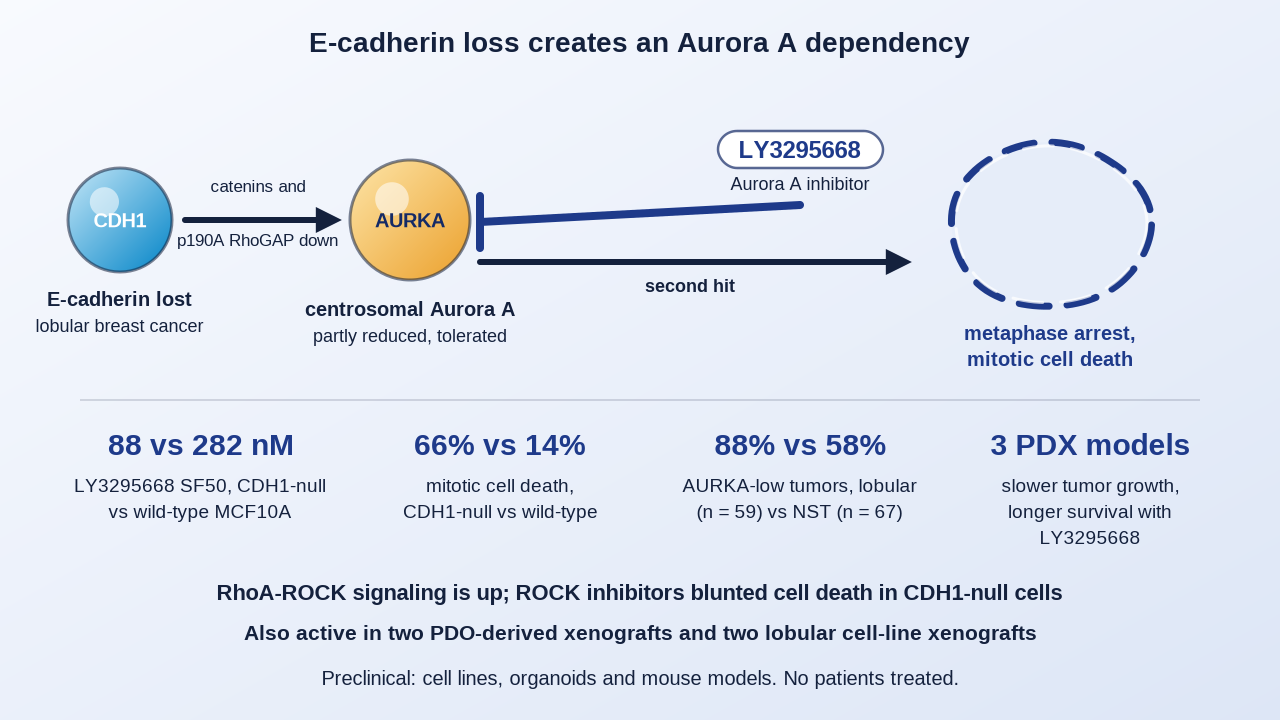 Daily brief · Nov 24, 2026Aurora A Inhibition Is Synthetic Lethal With E-Cadherin Loss in Lobular Breast Cancer Models, Slowing Tumors in Organoid-Derived and Patient-Derived Xenografts
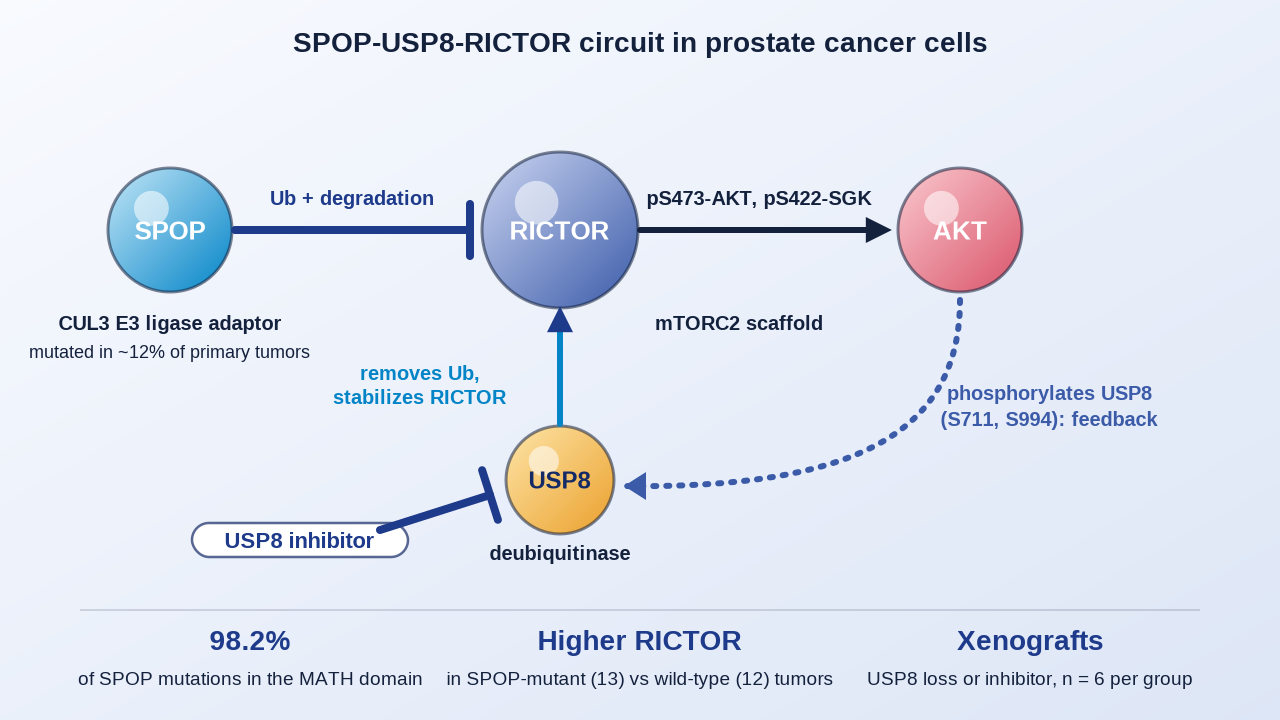 Daily brief · Nov 20, 2026SPOP Degrades RICTOR and USP8 Stabilizes It: Targeting USP8 Lowers mTORC2 Signaling and Slows Prostate Tumor Growth in Xenografts
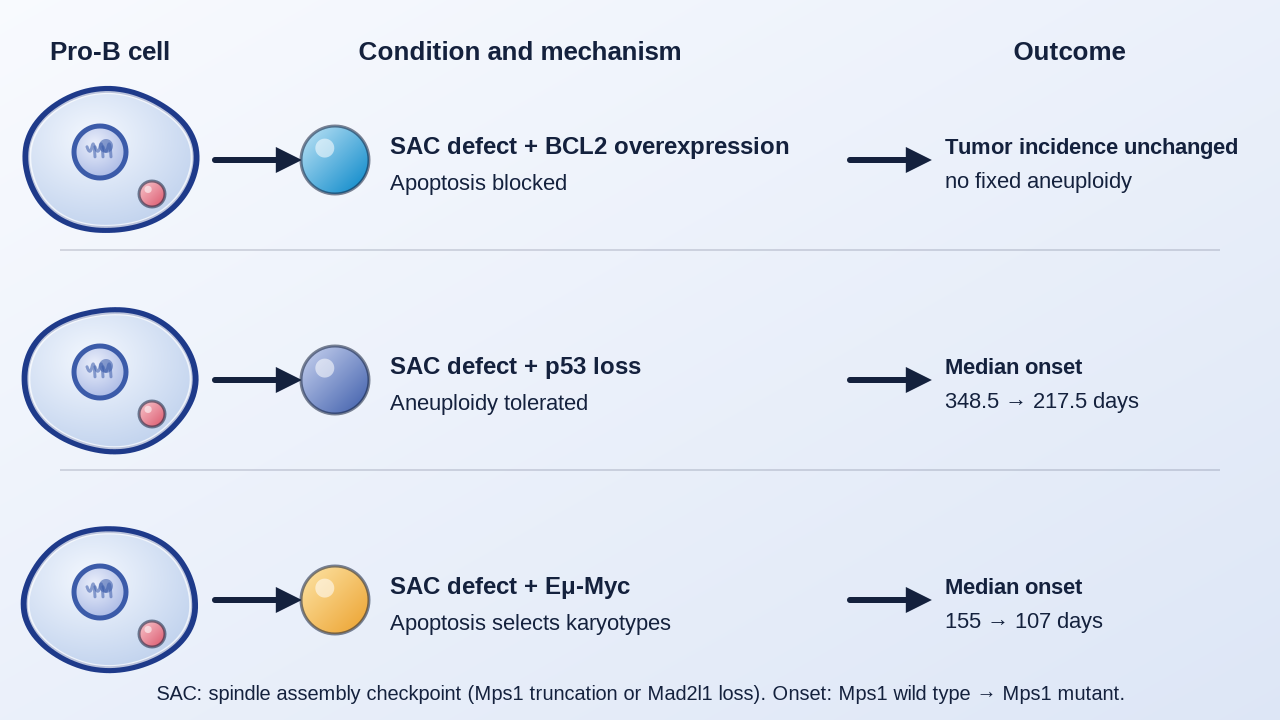 Daily brief · Nov 19, 2026Chromosome Missegregation Kills Developing B Cells but Speeds MYC-Driven Lymphoma in Mice, With Apoptosis Selecting the Surviving Karyotypes

Research focus: Molecular Oncology and Cancer Metabolism
Department of Molecular Diagnostics, Faculty of Biomedical Sciences, University of Benghazi, Libya
Weekly digest
The week's briefs and science news in one email. See the privacy policy.
Comments
No account needed. Comments are reviewed before they appear. Please be respectful and on topic.