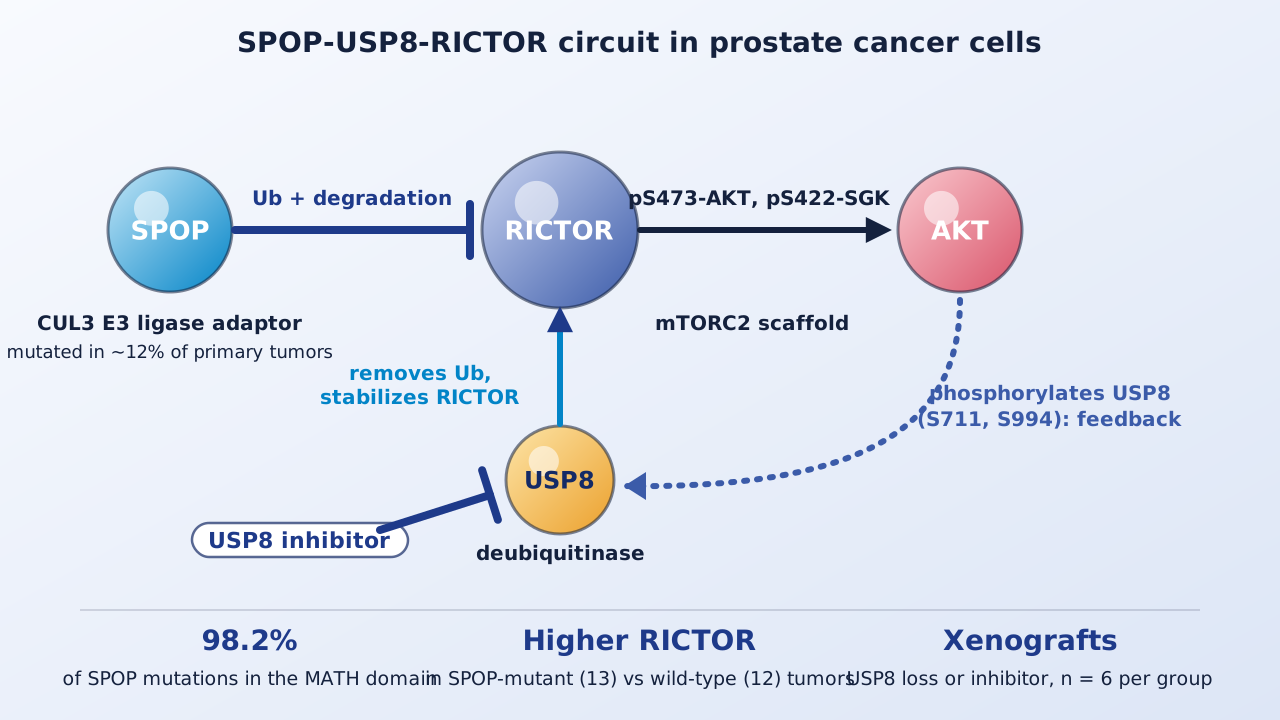
SPOP is one of the most frequently mutated genes in primary prostate cancer, yet the proteins it normally removes are only partly known. A group at Beth Israel Deaconess Medical Center and collaborators now adds RICTOR, the scaffold of the growth-signaling complex mTORC2, to that list, and shows that an enzyme that protects RICTOR from degradation can be targeted.
| Measure | System | Reported result |
|---|---|---|
| SPOP mutation frequency | Primary prostate cancer | About 12% (about 5% in mCRPC, about 10% in mHSPC) |
| SPOP mutations in the MATH domain | cBioPortal prostate adenocarcinoma | 98.2% |
| RICTOR IHC, SPOP-mutant versus wild-type | Patient tumors | Higher in mutant (n = 13 vs n = 12) |
| USP8 and RICTOR IHC | Paired tumor and adjacent tissue | 20 pairs; both higher in tumor |
| Xenograft groups | DU145 cells in mice | n = 6 per group |
| USP8 inhibitor in cell assays | Four prostate cancer lines | Viability reduced; mTORC1 readout unchanged in knockout |
Background
mTORC2 phosphorylates AKT at serine 473 and SGK at serine 422, and RICTOR is overexpressed in many cancers, including prostate cancer. SPOP is the substrate adaptor of the CUL3 ubiquitin ligase and is mutated in about 12% of primary prostate cancers, mostly in the substrate-binding MATH domain. No clinically validated drug acts directly on RICTOR.
SPOP controls RICTOR stability
RICTOR levels rose when the proteasome or cullin ligases were blocked. Screening cullin family members and BTB adaptors showed that RICTOR bound CUL3 and SPOP, but not the other mTOR complex components tested. SPOP promoted RICTOR polyubiquitination and degradation, and SPOP knockout lengthened RICTOR half-life in cycloheximide chase assays. Knocking out SPOP raised RICTOR and increased phosphorylation of AKT S473 and SGK S422 in AR-positive and AR-negative prostate cancer lines regardless of PTEN status.
SPOP loss drives growth through RICTOR
SPOP knockout and RICTOR overexpression each increased cell growth and colony formation and accelerated DU145 xenograft growth (n = 6 mice per group). Deleting RICTOR in SPOP-null cells reversed the in vitro and in vivo effects, which the authors take to mean that SPOP restrains tumors at least in part through RICTOR.
Cancer-derived SPOP mutants fail to bind RICTOR
Of the SPOP mutations in prostate adenocarcinoma cases in cBioPortal, 98.2% lie in the MATH domain. The hotspot mutants Y87C, F102C and W131G did not bind RICTOR, did not promote its ubiquitination or degradation, and, unlike wild-type SPOP, F102C did not suppress colony formation. In patient tissue, RICTOR immunostaining scores were higher in SPOP-mutant tumors (n = 13) than in SPOP wild-type tumors (n = 12). Deleting three SPOP-binding motifs in RICTOR stabilized it even with SPOP present.
USP8 is the deubiquitinase for RICTOR
Among a panel of deubiquitinase inhibitors, only a USP8 inhibitor lowered RICTOR. USP8 knockout lowered RICTOR, pS473-AKT and pS422-SGK but not the mTORC1 readout pT389-S6K. USP8 bound RICTOR, and wild-type USP8, but not the catalytically inactive C786A mutant, deubiquitinated it. The inhibitor lost its effect in SPOP-deficient cells and with the degron-deleted RICTOR, supporting an SPOP-dependent mechanism. AKT phosphorylated USP8 at serine 711 and 994, and the authors propose a positive feedback loop between mTORC2/AKT and USP8.
USP8 inhibition slows tumors in models
USP8 expression was higher in tumors than in adjacent tissue (20 paired specimens) and correlated with RICTOR, and higher USP8 expression tracked with shorter overall survival in database analyses. The USP8 inhibitor reduced viability in DU145, PC3, C4-2 and 22Rv1 cells. In xenografts, USP8 knockout or inhibitor treatment suppressed tumor growth, lowered RICTOR, pAKT and pSGK, and raised cleaved caspase-3, with no added benefit when both were combined, which supports on-target action. Re-expressing degron-deleted RICTOR partly rescued the inhibitor effect. SPOP loss also blunted the response to the AKT inhibitor capivasertib in cells, whereas USP8 depletion enhanced it.
Keep in mind
The work uses cultured cell lines, subcutaneous xenografts in mice and small tissue sets (12 and 13 tumors for RICTOR staining, 20 pairs for USP8). The USP8 inhibitor is a research compound whose selectivity was inferred from knockout comparisons, and no safety or dosing data are given. The survival association is correlative. The paper does not test patients and does not show that USP8 inhibition works in tumors with wild-type SPOP or in castration-resistant disease specifically; the authors present the approach as a rationale.
- Paper
- Wang J, Huang D, Liu B, et al. USP8 inhibition suppresses prostate tumorigenesis via promoting RICTOR degradation to inhibit mTORC2 signaling. Science Advances. 2026;12(47):eaeh0679. Published November 18, 2026.
- Type
- Cell, xenograft and tissue study
- DOI
- 10.1126/sciadv.aeh0679
- PubMed
- PMID 43050551
- Funding
- Beth Israel Deaconess Medical Center retention fund (W.W.) and start-up fund (H.I.). The authors declare no competing interests.
Related articles
 Daily brief · Nov 15, 2026In Enzalutamide-Resistant Prostate Cancer Cells, m6A Marking of ARv7 mRNA Raises Its Translation, Lactate Feeds the Loop, and a METTL3 Inhibitor Plus Enzalutamide Slowed Xenograft Growth
 Daily brief · Nov 2, 2026METTL13 Methylation of eEF1A Tunes Codon Decoding, Boosts KRAS Synthesis and Is Linked to Resistance to a KRAS Inhibitor in Lung Cancer Models
 Daily brief · Oct 22, 2026Cell Lineage, Not Only KRAS Signaling, Decides Whether Lung Tumors Escape KRAS Inhibitors in Mouse Models

Research focus: Molecular Oncology and Cancer Metabolism
Department of Molecular Diagnostics, Faculty of Biomedical Sciences, University of Benghazi, Libya
Weekly digest
The week's briefs and science news in one email. See the privacy policy.
Comments
No account needed. Comments are reviewed before they appear. Please be respectful and on topic.