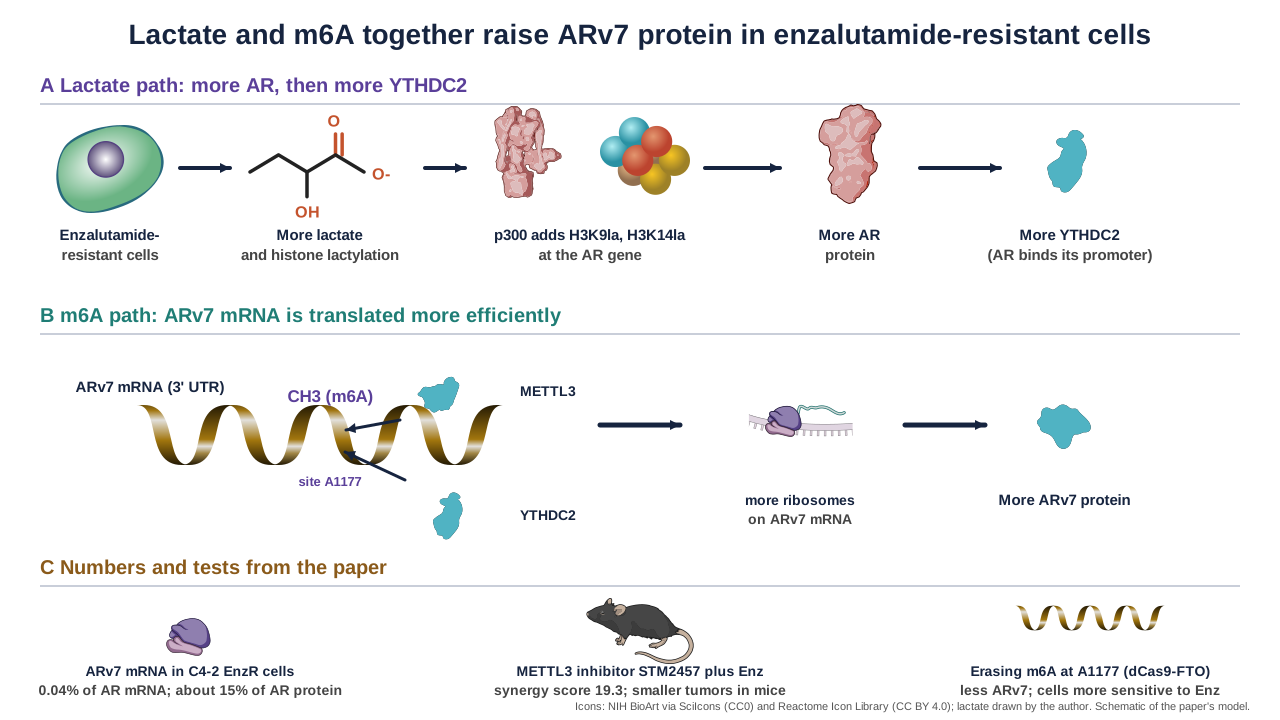
Enzalutamide blocks the androgen receptor (AR) and is widely used in advanced prostate cancer, but most patients eventually stop responding. One known driver of resistance is ARv7, a truncated AR variant that stays active without the hormone. A research group in China now reports that cells resistant to enzalutamide produce far more ARv7 protein than its mRNA level would predict, and that two linked mechanisms explain this: a chemical mark on the RNA and a metabolic signal from lactate.
| Measure | System | Reported result |
|---|---|---|
| ARv7 share of AR | C4-2 enzalutamide-resistant cells | 0.04% of mRNA; about 15% of protein |
| Main m6A site | ARv7 3' UTR (1,354 nucleotides) | A1177, of five predicted sites |
| m6A reader | Individual readers knocked down | Only YTHDC2 loss consistently lowered ARv7 protein |
| AR and YTHDC2 in tumors | Immunostaining of 40 specimens | r = 0.436, P = 0.004 |
| STM2457 plus enzalutamide | C4-2 cells and mouse xenografts | Synergy score 19.3; smaller tumors; no detected toxicity |
The puzzle
ARv7 is a small share of total AR mRNA. In the resistant C4-2 cells the authors measured ARv7 at 0.04% of AR transcripts, and in resistant 22Rv1 cells at 7%, yet ARv7 made up about 15% of AR protein in the C4-2 resistant line. That gap pointed to control at the level of translation. The authors had earlier shown how ARv7 is spliced; this study asks how its mRNA is read by ribosomes.
A methyl mark on ARv7 mRNA
Global m6A, the most common internal RNA modification, was higher in two enzalutamide-resistant lines (C4-2 and 22Rv1) than in their parental cells. ARv7 mRNA carries m6A in its 1,354-nucleotide 3' UTR, much shorter than the 6,778-nucleotide 3' UTR of full-length AR. Of five predicted sites, A1177 was the main one, and knocking down the methyltransferase METTL3 reduced m6A there. METTL3 loss lowered ARv7 protein without changing ARv7 mRNA level or stability, and polysome profiling, ribosomal-protein pull-downs and puromycin labeling all showed reduced translation. A reporter with a mutant A1177 3' UTR was translated less well than the wild-type version.
The reader and the feedback
Among the m6A readers tested, only knockdown of YTHDC2 consistently lowered ARv7 protein in both resistant lines. YTHDC2 bound ARv7 mRNA near A1177 and boosted a reporter with the wild-type but not the mutant 3' UTR. AR itself bound the YTHDC2 promoter and raised YTHDC2 expression, whereas AR knockdown did not change METTL3. In patient datasets (TCGA-PRAD, SU2C and the authors' AHMU cohort), METTL3 and YTHDC2 expression correlated with an ARv7 score. In 40 tumor specimens, AR and YTHDC2 staining correlated (r = 0.436, P = 0.004).
Lactate as the metabolic link
Resistant cells produced more lactate and had more global protein lactylation. Sodium lactate raised AR mRNA and protein, and the AR promoter carried the histone marks H3K9la and H3K14la, which depended on the acetyltransferase p300. Lactate also lowered enzalutamide sensitivity, raised the m6A level of ARv7 mRNA and increased YTHDC2 binding to it. Silencing ARv7 partly reversed the effect. The authors note that lactate production rose early and that this axis seems to sustain resistance rather than start it.
Tests of the pathway
Knocking down METTL3 or YTHDC2 restored enzalutamide sensitivity and cut invasion and proliferation, and re-expressing ARv7 partly rescued these effects. Using CRISPR-dCas9-FTO to erase m6A at A1177 alone lowered ARv7 protein and made cells more sensitive. In mice carrying 22Rv1 enzalutamide-resistant xenografts, METTL3 or YTHDC2 knockdown slowed tumor growth, and ARv7 re-expression reversed this. The METTL3 inhibitor STM2457 (50 mg/kg) with enzalutamide (30 mg/kg) gave a synergy score of 19.3 in C4-2 cells and smaller tumors in mice (6 per group), with stable body weight, normal liver histology and unchanged AST and ALT.
Keep in mind
These are cultured cell lines and nude-mouse xenografts, and patient data are correlations from existing cohorts and a small set of specimens, so the work does not show that the pathway drives resistance in patients. The authors suggest measuring the m6A level of ARv7 as a biomarker, but they did not test that clinically. The link between lactate and AR condensate formation is unexplained, and they say long-term or human toxicity of METTL3 inhibition, which could affect blood, immune and gut tissues, is not excluded. The paper reports no new therapy trial.
- Paper
- Zhang M, Cheng B, Jia M, Li X, Huang Y, Li B, et al. N6-methyladenosine-dependent ARv7 translation couples lactate metabolism with enzalutamide resistance in prostate cancer. Science Advances. 2026;12(45):eaeg8317. Published November 4, 2026.
- Type
- Laboratory study in cell lines and mouse xenografts
- DOI
- 10.1126/sciadv.aeg8317
- PubMed
- PMID 42981394
- Funding
- National Natural Science Foundation of China (grants 82470800 and 82472894), the Sichuan Science and Technology Program (2024NSFSC0749), the Anhui Province Higher Education Science Research Project (2024AH030029) and a Strategic Cooperation Project of Southwest Medical University (2024RSXNYD01). The authors declare no competing interests.
Related articles
 Daily brief · Nov 5, 2026Chemotherapy Raises NAD+ Recycling Through Macrophage IL-1β, and Blocking NAMPT Restores Chemotherapy Response and NK Cell Function in Mouse Tumor Models
 Daily brief · Nov 14, 2026[18F]FET PET Detected Glioblastoma Tissue That Contrast-Enhanced MRI Missed, With a 98.3% Positive Predictive Value Outside the Enhancing Margin, in 472 Histology-Verified Samples
 Daily brief · Nov 11, 2026Higher Blood Levels of Immune Proteins, Including IL15 and FLT3LG, Measured Years Before Diagnosis Were Linked to Lower Prostate Cancer Risk, and Genetics Pointed to PARP1, SPINT2 and NME3

Research focus: Molecular Oncology and Cancer Metabolism
Department of Molecular Diagnostics, Faculty of Biomedical Sciences, University of Benghazi, Libya
Weekly digest
The week's briefs and science news in one email. See the privacy policy.
Comments
No account needed. Comments are reviewed before they appear. Please be respectful and on topic.