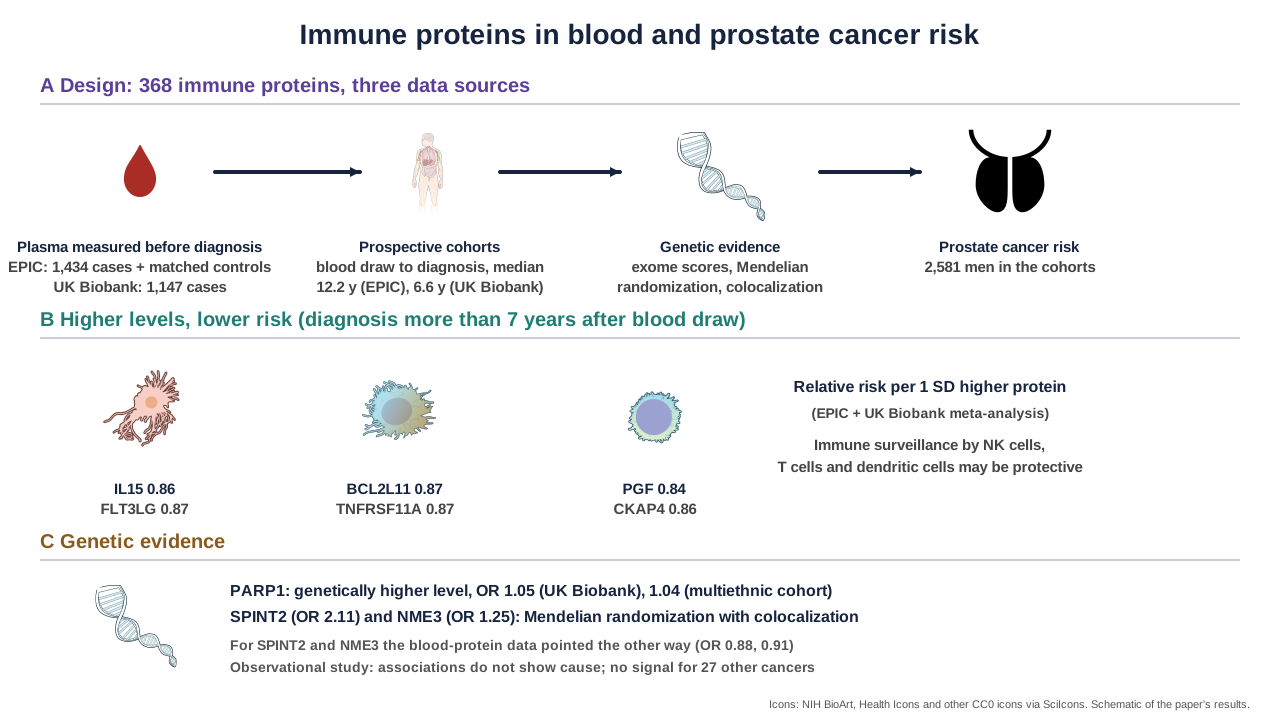
Prostate cancer often grows slowly, and the immune system may check early abnormal cells long before a tumor is found. A team at the University of Oxford and partner centers measured hundreds of immune and inflammation proteins in blood drawn before diagnosis, and combined these data with genetic evidence. Higher levels of several proteins linked to natural killer cells, T cells and dendritic cells were associated with lower risk, and genetics pointed to three other proteins.
| Measure | Data | Reported result |
|---|---|---|
| Proteins measured | Olink Explore Inflammation panel | 368 |
| Cases and controls | EPIC; UK Biobank | 1,434 matched pairs; 1,147 cases among 21,481 men |
| Higher level, lower risk | Diagnosis more than 7 years after blood draw | IL15 0.86, FLT3LG 0.87, BCL2L11 0.87, PGF 0.84, CKAP4 0.86, TNFRSF11A 0.87 |
| Genetically higher PARP1 | UK Biobank; Multiethnic Cohort | Odds ratio 1.05; 1.04 |
| SPINT2 and NME3 | Mendelian randomization with colocalization | Odds ratio 2.11; 1.25 |
What was measured
The authors measured 368 immune and inflammation-related proteins with a proximity extension assay (Olink Explore Inflammation panel). In the European Prospective Investigation into Cancer and Nutrition (EPIC) they studied 1,434 men who later developed prostate cancer and 1,434 matched controls, with a median of 12.2 years between blood draw and diagnosis. In the UK Biobank they studied 21,481 men including 1,147 cases, with a median of 6.6 years. Results were combined by meta-analysis. For genetic evidence they used exome-based protein scores in the UK Biobank (more than 8,500 cases) and in the Multiethnic Cohort, and Mendelian randomization with colocalization using about 80,000 cases from the PRACTICAL consortium.
Proteins linked to lower risk
After correction for multiple testing, higher FLT3LG was associated with lower overall risk (meta-analysis relative risk 0.88 per standard deviation) and higher CNTNAP2 with higher risk (1.10). Signals were stronger when diagnosis came more than seven years after blood collection. In that group six proteins were associated with lower risk: IL15 (0.86), FLT3LG (0.87), BCL2L11 (0.87), PGF (0.84), CKAP4 (0.86) and TNFRSF11A (0.87). After mutual adjustment, IL15, BCL2L11 and FLT3LG remained significant. No protein reached significance for high-grade, advanced or aggressive disease after correction, although IL15 and FLT3LG showed inverse associations with advanced stage at conventional significance.
What the genetics added
Genetically predicted PARP1 level was associated with higher risk in the UK Biobank (odds ratio 1.05 per standard deviation) and in the Multiethnic Cohort (1.04), with concordant direction in four of five ethnic groups. Mendelian randomization with colocalization supported SPINT2 (odds ratio 2.11) and NME3 (1.25) as risk proteins. The blood-protein data for SPINT2 and NME3 pointed the other way (0.88 and 0.91), which the authors say may reflect how the genetic instruments proxy protein levels. None of the seven highlighted proteins showed a clear link to the other cancers examined (up to 27 endpoints).
How the authors read it
They interpret the pattern as support for a protective role of immune surveillance, with IL15, which supports natural killer and CD8 T cells, as the most likely central protein, and FLT3LG, which drives dendritic cell development. Because associations were stronger for blood taken more than seven years before diagnosis, they argue the proteins are not just markers of an existing tumor. They also note that PARP1 inhibitors treat some prostate cancers and suggest that PARP1 may deserve research for prevention, which this study does not test.
Keep in mind
This is an observational and genetic-association study, so it cannot show that raising any protein would prevent cancer. Participants were mostly of European ancestry. Genetic instruments were missing for IL15, FLT3LG and BCL2L11, and for several proteins only a single genetic variant was available, so hidden pleiotropy cannot be excluded. The PARP1 signal was not seen in the blood-protein data, which may reflect limited power. The seven proteins are a small part of the proteome, and the numbers of cases were limited for subtypes and for some other cancers.
- Paper
- Parsaeian M, Chan WC, Atkins JR, Papier K, Breeur M, Desai TA, et al. Prospective and genetic analyses implicate lower immunosurveillance in the aetiology of prostate cancer. Nature Communications. 2026;17(1). Published November 10, 2026.
- Type
- Prospective cohort and genetic-association study
- DOI
- 10.1038/s41467-026-77378-3
- PubMed
- PMID 43009480
- Funding
- Cancer Research UK (C8221/A29017, C8221/A29186 and a studentship, C8221/A30904), the Wellcome Our Planet Our Health programme (205212/Z/16/Z) and IDIBELL through the Generalitat de Catalunya CERCA Programme, for named authors; the funders had no role in the study. The authors declare no potential conflicts of interest.
Related articles
 Daily brief · Nov 15, 2026In Enzalutamide-Resistant Prostate Cancer Cells, m6A Marking of ARv7 mRNA Raises Its Translation, Lactate Feeds the Loop, and a METTL3 Inhibitor Plus Enzalutamide Slowed Xenograft Growth
 Daily brief · Nov 14, 2026[18F]FET PET Detected Glioblastoma Tissue That Contrast-Enhanced MRI Missed, With a 98.3% Positive Predictive Value Outside the Enhancing Margin, in 472 Histology-Verified Samples
 Daily brief · Oct 30, 2026Intron Retention in STAT2 Alters Interferon Signaling and Tracks With Response to Anti-PD-L1 Therapy in Lung Adenocarcinoma

Research focus: Molecular Oncology and Cancer Metabolism
Department of Molecular Diagnostics, Faculty of Biomedical Sciences, University of Benghazi, Libya
Weekly digest
The week's briefs and science news in one email. See the privacy policy.
Comments
No account needed. Comments are reviewed before they appear. Please be respectful and on topic.