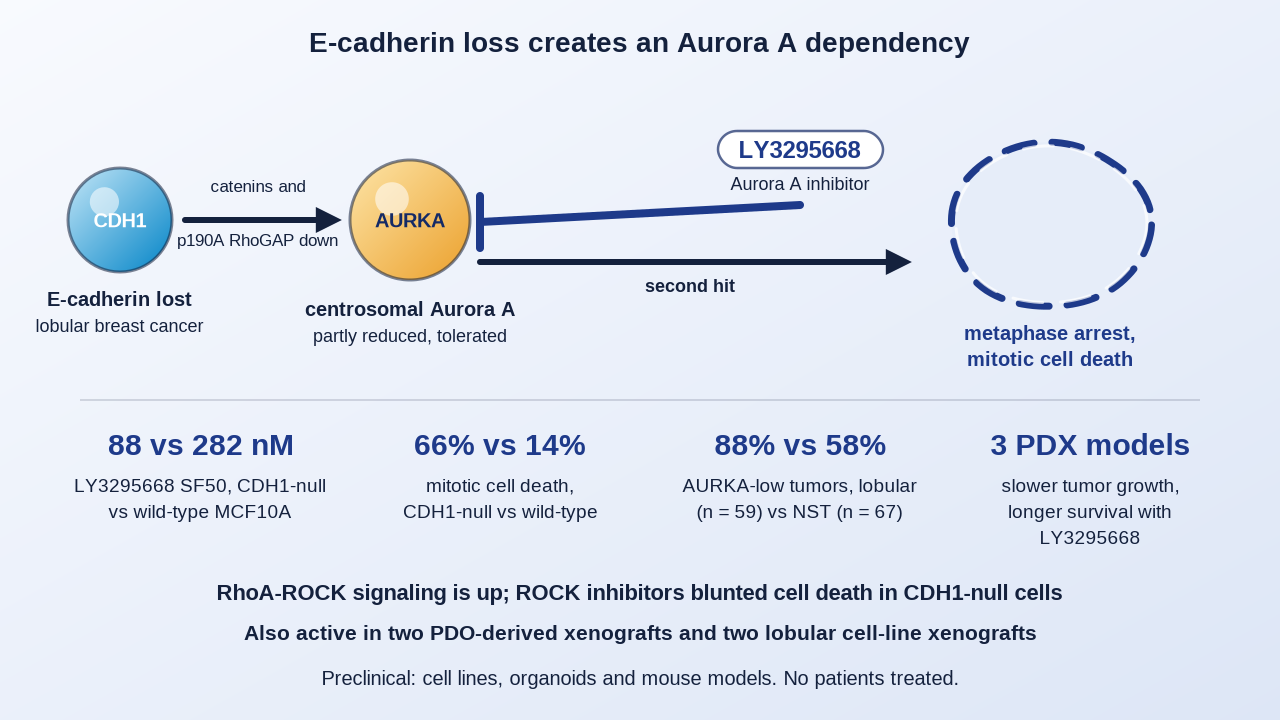
Invasive lobular carcinoma, the second most common form of breast cancer, is defined by loss of the adhesion protein E-cadherin, and metastatic disease has few targeted options. A London group now reports that this loss makes cells dependent on the kinase Aurora A, which suggests a way to select patients for an existing class of drugs.
| Measure | System | Reported result |
|---|---|---|
| LY3295668 SF50, CDH1 knockout vs wild type | MCF10A / T47D | 88 vs 282 nM / 90 vs 331 nM |
| Mitotic cell death after drug | MCF10A knockout vs wild type | 66% vs 14% |
| SF50 in lobular lines with CDH1 mutations | MDA-MB-134VI / SUM44PE | 55 nM / 71 nM |
| Therapeutic ratio vs crizotinib | MCF10A isogenic screen | −1.66 vs −0.52 log2 FC |
| PDX survival model, oral LY3295668 | Mammary fat pad, n = 10 per group | Slower growth, longer survival |
| Aurora A-low tumors, ILC vs NST | Tissue microarrays, n = 59 vs 67 | 88% vs 58%; OR 5.3, P < 0.001 |
Background
Invasive lobular carcinoma (ILC) accounts for about 15% of breast cancers, and loss-of-function CDH1 mutations are present in 50% to 63% of cases. Metastatic ILC (mILC) often spreads to unusual sites, including the meninges, responds poorly to chemotherapy and has a worse outcome than metastatic invasive breast cancer of no special type (NST). Synthetic lethal screens had nominated the kinase ROS1, but ROS1 inhibitors have not helped patients so far.
A screen points to Aurora kinases
The authors analyzed the PRISM Repurposing screen (1,522 compounds, 859 tumor cell lines), restricting the analysis to eight cancer types in which CDH1 expression is bimodal, which left 326 classified lines. Several Aurora kinase inhibitors preferentially inhibited CDH1-low lines. A new screen of 382 oncology compounds in isogenic CDH1 wild-type and CRISPR-knockout MCF10A and MCF7 cells confirmed it. The Aurora A inhibitor LY3295668, which is more than 1,000-fold selective over Aurora B, gave the largest effect: a therapeutic ratio of −1.66 log2 fold change versus −0.52 for crizotinib.
Cell death in mitosis
The surviving-fraction 50 (SF50) of LY3295668 was about 282 nM in MCF10A wild-type and 88 nM in CDH1 knockout cells, and 331 nM versus 90 nM in T47D cells. Two lobular lines carrying CDH1 mutations were more sensitive still (55 nM and 71 nM). In time-lapse imaging, drug-treated knockout cells showed metaphase arrest with failed chromosome congression and died in mitosis in 66% of cases (12% mitotic slippage), against 14% death and 20% slippage in wild-type cells. Caspase-3/7 activity rose accordingly. Crizotinib caused a different defect, abnormal cytokinesis.
A partial centrosomal Aurora A defect
Proteomics showed that knockout cells had less Aurora A and less of its activators and centrosome components (AJUBA, TPX2, pericentrin, CEP135), as well as lower alpha-, beta- and p120-catenin and p190A/B RhoGAP. Centrosomal Aurora A, phospho-Aurora A (T288), pericentrin, γ-tubulin and CEP192 were reduced in knockout and in two lobular lines. Constitutive Src activity, created by deleting CSK, restored centrosomal Aurora A and reduced drug sensitivity, and the Src inhibitor PP2 re-sensitized the cells (ZIP synergy score +20.0). Silencing p190A in wild-type cells lowered centrosomal Aurora A and increased sensitivity.
RhoA-ROCK signaling in the response
Knockout cells had higher RhoA and ROCK2. The ROCK inhibitors GSK269962 and netarsudil and the myosin II inhibitor blebbistatin antagonized LY3295668 in knockout and lobular cells and reduced caspase activation, whereas in wild-type cells the combinations were generally synergistic. The authors conclude that ROCK-driven contractility helps execute mitotic death, and that a ROCK plus Aurora A inhibitor combination would not be advantageous in mILC.
Activity in patient-derived models
In a PDX from the pleural effusion of a heavily pretreated patient (n = 10 per group), oral LY3295668 slowed tumor growth and extended survival (day-98 endpoint). Organoids from five women with metastatic lobular or lobular-like cancer, including leptomeningeal disease, were as sensitive as lobular cell lines and more sensitive than to crizotinib or standard therapies. Two PDX models derived from those organoids, one with a CTNNA1 mutation and wild-type CDH1, showed delayed growth and longer survival without appreciable weight loss at 50 mg/kg daily. Intraductal xenografts of two lobular lines also responded, and one reduced metastatic burden across organs.
Low Aurora A is common in lobular tumors
In tissue microarrays, 88% of 59 primary ILCs were Aurora A low at the 10% positivity threshold used in the phase 2 TBCRC041 trial of alisertib, against 58% of 67 NST tumors (odds ratio 5.3, P < 0.001). In that trial, patients with low Aurora A benefited more, which the authors say fits their mechanism and runs against the idea that high Aurora A predicts sensitivity.
Keep in mind
The evidence is preclinical: few lobular cell lines exist, mice were immunodeficient, and the arrays were from untreated primary tumors without outcome data, so whether E-cadherin loss or low Aurora A predicts benefit needs prospective trials. The catenin-Rho-ROCK mechanism is partial, and Src and other routes may contribute. The authors propose trials selecting mILC by E-cadherin loss; no patient was treated here, and the safety and dosing of LY3295668 in people were not assessed.
- Paper
- Yang WW, Brough R, Song F, et al. E-cadherin/Aurora A kinase inhibitor synthetic lethality in breast cancer. Cell Reports. 2026;45(12):118366. Published November 21, 2026.
- Type
- Cell, organoid and mouse xenograft study
- DOI
- 10.1016/j.celrep.2026.118366
- PubMed
- PMID 43066934
- Funding
- Breast Cancer Now Program Grant (Toby Robins Breast Cancer Research Centre); NIHR Biomedical Research Centre at The Royal Marsden and the Institute of Cancer Research. The senior author discloses industry funding, consulting, stock and a patent rewards scheme related to DNA repair inhibitors; other authors declare none.
Related articles
 Daily brief · Nov 20, 2026SPOP Degrades RICTOR and USP8 Stabilizes It: Targeting USP8 Lowers mTORC2 Signaling and Slows Prostate Tumor Growth in Xenografts
 Daily brief · Nov 16, 2026A TROP2-Binding DNA Aptamer Linked to the Toxin MMAE Slowed Pancreatic Cancer Growth in Mouse Models and Added Benefit to PD-1 Blockade
 Daily brief · Nov 2, 2026METTL13 Methylation of eEF1A Tunes Codon Decoding, Boosts KRAS Synthesis and Is Linked to Resistance to a KRAS Inhibitor in Lung Cancer Models

Research focus: Molecular Oncology and Cancer Metabolism
Department of Molecular Diagnostics, Faculty of Biomedical Sciences, University of Benghazi, Libya
Weekly digest
The week's briefs and science news in one email. See the privacy policy.
Comments
No account needed. Comments are reviewed before they appear. Please be respectful and on topic.