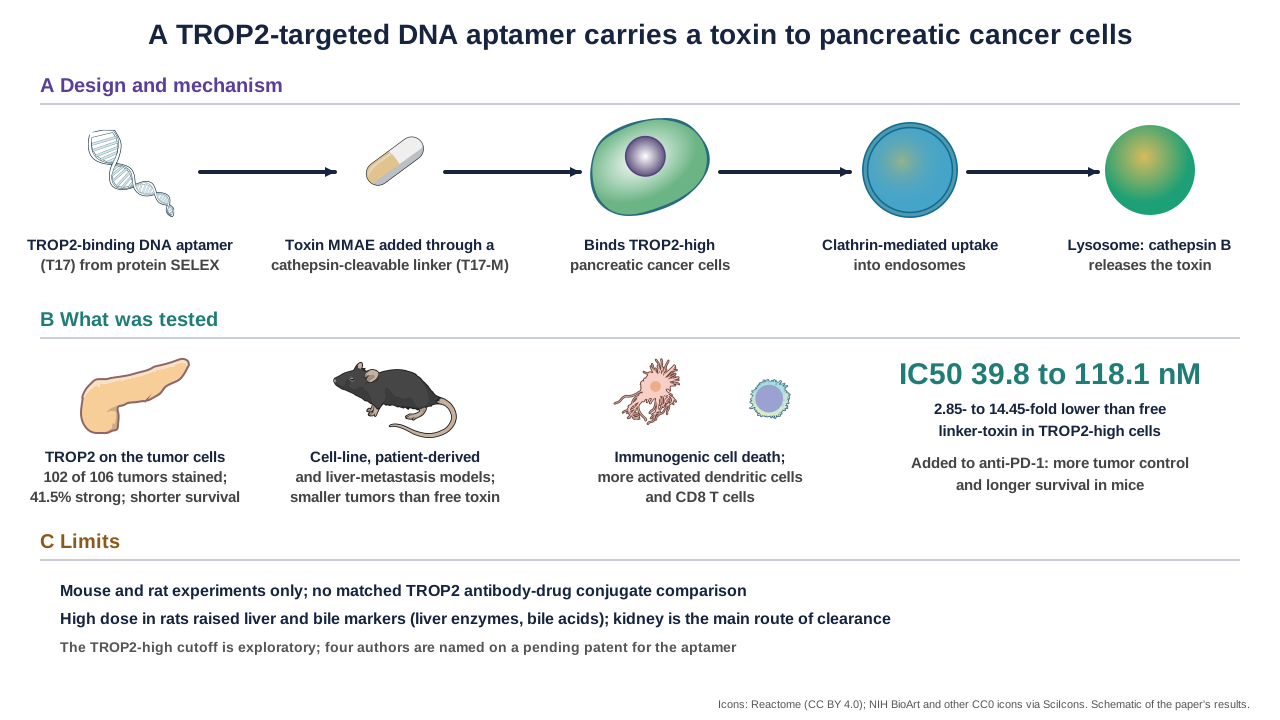
Pancreatic ductal adenocarcinoma (PDAC) has a 5-year survival of about 12%, and no drug that delivers a toxin through a cell-surface protein has been approved for it. Researchers in Shanghai and Hangzhou now describe a different kind of carrier: a short DNA aptamer that binds TROP2, a surface protein common on pancreatic cancer cells, linked to the toxin monomethyl auristatin E (MMAE). In cells and mouse models it killed TROP2-high cells and slowed tumors, and it also activated the immune system.
| Measure | System | Reported result |
|---|---|---|
| TROP2 staining | 106 PDAC tumors (Renji Hospital) | 102 positive (96.2%); 44 strong (41.5%); strong staining linked to shorter survival |
| Aptamer affinity (Kd) | TROP2-17 vs TROP2-1 | About 111 nM vs about 304 nM |
| Potency of T17-M | BxPC-3 and Capan-2 cells | IC50 39.8 to 118.1 nM; 2.85- to 14.45-fold lower than free linker-toxin |
| Uptake and release | Cells with lysosome staining | Clathrin-mediated; cathepsin B cleavage at pH 5.0 |
| Safety signal | Rats, 1,250 nmol/kg every 4 days, four doses | Raised liver enzymes and bile acids; no visible tissue damage |
Why TROP2
TROP2, encoded by TACSTD2, is raised in PDAC, and high TACSTD2 expression was linked to shorter progression-free interval and overall survival in the TCGA cohort. In a Renji Hospital cohort of 106 tumors, 102 (96.2%) stained for TROP2, 44 (41.5%) strongly, and strong staining was linked to shorter overall survival. The authors note that an antibody-drug conjugate to TROP2, sacituzumab govitecan, helped in breast cancer but gave no objective responses in 16 heavily pretreated PDAC patients in an earlier trial, and suggest that smaller carriers might penetrate the dense tumor stroma better.
Selecting and building the conjugate
Using protein SELEX against the TROP2 extracellular domain, they chose two aptamers after eight rounds. TROP2-17 (T17) bound more tightly (dissociation constant about 111 nM, against about 304 nM for TROP2-1), bound TROP2-high BxPC-3 and Capan-2 cells but little to a nonmalignant ductal line, lost binding when TROP2 was knocked down, and accumulated better in xenografts. They coupled T17 to MMAE through an MC-Val-Cit-PAB linker, called T17-M. Of three toxins compared, MMAE gave the best overall profile.
How it works in cells
T17-M had IC50 values of about 39.8 to 54.0 nM in BxPC-3 and 72.1 to 118.1 nM in Capan-2 cells, 2.85- to 14.45-fold lower than the free linker-toxin, and the advantage shrank in cell lines with less TROP2. It entered cells by clathrin-mediated endocytosis (blocked by dynasore, not by other uptake inhibitors) and into lysosomes, where cathepsin B cleaved the linker at pH 5.0 but not at pH 7.0. It also entered two patient-derived organoid lines.
Tests in animals
At 250 nmol/kg, T17-M slowed tumor growth more than the vehicle, the aptamer alone or the free linker-toxin in two cell-line xenograft models, reduced liver metastases in a splenic-injection model, and shrank patient-derived xenografts. In rats the free toxin was only about 3.8% of total MMAE exposure in plasma, and imaging in mice showed the kidney as the main clearance organ. At four times the therapeutic dose, mice showed no differences in blood counts or organ histology, but in rats the highest dose (1,250 nmol/kg every 4 days for four doses) raised liver enzymes and bile acids without visible tissue damage, which the authors call a possible hepatobiliary signal.
Immune effects and PD-1
In cells T17-M caused calreticulin exposure, ATP release and HMGB1 secretion, signs of immunogenic cell death. In an immunocompetent KPC-derived orthotopic model it cut tumor weight, raised plasma IFN-gamma and TNF-alpha, increased activated dendritic cells and the CD8 to regulatory T cell ratio, and also increased exhausted PD-1 and TIM-3 positive CD8 cells. Combined with anti-PD-1 it gave the greatest reduction in tumor weight and longer survival than either alone (6 mice per group). Depleting CD8 T cells weakened the effect but did not remove it.
Keep in mind
All results are from cell lines, organoids, mice and rats. The authors state that no matched TROP2 antibody-drug conjugate was tested, that the cutoff for TROP2-high disease is exploratory, that the orthotopic model is not a full genetic model, and that longer toxicology studies are needed. Four of the authors are named on a pending patent application for the aptamer. The study offers a proof of concept for further development, not evidence of benefit in patients.
- Paper
- Liu Y, Luo Z, Gao Y, Pan T, Yang C, Zhang Z, et al. A TROP2-targeting aptamer enables selective drug delivery and potent antitumor activity in pancreatic cancer. Science Advances. 2026;12(46):eaee3585. Published November 11, 2026.
- Type
- Preclinical study in cells, organoids and animals
- DOI
- 10.1126/sciadv.aee3585
- PubMed
- PMID 43013672
- Funding
- Strategic Priority Research Program of the Chinese Academy of Sciences (XDB1020000), the National Key Research and Development Program of China (2023YFC3405100) and the Innovation Research Team of High-Level Local Universities in Shanghai. Z.L., Z.Z., Y.S. and W.T. are named inventors on a pending Chinese patent application for the TROP2 aptamer (Hangzhou Institute of Medicine, Chinese Academy of Sciences); the other authors declare no competing interests.
Related articles
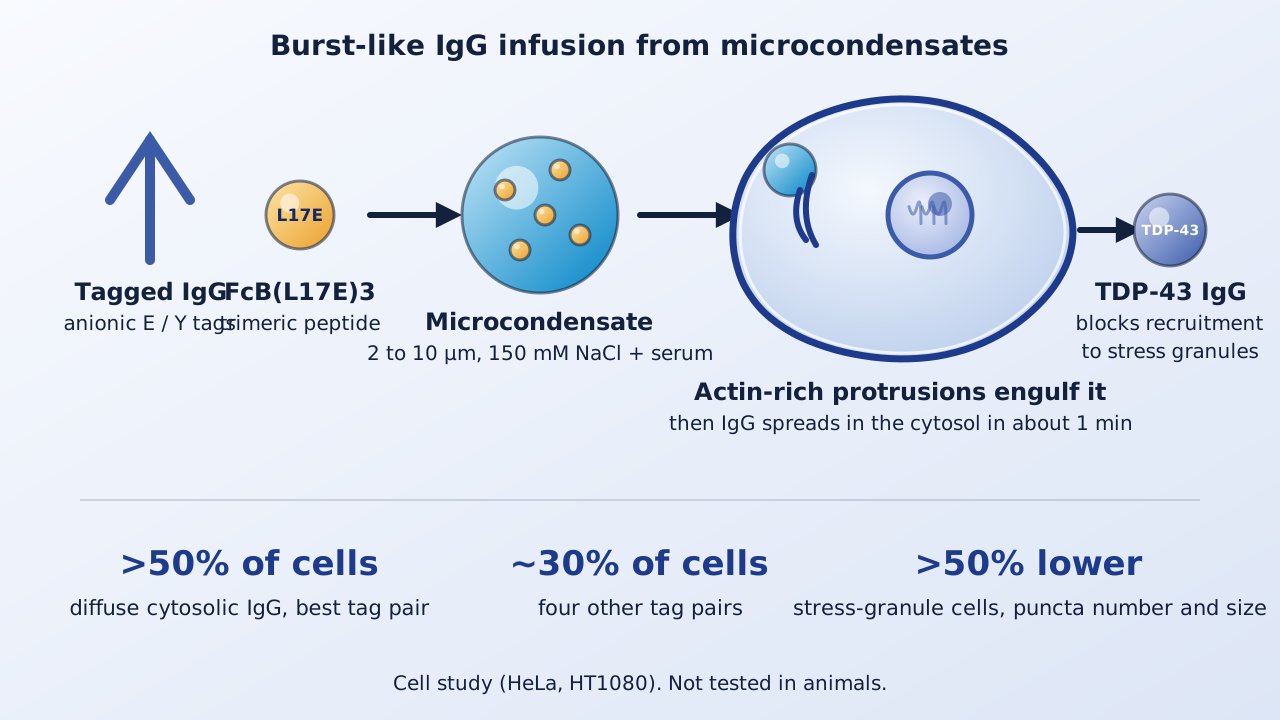 Daily brief · Nov 18, 2026Charged IgG and a Membrane-Permeabilizing Peptide Form Microcondensates That Infuse Antibodies Into Cells and Block TDP-43 Recruitment to Stress Granules
 Daily brief · Nov 6, 2026Sitagliptin, a Diabetes Drug, Lowers RRM1 and RRM2 and Restores Gemcitabine Response in Models; a 22-Patient Phase 2 Trial in Pancreatic Cancer Reports a 36.4% Response Rate
 Daily brief · Nov 2, 2026METTL13 Methylation of eEF1A Tunes Codon Decoding, Boosts KRAS Synthesis and Is Linked to Resistance to a KRAS Inhibitor in Lung Cancer Models

Research focus: Molecular Oncology and Cancer Metabolism
Department of Molecular Diagnostics, Faculty of Biomedical Sciences, University of Benghazi, Libya
Weekly digest
The week's briefs and science news in one email. See the privacy policy.
Comments
No account needed. Comments are reviewed before they appear. Please be respectful and on topic.