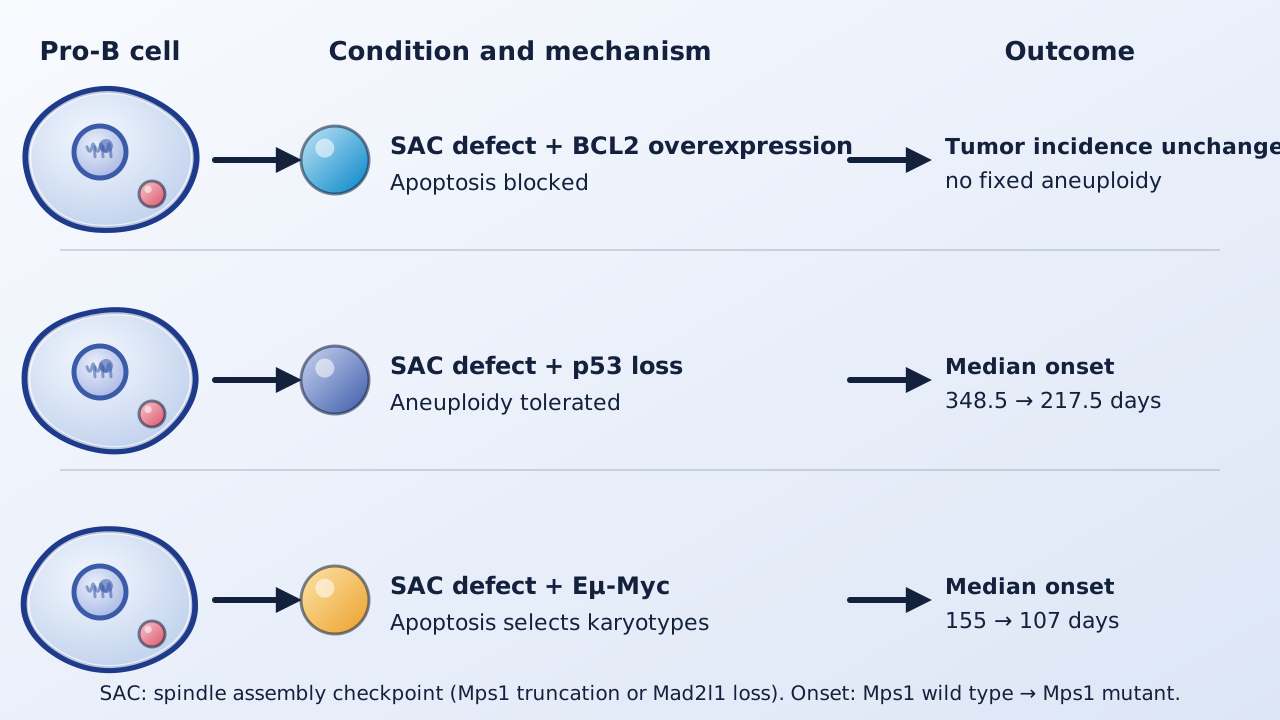
Most tumors carry an abnormal number of chromosomes, yet cells that missegregate chromosomes usually die. A team at the Medical University of Innsbruck now asks which death pathway removes such cells in developing B lymphocytes, and what happens when that pathway, or p53, or the oncogene MYC, is altered.
| Model (mouse) | Group | Median onset or finding |
|---|---|---|
| Mb1-Cre, p53 f/f | Mps1 w/w, n = 14 | 348.5 days |
| Mb1-Cre, p53 f/f | Mps1 w/f, n = 8 | 267 days |
| Mb1-Cre, p53 f/f | Mps1 f/f | 217.5 days (HR 0.33 vs w/w, P = 0.0074) |
| Eμ-Myc, Mb1-Cre | Mps1 w/w, n = 16 | 155 days |
| Eμ-Myc, Mb1-Cre | Mps1 w/f, n = 23 | 160 days |
| Eμ-Myc, Mb1-Cre | Mps1 f/f, n = 27 | 107 days (HR 0.52 vs w/w, P = 0.042) |
| CRISPR screen, Ba/F3 + Reversine | Candidate genes | 41 genes; Tp53 6 of 6 guides |
Background
The spindle assembly checkpoint (SAC) delays anaphase until every chromosome is attached to the spindle. When it fails, cells missegregate chromosomes, a state called chromosomal instability (CIN) that produces aneuploidy. Inhibitors of the SAC kinase MPS1 are in phase 1 and 2 trials with mixed results. Whether blocking cell death lets aneuploid cells expand and transform, and whether B cells behave like other lineages, was unclear.
SAC loss depletes B cells
The authors used two mouse models with Cre recombinase driven from the pro-B cell stage (Mb1-Cre): deletion of Mad2l1 (complete SAC loss) or a truncated, hypomorphic Mps1 (delayed mitosis and CIN). B cells were reduced in both. Mad2l1-deleted mice lacked mature B cells, and development stalled at the pro-B stage, inverting the pro-B to pre-B ratio. Mps1-mutant mice kept a few mature B cells, which proliferated poorly and trended toward lower serum IgG, with normal IgM.
A CRISPR screen points to mitochondrial apoptosis
In a genome-wide screen in mouse Ba/F3 pro-B cells treated with the MPS1 inhibitor Reversine, 41 genes met the criteria. Tp53 was a top hit (6 of 6 guides), along with Puma (Bbc3), Bim (Bcl2l11), Apaf1, caspase-9, Pten and Foxo3, and mTOR pathway genes. The mTOR hits were explained by slowed cycling: Torin 1 reduced the fraction of cells in G2-M and in mitosis, so fewer cells entered the mitosis that Reversine disrupts. Cell death was reduced by BCL2 overexpression, by Bax and Bak double knockout, and by the pan-caspase inhibitor qVD-oph. In the human B-ALL line NALM6, knockout of BAX and BAK, BIM, PUMA, caspase-9, caspases-3, -6 and -7, or P53 rescued Reversine-induced death.
BCL2 outperforms p53 loss in vivo
In Mps1-mutant mice, BCL2 overexpression (Eμ-BCL2) partly restored B cell numbers and lowered cell death. Loss of p53 gave a smaller rescue, and loss of Casp2 gave no significant protection, which argues against cytokinesis defects as the main trigger. In primary pro-B cells cultured with IL-7, loss of Bim and BCL2 overexpression gave partial protection from Reversine, and loss of p53 did not give a significant benefit.
Blocking apoptosis does not cause tumors
Eμ-BCL2 mice with one or two mutant Mps1 alleles did not show a change in their low tumor incidence. Splenic B cells from 1-year-old mice of this genotype showed no fixed aneuploidies by whole-genome sequencing of mini-bulks of 30 nuclei. The authors conclude that inhibiting apoptosis alone does not allow CIN-driven aneuploidy to persist.
p53 loss and MYC each make CIN oncogenic
With p53 deleted in B cells, an Mps1-mutant background shortened median lymphoma-free survival from 348.5 to 217.5 days (HR 0.33, 95% CI 0.15 to 0.74; P = 0.0074). Heterozygous Mps1 loss also accelerated onset on a p53 background. Tumors with and without Mps1 mutation had similar aneuploidy scores, and segmental gains around Myc on chromosome 15 appeared in tumors lacking p53 and carrying the Mps1 mutation. In four human lymphoma and leukemia datasets, aneuploidy scores correlated with MYC amplification or P53 loss, and the two alterations co-occurred more often than expected. On the Eμ-Myc background, median survival was 155 days with Mb1-Cre alone, 160 with one mutant Mps1 allele and 107 with two (P = 0.042 versus Mb1-Cre; P = 0.0062 versus the heterozygous group). Mad2l1 loss did not accelerate Eμ-Myc lymphoma, probably because progenitors were eliminated too efficiently.
Apoptosis selects the karyotype
Premalignant Eμ-Myc B cells with mutant Mps1 showed higher active caspase-3 and sharply fewer B cells in bone marrow and lymphoid organs. The lymphomas that emerged were highly aneuploid, with recurrent gains of chromosomes 3, 6, 14, 15 and 16, whereas Eμ-Myc lymphomas with a working SAC were mostly euploid. In 4 of 7 Mps1-mutant tumors tested, p53 appeared mutated or deleted by p19 ARF and p53 immunoblots; the rest seemed to retain p53. RNA sequencing found 694 differentially expressed genes (328 up, 366 down). Pro-apoptotic Bbc3 (Puma), Apaf1 and Bak were down-regulated, and PI3K and MAPK pathway activity was higher. Tumors with intact p53 showed higher Bcl2 and JAK/STAT activity. The authors propose that BCL2 induction and inflammatory signaling help aneuploid cells that keep functional p53, and note that this suggests studying aneuploidy before and after BCL2-targeting therapy.
Keep in mind
All in vivo results come from mice on a C57BL/6N background with Cre-driven alleles; the human data are correlations between aneuploidy scores and MYC or P53 status, not tests of cause. Only 6 or 7 Mps1-mutant Eμ-Myc tumors had RNA or p53 data, and the candidate genes Endou and Spdef were not tested functionally. The paper does not test a BCL2 inhibitor, so any implication for BCL2-targeting drugs,, remains a hypothesis. It does not show that MPS1 inhibitors help or harm patients.
- Paper
- Weiss JG, Petermann PY, Rigato I, et al. Aneuploidy impairs B cell development but accelerates their MYC-driven transformation. Science Advances. 2026;12(46):eaef2143. Published November 13, 2026.
- Type
- Mouse genetics, CRISPR screen and human data analysis
- DOI
- 10.1126/sciadv.aef2143
- PubMed
- PMID 43024719
- Funding
- Tyrolean Science Fund (F.52837), European Research Council Advanced Grant 787171 (POLICE), and Austrian Science Fund (FWF) grant 10.55776/FG25. One author is CSO of iPsomics and states no financial benefit from the role.
Related articles
 Feature · Oct 19, 2026MCL-1 and Apoptosis: What Obatoclax Teaches Us About Cancer Cell Death
 Daily brief · Nov 15, 2026In Enzalutamide-Resistant Prostate Cancer Cells, m6A Marking of ARv7 mRNA Raises Its Translation, Lactate Feeds the Loop, and a METTL3 Inhibitor Plus Enzalutamide Slowed Xenograft Growth
 Daily brief · Nov 8, 2026Peptides Cut From the Drosophila Sleep Protein Nemuri Kill Bacteria by Clumping Their Ribosomes and Shutting Down Protein Synthesis

Research focus: Molecular Oncology and Cancer Metabolism
Department of Molecular Diagnostics, Faculty of Biomedical Sciences, University of Benghazi, Libya
Weekly digest
The week's briefs and science news in one email. See the privacy policy.
Comments
No account needed. Comments are reviewed before they appear. Please be respectful and on topic.