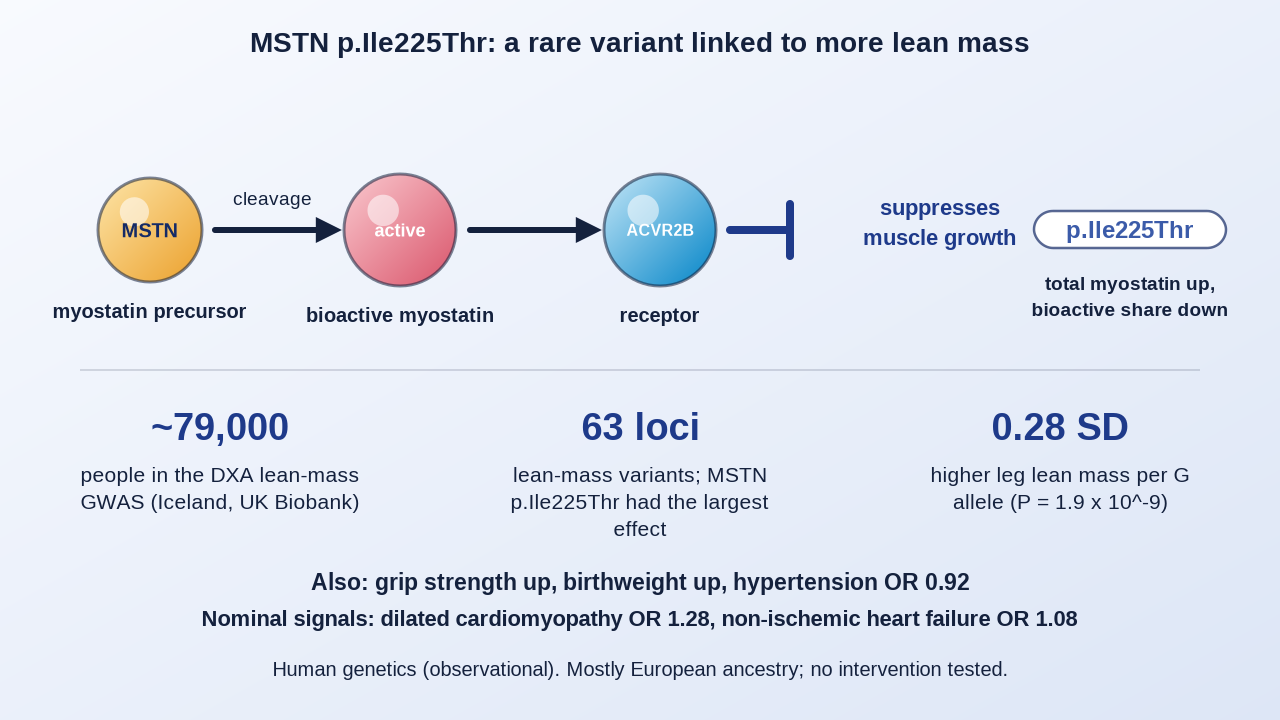
Muscle loss with age and during weight-loss therapy is a growing clinical concern, and myostatin, a growth factor that restrains muscle, is a long-standing drug target. A human genetics study now shows which myostatin variant has the clearest effect on lean mass and how it seems to work.
| Measure | Cohort | Reported result |
|---|---|---|
| Lean-mass GWAS size and loci | Iceland and UK Biobank, DXA | About 79,000 people; 63 loci |
| MSTN p.Ile225Thr, leg lean mass | GWAS meta-analysis | β = 0.28 SD (0.19 to 0.37); P = 1.9 × 10⁻⁹ |
| Serum creatinine | N = 1,183,832 | β = 0.12 SD; no cystatin C association |
| Total myostatin, Olink cis-pQTL | N = 46,446 | β = 0.84 SD; P = 7.6 × 10⁻³² |
| Bioactive-to-total myostatin ratio | 395 matched pairs | Mean difference −0.32; P = 1.6 × 10⁻⁷ |
| Hypertension | 882,927 cases; 1,409,034 controls | OR 0.92 (0.89 to 0.96) |
| Dilated cardiomyopathy (nominal) | 7,419 cases | OR 1.28 (1.05 to 1.56); P = 0.017 |
Background
Myostatin (MSTN) is made as an inactive precursor, activated by proteolytic cleavage of its propeptide, and signals through the activin type IIB receptor (ACVR2B) to suppress muscle growth. Mouse knockouts have more muscle, and one boy with a homozygous loss-of-function mutation had extreme muscle hypertrophy. In humans, common MSTN variants gave inconsistent results, and rare variants had been tied to muscle water volume on MRI.
Design
The authors ran GWAS meta-analyses of arm, leg, trunk and total lean mass measured by DXA in about 79,000 people of European ancestry from Iceland and the UK Biobank, adjusting for sex, age, BMI and height. They followed up with other body-composition measures, a phenome scan of 84 traits, rare-variant burden tests and plasma protein measurements.
63 loci, with MSTN on top
The analysis found 63 independent lean-mass variants, nine of them reported before. The rare missense variant MSTN p.Ile225Thr (rs143242500-G) had the largest effect, strongest for leg lean mass (β = 0.28 SD, 95% CI 0.19 to 0.37; P = 1.9 × 10⁻⁹), with no difference between men and women. It is most frequent in Finnish (1.03%) and Norwegian (0.95%) people and below 0.1% in other ancestries. Of the 63 loci, 37 were in linkage disequilibrium with coding variants or expression or protein QTLs, and 20 genes were prioritized. A common variant near ACVR2B lowered lean mass (β = −0.04 SD; P = 3.7 × 10⁻¹³) and circulating myostatin, which supports the MSTN–ACVR2B pathway in humans. New signals included CASQ1 p.Met87Thr (lower arm lean mass) and a TRIM13 3′ UTR variant (higher lean mass).
Confirmation with other measures
In the UK Biobank, p.Ile225Thr was associated with greater leg fat-free mass by bioimpedance (β = 0.11 SD; N = 363,056), higher thigh muscle volume on MRI (β = 0.23 SD; N = 51,068) and higher serum creatinine (0.12 SD; N = 1,183,832), but not cystatin C, so the creatinine signal is unlikely to reflect kidney function.
Loss-of-function-like biology
Predicted loss-of-function MSTN variants (34 carriers of 28 variants) were collectively associated with more lean mass in legs (β = 1.12 SD) and arms (β = 1.05 SD), although only five carriers had DXA data. The p.Ile225Thr variant was the main cis protein QTL for myostatin on the Olink platform and raised total circulating myostatin (β = 0.84 SD; N = 46,446), but not on SomaScan. Using assays for total and bioactive myostatin in 395 matched pairs, carriers had higher total and bioactive levels but a lower bioactive-to-total ratio (mean difference −0.32; P = 1.6 × 10⁻⁷). The authors speculate that the substitution stabilizes the inhibitory propeptide complex and reduces cleavage. In African-ancestry participants, the common variant p.Ala55Thr was associated with lower myostatin (β = −0.40 SD) and lower creatinine.
Other traits, including heart signals
After correction for 84 tests, p.Ile225Thr was associated with greater grip strength (β = 0.09 SD), birthweight (β = 0.13 SD) and height, and with lower risk of hypertension (OR 0.92, 95% CI 0.89 to 0.96; 882,927 cases), and nominally with less fat mass. It showed nominal associations with dilated cardiomyopathy (OR 1.28; 7,419 cases; P = 0.017) and non-ischemic heart failure (OR 1.08; P = 0.042), which did not pass the correction. The authors say these call for caution and for cardiovascular monitoring when myostatin activity is reduced.
Keep in mind
These are associations in observational cohorts of mostly European ancestry, and the strongest evidence for MSTN comes from one rare variant. BMI adjustment can introduce collider bias, though p.Ile225Thr was not associated with BMI. Protein assays disagreed between platforms, and the mechanism proposed for the variant is a hypothesis. The paper tests no drug, and nominal heart signals are not established risks. Several authors are employees of Amgen deCODE genetics.
- Paper
- Larusdottir AE, Teitsdottir UD, Tragante V, et al. Genome-wide association study identifies a functional myostatin variant increasing lean mass in humans. Nature Communications. 2026;17. Published November 20, 2026.
- Type
- Genome-wide association study with protein-level follow-up
- DOI
- 10.1038/s41467-026-77766-9
- PubMed
- PMID 43064726
- Funding
- Amgen deCODE genetics (employer of many authors); contributing cohorts report support from the Estonian Research Council, the European Union Horizon Europe programme, and Business Finland with industry partners (FinnGen). Many authors are employed by Amgen deCODE genetics; the remaining authors declare no competing interests.
Related articles
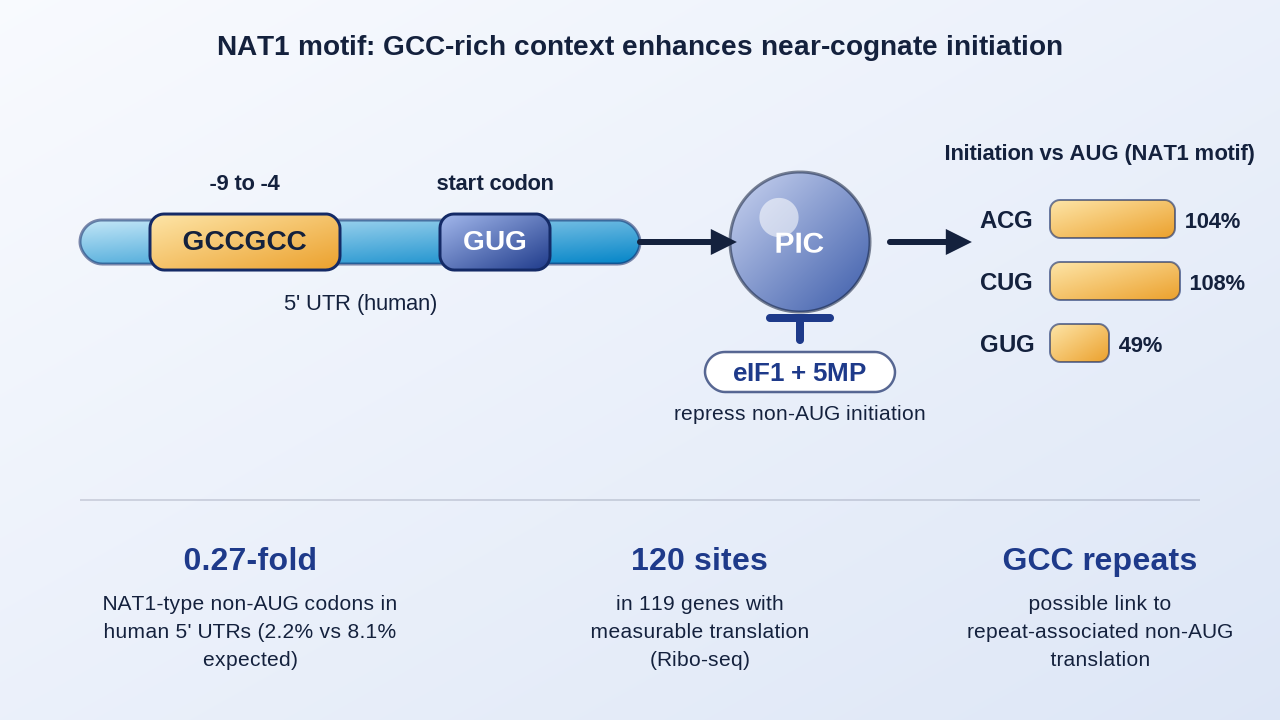 Daily brief · Nov 17, 2026A GCC-Rich Motif Boosts Translation From Non-AUG Start Codons in Human Cells, While eIF1 and 5MP Hold It in Check
 Daily brief · Nov 14, 2026[18F]FET PET Detected Glioblastoma Tissue That Contrast-Enhanced MRI Missed, With a 98.3% Positive Predictive Value Outside the Enhancing Margin, in 472 Histology-Verified Samples
 Daily brief · Nov 11, 2026Higher Blood Levels of Immune Proteins, Including IL15 and FLT3LG, Measured Years Before Diagnosis Were Linked to Lower Prostate Cancer Risk, and Genetics Pointed to PARP1, SPINT2 and NME3

Research focus: Molecular Oncology and Cancer Metabolism
Department of Molecular Diagnostics, Faculty of Biomedical Sciences, University of Benghazi, Libya
Weekly digest
The week's briefs and science news in one email. See the privacy policy.
Comments
No account needed. Comments are reviewed before they appear. Please be respectful and on topic.