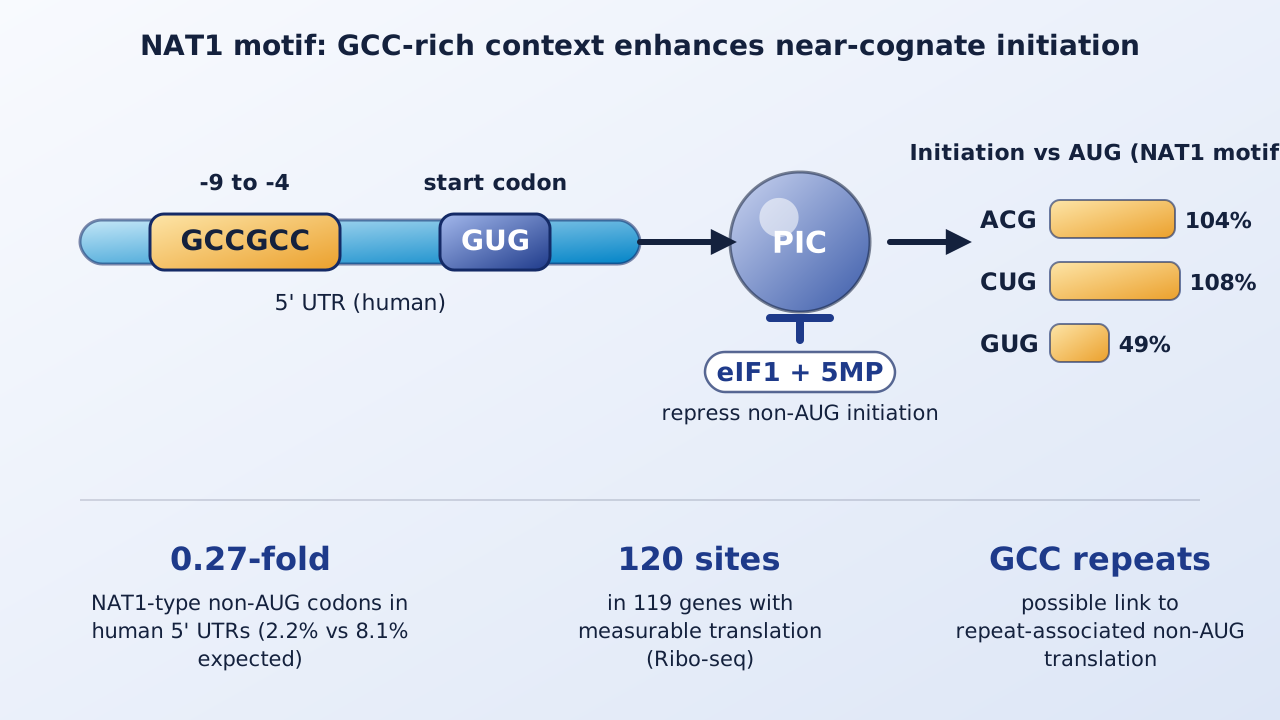
Protein synthesis normally starts at an AUG codon, yet ribosomes also start at near-cognate codons such as GUG and CUG, adding protein variants and short upstream open reading frames. A team from Kansas State University and collaborators in Japan and France now reports a sequence context that explains much of this behavior in mammals.
| Measure | System | Reported result |
|---|---|---|
| GUG versus AUG reporter | Wheat germ extract | About 30% |
| Initiation under full NAT1 motif (ACG / CUG / GUG vs AUG) | Human Ribo-seq sites | 104% / 108% / 49% |
| Sites with measurable translation | Human 5′ UTRs | 120 sites in 119 genes |
| NAT1-type non-AUG codons in 5′ UTRs | Human genome | 2.2% vs 8.1% expected (0.27-fold) |
| Natural non-AUG contexts with a C −7 change | Reporter assays | 13 of 16 (81%) |
| 5MP1 mRNA, tumor vs normal | 22 cancer types | 7,607 vs 5,833 samples; higher in tumors |
Background
Start-codon selection depends on the Kozak context (an A or G at position −3 and a G at +4) and on initiation factors eIF1, eIF1A and the small protein 5MP, which keep the preinitiation complex from accepting weak starts. Human NAT1 (DAP5/eIF4G2), for example, starts at a GUG codon and serves as a model for non-AUG initiation. What allows such starts, and how general the mechanism is, was not clear.
Cell-free systems show conserved repression by eIF1 and 5MP
In wheat germ extract, a GUG reporter produced about 30% of the AUG signal. Adding recombinant wheat eIF1 strongly suppressed GUG-dependent translation without affecting AUG up to 2 μM, and wheat 5MP reduced GUG initiation in a dose-dependent manner, although it also moderately repressed AUG. In rabbit reticulocyte lysate, human 5MP1 and 5MP2 (2 μM) repressed GUG-initiated translation more strongly than AUG and did not repress an IRES-driven control mRNA. The authors note that HeLa and reticulocyte extracts are intrinsically relaxed for non-AUG initiation.
The NAT1 motif and its key bases
In human cells, GUG, CUG or UUG start codons inside the GCCGCC-containing NAT1 context were translated about threefold more than FACS-seq data predicted from the surrounding sequence alone. Single-base substitutions identified G at −6 and C at −7 as the most important positions. A G at +5 reduced translation, and 13 of 16 natural non-AUG contexts tested (81%) carried a change at C −7.
Ribosome profiling in the human transcriptome
Searching human 5′ UTRs for the motif and single-base variants with seven near-cognate codons, the authors found 120 sites in 119 genes with measurable translation in ribosome footprinting data. Under the complete motif, the fitted initiation frequencies were 104% (ACG), 108% (CUG) and 49% (GUG) of the AUG control, with significant correlations between footprint density and motif strength (P = 0.0002, 0.0003 and 0.005).
Purifying selection against strong non-AUG starts
Non-AUG codons inside the NAT1 motif were 0.27-fold depleted in human 5′ UTRs (2.2% observed versus 8.1% expected) but not in coding sequences or 3′ UTRs, and were depleted on the sense relative to the antisense strand. Drosophila showed a weaker pattern and wheat none; fission and budding yeasts, whose 5′ UTRs are AT rich, showed little or no motif. In fission yeast the motif reduced GUG initiation by about half, which led the authors to describe it as a mammal-specific enhancer. Yeast genetics and molecular dynamics also indicated that the disordered N-terminal tail of eIF1A governs the preference for nucleotides after the start codon (+4 and +5).
Possible links to cancer and repeat expansions
Across 22 cancer types, 5MP1 mRNA was higher in 7,607 tumor samples than in 5,833 normal samples, and higher expression or gene copy number tracked with shorter overall survival in pan-cancer analyses. The 119 motif-associated genes are enriched for roles in proliferation and migration. Structure predictions (AlphaFold 3) suggested that non-AUG products from CLK2 and REV1 5′ UTRs could bind and interfere with the main protein. A GCC codon inside the motif gave low initiation, 2.7% of GUG or 1.4% of the equivalent AUG, which the authors propose as a route for poly-alanine repeat-associated translation.
Keep in mind
Most data come from reporter constructs, cell-free extracts and cultured cells; the cancer survival analysis is correlative, and the CLK2 and REV1 effects are structure predictions that were not tested biochemically. The paper does not show that non-AUG initiation at these sites changes tumor behavior or contributes to a repeat-expansion disease; the authors label both as hypotheses.
- Paper
- Furukawa H, Banerjee A, Tidu A, et al. Evolutionarily reinforced GC-rich motif enables non-AUG translation in mammals under eIF1/5MP-mediated fidelity control. Science Advances. 2026;12(46):eaek4290. Published November 11, 2026.
- Type
- Cell-free, reporter and genome-wide analyses
- DOI
- 10.1126/sciadv.aek4290
- PubMed
- PMID 43013649
- Funding
- Terry Johnson Cancer Center Innovative Award (Kansas State University); NIH GM124671 and GM147542; NSF 1412250; JSPS KAKENHI 18K19963, 23KK0128, 25K02227, 24K08832 and 23K27350. The authors declare no competing interests.
Related articles
 Daily brief · Nov 14, 2026[18F]FET PET Detected Glioblastoma Tissue That Contrast-Enhanced MRI Missed, With a 98.3% Positive Predictive Value Outside the Enhancing Margin, in 472 Histology-Verified Samples
 Daily brief · Nov 11, 2026Higher Blood Levels of Immune Proteins, Including IL15 and FLT3LG, Measured Years Before Diagnosis Were Linked to Lower Prostate Cancer Risk, and Genetics Pointed to PARP1, SPINT2 and NME3
 Daily brief · Nov 8, 2026Peptides Cut From the Drosophila Sleep Protein Nemuri Kill Bacteria by Clumping Their Ribosomes and Shutting Down Protein Synthesis

Research focus: Molecular Oncology and Cancer Metabolism
Department of Molecular Diagnostics, Faculty of Biomedical Sciences, University of Benghazi, Libya
Weekly digest
The week's briefs and science news in one email. See the privacy policy.
Comments
No account needed. Comments are reviewed before they appear. Please be respectful and on topic.