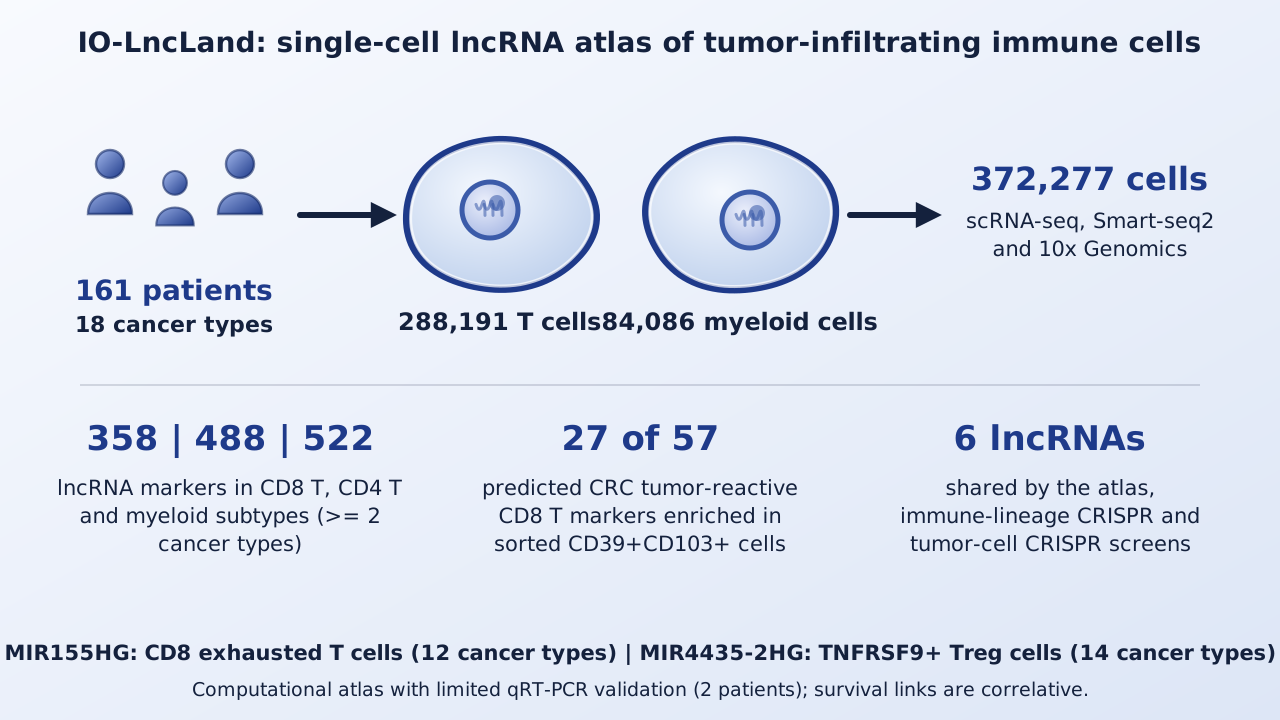
Single-cell studies of tumors have cataloged which protein-coding genes mark each immune cell state, but most long noncoding RNAs (lncRNAs) were left out because they are expressed at low levels. A Chinese team now reports a pan-cancer atlas of lncRNAs in tumor-infiltrating T cells and myeloid cells and uses it to nominate candidates for follow-up.
| Measure | Scope | Reported result |
|---|---|---|
| Immune cells in the atlas | 161 patients, 18 cancer types | 372,277 (288,191 T; 84,086 myeloid) |
| Subtype-specific lncRNA markers | CD8 T / CD4 T / myeloid | 358 / 488 / 522 |
| lncRNAs raised in tumor-reactive T cells | 11 cancer types | 217 |
| Predicted CRC markers enriched in sorted tumor-reactive CD8 T cells | Public data | 27 of 57 |
| lncRNAs supported by atlas, immune and tumor CRISPR screens | Published screens | 6 of 3,550 |
| Response-associated lncRNAs enriched in nonresponders | Immunotherapy cohort | 87% of 100 |
Background
lncRNAs regulate T cell activation, exhaustion and immune evasion in individual studies, for example lnc-TIM3 and NKILA, but their distribution across immune lineages and cancer types was not mapped at single-cell resolution. An earlier single-cell lncRNA study covered 24,068 T cells from three cancers.
How the atlas was built
The authors integrated public Smart-seq2 and 10x Genomics data from treatment-naïve patients using a combined lncRNA gene model. IO-LncLand contains 372,277 immune cells from 161 patients and 18 cancer types: 288,191 T cells (14 cancer types, 110 patients, including tumor, adjacent normal and blood) and 84,086 myeloid cells (11 cancer types, 82 patients). They resolved 14 CD8 and 14 CD4 T cell subtypes and 14 myeloid subtypes. Smart-seq2 detected lncRNAs more sensitively and 10x gave more cells, and many state-associated lncRNAs were supported on both platforms.
Cell type markers
Of the lncRNAs expressed in more than 20% of cells, 3,833 were in CD8 T cells, 3,216 in CD4 T cells and 6,312 in myeloid cells. Subtype-specific markers in at least two cancer types numbered 358 (CD8), 488 (CD4) and 522 (myeloid). MIR155HG marked exhausted CD8 T cells in 12 cancer types and MIR4435-2HG marked TNFRSF9-positive regulatory T cells in all 14. Some lncRNAs were more cell type specific than established coding markers.
Tumor-reactive T cells and state transitions
Of 217 lncRNAs raised in potentially tumor-reactive T cell subsets across 11 cancer types, 13 of 19 lncRNAs from experimentally defined neoantigen-reactive T cells overlapped. Among 57 predicted markers for colorectal tumor-reactive CD8 T cells, 27 were enriched in sorted CD39+CD103+ cells in public data, and five tested by qRT-PCR were higher in these cells than in double-negative cells in both fresh colorectal tumors studied. Along inferred trajectories, 953 lncRNAs changed with CD8 exhaustion, 723 with regulatory T cell activation and 212 with a TH1-to-TFH/TH1 transition. SCENIC regulon analysis placed 92 lncRNAs in CD8 and 94 in CD4 T cell programs.
Myeloid cells and angiogenesis
In LAMP3-positive dendritic cells, 121 lncRNAs changed during maturation, and 19 differed between cDC1- and cDC2-derived cells. Among tumor-associated macrophages, 57 lncRNAs correlated with an angiogenesis score. NEAT1 correlated with this score in uterine cancer (rho = 0.56, FDR = 0.004) and MIR4435-2HG was higher in SPP1-positive macrophages in esophageal tumors and tracked with poorer disease-free survival.
Survival, CRISPR screens and immunotherapy
In TCGA, 53 CD8 T cell and 50 CD4 T cell markers and 97 myeloid markers were associated with overall survival. BayesPrism deconvolution found 52 markers whose bulk expression tracked the inferred abundance of the matching cell state, for example MIR155HG in kidney cancer (HR 1.64, P = 3.97 × 10⁻⁶; rho = 0.44 with inferred exhausted CD8 T cells). Overlaying 3,550 immune-associated lncRNAs with published CRISPR screens gave 25 overlaps with immune-lineage screens and 14 shared with tumor-cell screens; six were in all three, including SNHG12 and EPB41L4A-AS1. Of 100 lncRNAs that differed by immunotherapy response, 87% were enriched in nonresponders, among them MALAT1, SNHG14 and SMARCA5-AS1.
Keep in mind
This is mainly a computational resource built on public data, and most links are correlations. Experimental validation covered five lncRNAs in two colorectal tumors. The authors state that bulk survival associations cannot be assigned to a cell type, that cell-line CRISPR screens do not replace perturbation in primary T cells or macrophages, and that causal roles remain to be shown. Nothing here shows that targeting any of these lncRNAs helps patients.
- Paper
- Wang S, Qian Q, Liu Y, et al. An integrative single-cell long noncoding RNA atlas reveals regulatory programs in the pan-cancer tumor microenvironment. Science Advances. 2026;12(47):eaei2542. Published November 18, 2026.
- Type
- Computational atlas with limited experimental validation
- DOI
- 10.1126/sciadv.aei2542
- PubMed
- PMID 43050536
- Funding
- National Natural Science Foundation of China (32470713, 32100520, 82501745, 32570790, and others); Youth Innovation Promotion Association of the Chinese Academy of Sciences (2023110); Chinese Academy of Sciences programs; Chongqing municipal programs; National Science and Technology Major Project (2025ZD0552500, 2025ZD0552501). The authors declare no competing interests.
Related articles
 Daily brief · Oct 29, 2026Perioperative Durvalumab With Enfortumab Vedotin Improves Event-Free Survival in Cisplatin-Ineligible Muscle-Invasive Bladder Cancer: The VOLGA Trial
 Daily brief · Oct 28, 2026Clones Within Single Pancreatic Tumors Differ in MYC Amplification, and MYC Is Linked to a Basal, Immune-Depleted State
 Daily brief · Oct 25, 2026Propionate Blocks a Ubiquitin Ligase and Keeps MHC Class I on Tumor Cells, Boosting Anti-PD-1 Efficacy in Models

Research focus: Molecular Oncology and Cancer Metabolism
Department of Molecular Diagnostics, Faculty of Biomedical Sciences, University of Benghazi, Libya
Weekly digest
The week's briefs and science news in one email. See the privacy policy.
Comments
No account needed. Comments are reviewed before they appear. Please be respectful and on topic.