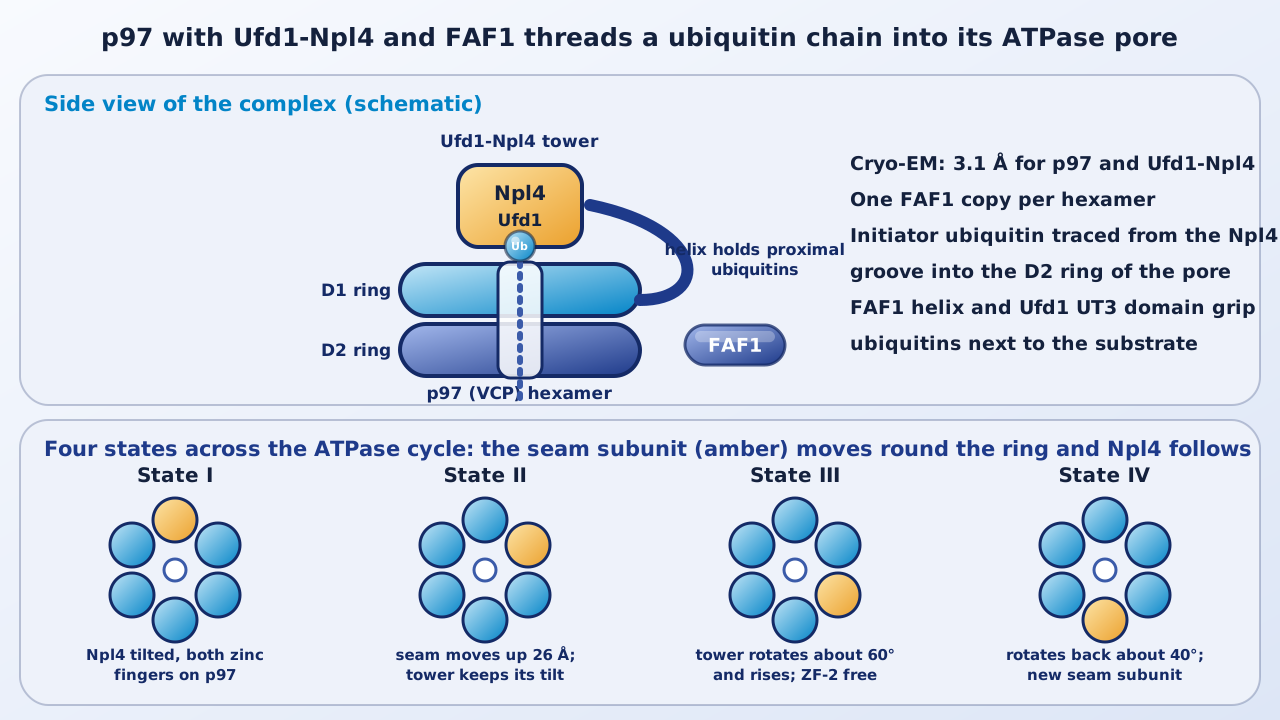
Cells mark damaged or unneeded proteins with chains of ubiquitin, and a molecular motor called p97 then pulls them apart so they can be degraded or recycled. A team at the University of Münster and the University of Duisburg-Essen now reports how p97 and two of its adapter proteins, Ufd1-Npl4 and FAF1, hold such a chain and feed it into the motor, in the most detailed structures of this assembly so far.
| Measure | Detail | Reported result |
|---|---|---|
| Cryo-EM data | Titan Krios G4, about 12.5 days | About 280,000 movies |
| Best resolution | State II | 3.1 Å for p97 and Ufd1-Npl4; about 8 Å for FAF1 |
| FAF1 per p97 hexamer | Mass photometry, unfolding assays | One (earlier work suggested three) |
| Conformational states | Seam subunit positions | Four (I to IV) |
| Npl4 tower movement, state II to III | Cryo-EM models | About 60° rotation, about 20 Å rise |
Why p97 matters
p97, also called VCP in mammals, is an AAA+ ATPase that uses ATP to unfold proteins tagged with polyubiquitin. The authors list roles in clearing damaged proteins and organelles, autophagy, mitochondrial protein degradation, DNA damage repair and endoplasmic reticulum-associated degradation. Point mutations in p97 cause a degenerative disease, multisystem proteinopathy-1, with muscle, dementia and ALS features, and p97 is raised in some cancers, which makes it a drug target. What was unclear was how the adapters Ufd1-Npl4 and FAF1 coordinate the ubiquitin chain with the motor.
How the structures were made
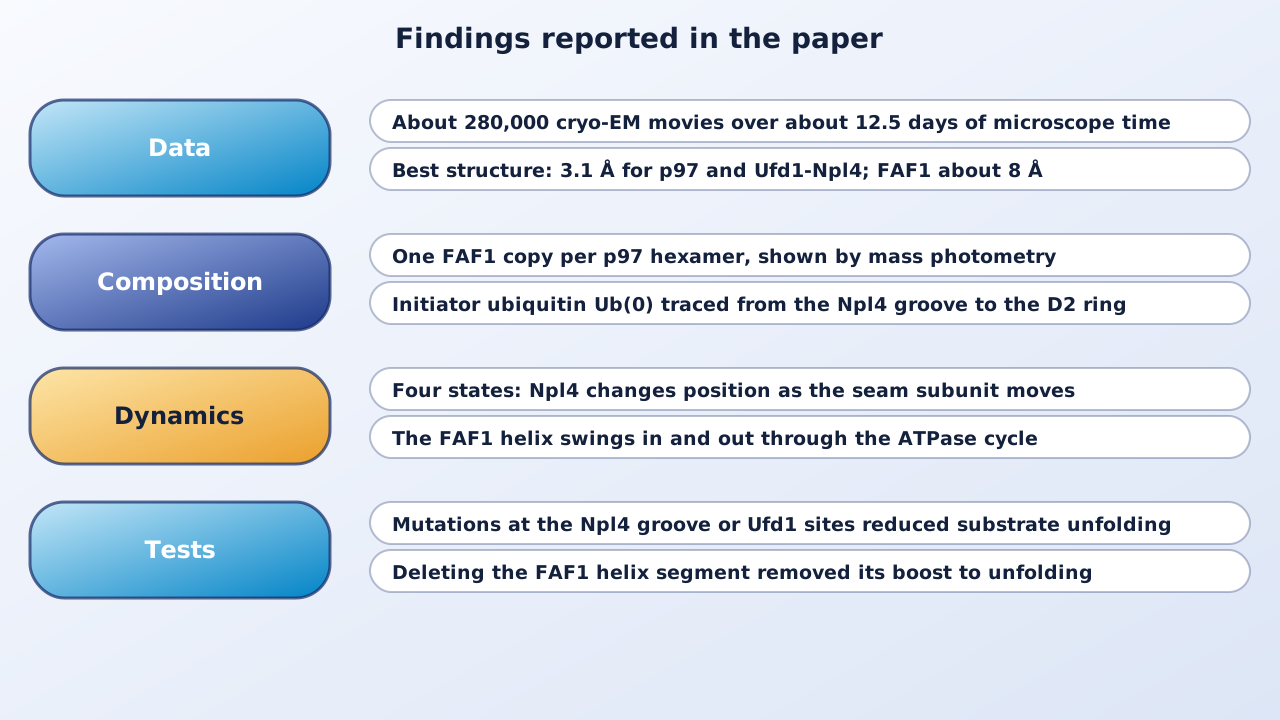
The team assembled p97 with Ufd1-Npl4 and the C-terminal part of FAF1 (its UBX domain and the first 65 residues of its long helix) on a model substrate, a K48-polyubiquitinated Eos protein. They used two p97 mutations (A232E and E578Q) that reduce unfolding but keep the complex functional, and ADP with beryllium fluoride to lock the ATPase in an early, pre-hydrolysis state. Because the cis side of the complex is highly flexible, they recorded about 280,000 cryo-EM movies over about 12.5 days on a Titan Krios microscope. The best map reached 3.1 Å for p97 and Ufd1-Npl4 and about 8 Å for FAF1.
The initiator ubiquitin goes into the pore
The map shows the first (initiator) ubiquitin, Ub(0), running from the groove of Npl4 down into the D2 ring of the ATPase, which the authors could model from its K48 branch point to its N-terminal methionine. A β-hairpin of Npl4 (residues 425 to 439) fits two pockets around residues T22 and I23 of the ubiquitin and positions it at the entrance of the pore. Mutating the groove (E446K with Y447A) reduced substrate unfolding. Three more ubiquitins cap the Ufd1-Npl4 tower, and they are arranged in sequence along the chain.
One FAF1, and how it links the tower to the ring
Earlier low-resolution work had suggested three FAF1 molecules per p97. The structure shows a single copy, which mass photometry and unfolding assays also support. Its UBX domain binds one N-terminal domain of p97, and the same domain also holds the SHP box of Ufd1, so the two adapters are tied together. A helix of FAF1 (residues 496 to 523) reaches the Ufd1 UT3 domain and two ubiquitins close to the substrate. Mutations at that interface (V507A with K508A) and deletion of the contacting helix segment reduced or removed FAF1's boost to unfolding, and mutations in Ufd1 at predicted ubiquitin-binding sites lowered unfolding without disturbing assembly.
Four states across the ATPase cycle
Classification of the images gave four states that differ in the position of the seam subunit, the one p97 subunit not gripping the substrate. FAF1 stays on the same p97 domain throughout. Going from state I to II the seam subunit moves up by 26 Å and Npl4 keeps its tilt. From II to III the seam moves on, a zinc finger of Npl4 finds a new site on the seam subunit, and the whole Ufd1-Npl4 tower rotates about 60° and rises about 20 Å, while the FAF1 helix and UT3 swing out about 13°. From III to IV the tower rotates back about 40°. The authors describe a continuous swing-in and swing-out of the FAF1 helix during the cycle and propose that it keeps ubiquitins aligned with the Npl4 groove.
Why it matters
The work shows in detail how an accessory adapter and a ubiquitin-binding tower adapt to the motor's moving staircase, which the authors call a framework for understanding other p97-adapter combinations. Because p97 is a drug target and is mutated in degenerative disease, such structures can inform later work on how the machine is regulated.
Keep in mind
These are structures of purified human proteins with mutations and a pre-hydrolysis nucleotide analog, a truncated FAF1 and a model substrate, so they capture an early step, not the whole cycle or the behavior inside cells. FAF1 is resolved only at about 8 Å, parts of the chain were placed with AlphaFold3 predictions that were tested with mutations, and the UAS domain of FAF1 appears only at low resolution. The study does not test a drug or a disease model.
- Paper
- Drakonaki A, van den Boom J, Kröning A, Meyer H, Gatsogiannis C. Structural dynamics of substrate processing by the p97-Ufd1-Npl4-FAF1 machinery. Nature Communications. 2026;17(1):11081. Published October 25, 2026.
- Type
- Cryo-EM structure of purified proteins with mutational tests
- DOI
- 10.1038/s41467-026-78639-x
- PubMed
- PMID 42928384
- Funding
- Deutsche Forschungsgemeinschaft (CRC 1430, project 424228829, and grant 509479817), including funding of the University of Münster cryo-EM infrastructure and computing; NIH R01-GM129325 supported the molecular graphics software used. The authors declare no conflict of interest.
Related articles
 Daily brief · Oct 25, 2026Propionate Blocks a Ubiquitin Ligase and Keeps MHC Class I on Tumor Cells, Boosting Anti-PD-1 Efficacy in Models
 Daily brief · Nov 8, 2026Peptides Cut From the Drosophila Sleep Protein Nemuri Kill Bacteria by Clumping Their Ribosomes and Shutting Down Protein Synthesis
 Daily brief · Nov 7, 2026Lowering MSH3 With an AAV-Delivered microRNA Cut Somatic CAG Expansion in a Huntington's Disease Mouse Model and Reduced MSH3 mRNA 48 to 94% in Macaque Striatal Neurons

Research focus: Molecular Oncology and Cancer Metabolism
Department of Molecular Diagnostics, Faculty of Biomedical Sciences, University of Benghazi, Libya
Weekly digest
The week's briefs and science news in one email. See the privacy policy.
Comments
No account needed. Comments are reviewed before they appear. Please be respectful and on topic.