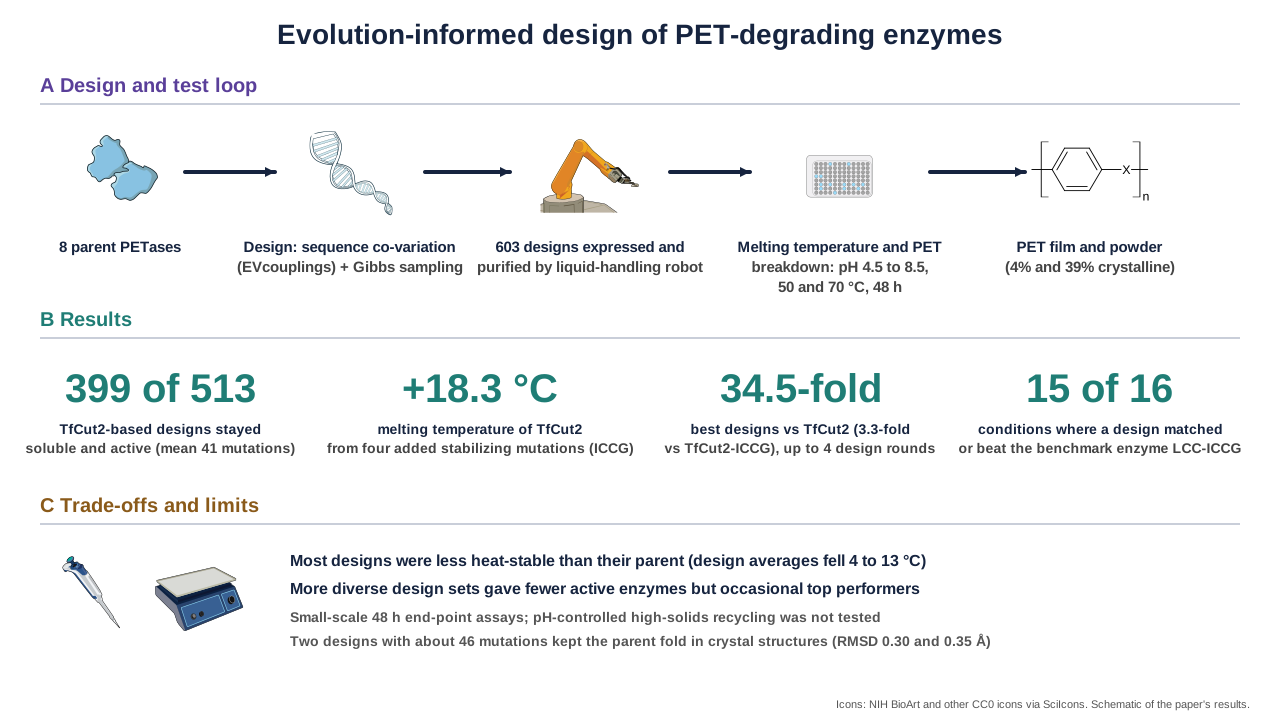
Enzymes that break down polyethylene terephthalate (PET), the plastic in many bottles and textiles, could make recycling cleaner, but they must work at high temperature and low pH and on crystalline plastic. A team from the National Laboratory of the Rockies, Harvard Medical School and partners reports a way to generate many such enzymes at once: design them from the evolutionary record of related proteins, test hundreds, and repeat the cycle.
| Measure | Detail | Reported result |
|---|---|---|
| Designs tested | Eight parent PETases | 603 designs |
| Active TfCut2-based designs | Mean 41 mutations | 399 of 513 |
| Four stabilizing mutations (ICCG) | Added to TfCut2 | Melting temperature up 18.3 degrees; activity up 16-fold |
| Best designs after iteration | Up to four design rounds | 34.5-fold over TfCut2; 3.3-fold over TfCut2-ICCG |
| Versus the benchmark LCC-ICCG | 16 conditions, 48 h | At least one design matched or beat it in 15 |
The design method
The method, called EVdesign, builds a statistical model of a protein family with EVcouplings, which captures conserved positions and pairs of positions that mutate together. It then samples new sequences that the model scores as fit while staying within set identity limits to the parent. Depending on the parent enzyme, 5 to 20% of amino acids were changed, an average of 24 to 44 mutations per design. Variants were made in E. coli, purified by a liquid-handling robot and tested for melting temperature and for breakdown of amorphous film (about 4% crystalline) and crystalline powder (about 39%) at pH 4.5 to 8.5 and 50 and 70 degrees Celsius, with product measured after 48 hours.
Choosing a parent
The authors designed variants of eight parent PET hydrolases. Five parents gave designs with measurable activity. The enzyme TfCut2 from Thermobifida fusca was the most design-tolerant: its active designs averaged about 3.1-fold the parent's activity, up to 14-fold, though average melting temperature fell by about 5 degrees. No design based on the benchmark enzyme LCC beat its parent in any condition.
Diversity and outliers
In a second round on TfCut2, four design sets with rising diversity (26 to 39 mutations per design) were compared. Less diverse sets had higher average activity (2.33-fold, 1.57-fold, 1.02-fold and 0.19-fold of wild type for the low, medium, high and maximum sets), but the best single design, at 5.4-fold, came from the high-diversity set. The authors conclude that more diversity yields fewer reliable improvements but occasional exceptional variants.
Adding four stabilizing mutations
Because most designs were less heat-stable, the team added the four substitutions known from the stabilized enzyme LCC-ICCG to TfCut2. This raised the melting temperature of TfCut2 by 18.3 degrees and by 15.2 degrees on average across designs, and increased TfCut2 activity 16-fold. Of 80 designs built on this scaffold with 12 to 60 mutations, 76 had melting temperatures above 50 degrees, 59 had melting temperatures at or above 70 degrees, and 74 were active.
Iterating the design
The authors then ran up to four rounds, giving 201 designs in the later generations. In the 16 test conditions, the best designs averaged 34.5-fold the activity of TfCut2 and 3.3-fold that of the stabilized TfCut2-ICCG. In 15 of 16 conditions at least one design matched or beat LCC-ICCG; at pH 4.5 and 70 degrees the top design was about 2.2-fold (powder) and 3.3-fold (film) higher. Across the work, 399 of 513 TfCut2-based designs, which carried 41 mutations on average, remained soluble and active. Two designs with 46 mutations each, crystallized by the authors, kept the parent fold (root-mean-square deviation 0.30 and 0.35 angstroms).
Keep in mind
Most designs were less heat-stable than their parents, and several parent enzymes gave no usable designs. The assays were small-scale, 48-hour end-point measurements, not pH-controlled, high-solids recycling conditions, so the results do not show industrial performance. The authors say further work is needed to understand the reaction mechanism, kinetics and the changes in the plastic during degradation. Data, code and plasmids are public (GitHub, Zenodo and Addgene; PDB entries 9PM1 and 9PM2).
- Paper
- Norton-Baker B, Fram B, Thadani NN, Komp E, Su Y, Storment OO, et al. Iterative computational and rational design generates diverse PET hydrolases for plastic depolymerization. Nature Communications. 2026;17(1). Published November 3, 2026.
- Type
- Laboratory study with computational protein design
- DOI
- 10.1038/s41467-026-78471-3
- PubMed
- PMID 42977755
- Funding
- U.S. Department of Energy: Office of Science Genomic Science Program (DE-SC0022024), the Alternative Fuels and Feedstocks Office (Agile BioFoundry, CPS 40550), and the BOTTLE Consortium (DE-AC36-08GO28308); synchrotron access at SLAC supported by the DOE and NIH NIGMS (P30GM133894); and the Dana-Farber Cancer Institute. The authors declare no competing interests.
Related articles
 Daily brief · Oct 21, 2026A Compact RNA Switch Lets a Small-Molecule Drug Turn Gene Therapy On and Off in Mice
 Daily brief · Nov 15, 2026In Enzalutamide-Resistant Prostate Cancer Cells, m6A Marking of ARv7 mRNA Raises Its Translation, Lactate Feeds the Loop, and a METTL3 Inhibitor Plus Enzalutamide Slowed Xenograft Growth
 Daily brief · Nov 14, 2026[18F]FET PET Detected Glioblastoma Tissue That Contrast-Enhanced MRI Missed, With a 98.3% Positive Predictive Value Outside the Enhancing Margin, in 472 Histology-Verified Samples

Research focus: Molecular Oncology and Cancer Metabolism
Department of Molecular Diagnostics, Faculty of Biomedical Sciences, University of Benghazi, Libya
Weekly digest
The week's briefs and science news in one email. See the privacy policy.
Comments
No account needed. Comments are reviewed before they appear. Please be respectful and on topic.