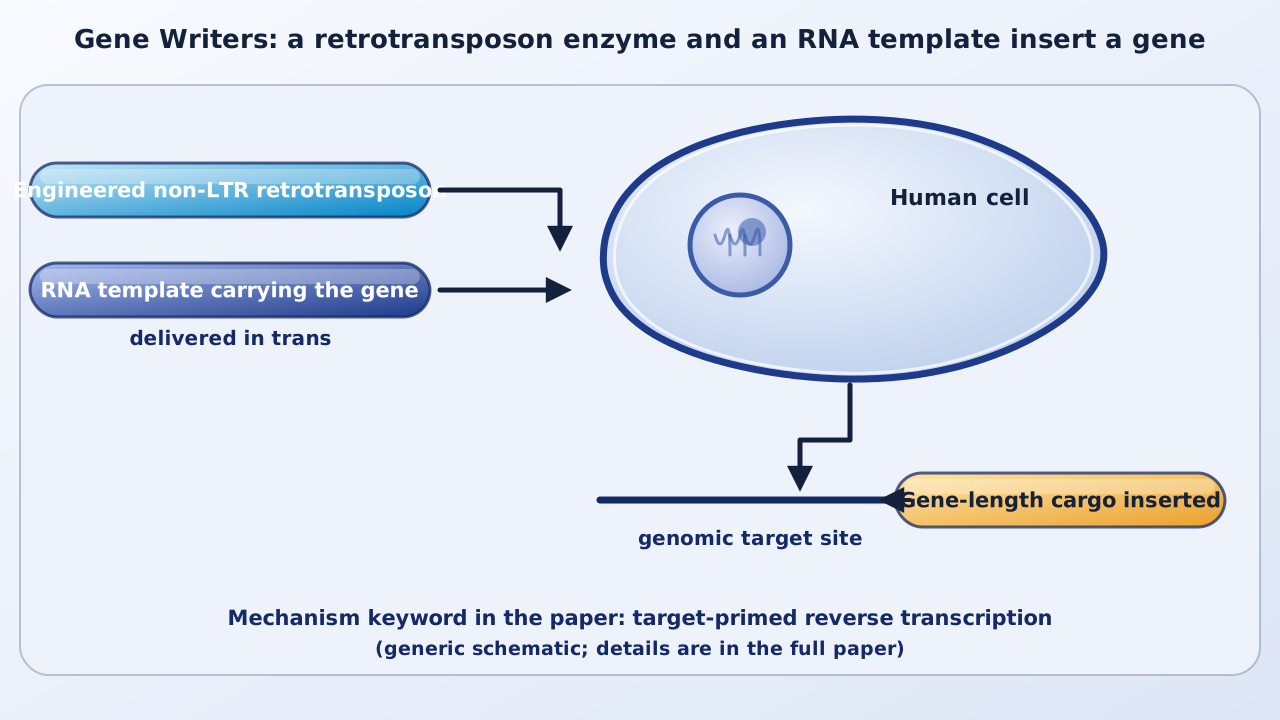
Putting a whole gene into a chosen place in the genome is still hard, especially inside the body. A team at Tessera Therapeutics now reports that retrotransposons, natural genetic elements that copy themselves through an RNA intermediate, can be engineered into a tool for this, which they call Gene Writers.
The problem
Efficient insertion of gene-length cargo in vivo remains difficult. Non-LTR retrotransposons naturally move large DNA segments through an RNA intermediate, which makes them a candidate for carrying genes, but they had not been developed into a general tool.
What the authors did
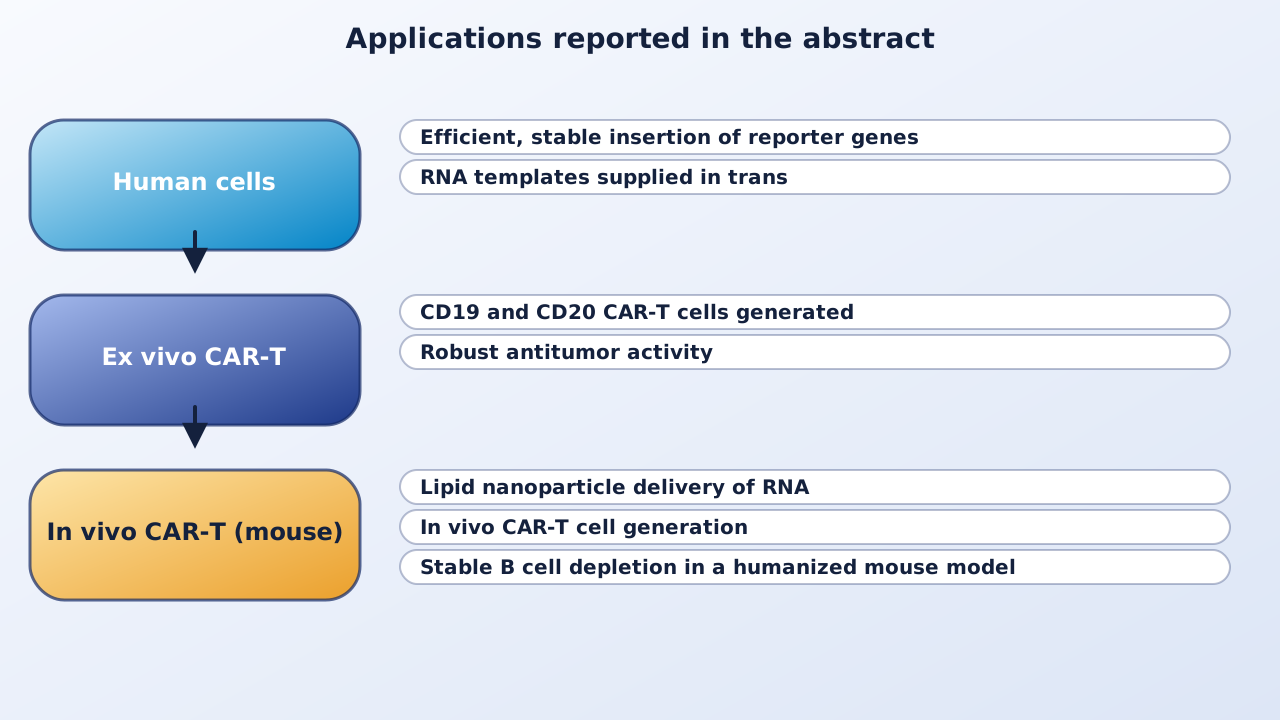
They built a computational pipeline to identify a diverse set of non-LTR retrotransposons and then engineered them extensively. The result is elements that insert reporter genes efficiently and stably in human cells using RNA templates introduced in trans, that is, supplied separately from the enzyme.
What they reported
Gene Writers were used to make CD19 and CD20 chimeric antigen receptor (CAR) T cells ex vivo, and these cells showed robust antitumor activity. When the RNA was delivered with lipid nanoparticles, the system generated CAR-T cells in vivo and produced stable B cell depletion in a humanized mouse model. The authors describe a framework for discovering, engineering and applying non-LTR retrotransposons and say it bridges a gap among existing gene therapy approaches.
Why it matters
Making CAR-T cells inside the body, instead of collecting and engineering a patient's cells in a laboratory, is an active goal in cell therapy. The report adds a way to insert a gene-sized cargo using RNA that can be packaged in lipid nanoparticles, the same class of carrier discussed in the brief on lipid nanoparticle design.
Keep in mind
The abstract gives no numbers: no insertion efficiency, no measure of antitumor activity or B cell depletion, no durability, and no information on where in the genome the cargo lands or on off-target insertions. The in vivo work is in a humanized mouse model, not in people. Nearly all authors are affiliated with Tessera Therapeutics. Safety, specificity and delivery to relevant tissues would need to be shown before any clinical use.
- Paper
- Li D, De Iaco A, Ngan KC, et al. In vivo Gene Writing with engineered retrotransposons. Cell. 2026. Published October 21, 2026.
- Type
- Preclinical study in human cells and a humanized mouse model
- DOI
- 10.1016/j.cell.2026.09.054
- PubMed
- PMID 42906542
Related articles
 Daily brief · Oct 23, 2026Designing Lipid Nanoparticles Around mRNA Size Improves In Vivo Genome Editing in Liver, Brain and Lung
 Daily brief · Oct 21, 2026A Compact RNA Switch Lets a Small-Molecule Drug Turn Gene Therapy On and Off in Mice
 Science news · Oct 24, 2026First Prime Editing Treatment Given Directly in the Body Enters a Wilson Disease Trial

Research focus: Molecular Oncology and Cancer Metabolism
Department of Molecular Diagnostics, Faculty of Biomedical Sciences, University of Benghazi, Libya
Weekly digest
The week's briefs and science news in one email. See the privacy policy.
Comments
No account needed. Comments are reviewed before they appear. Please be respectful and on topic.